
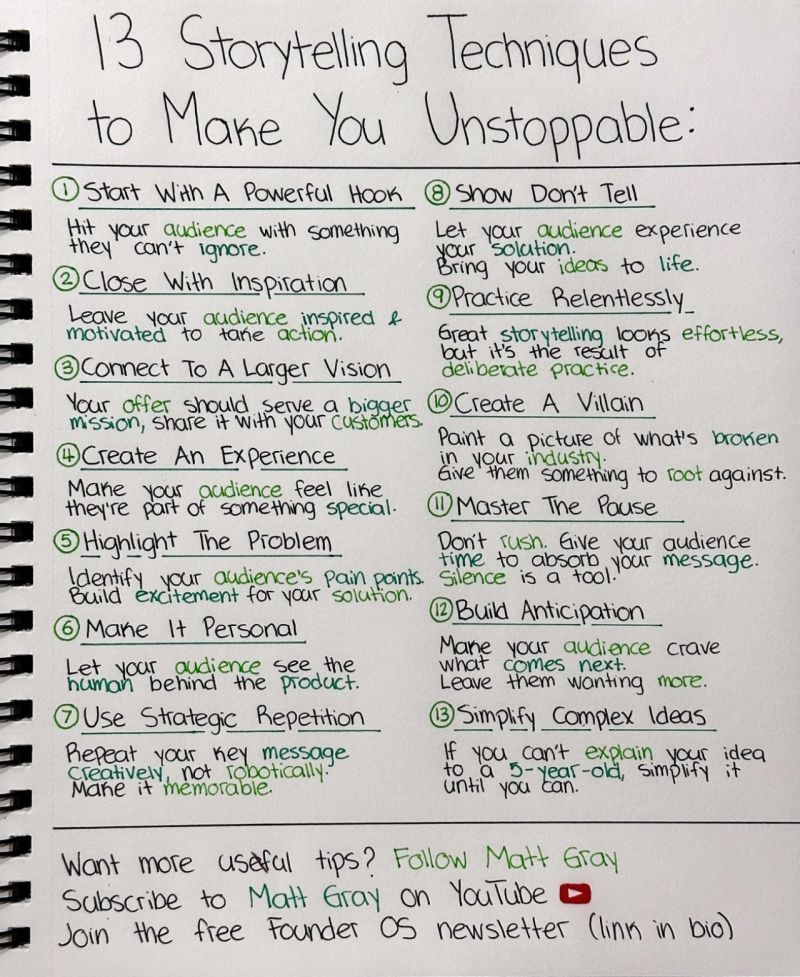
In a recent LinkedIn post, Matt Gray explores the art of storytelling and its critical role in business and life, drawing inspiration from the legendary Steve Jobs. Gray emphasizes that while storytelling is a powerful tool, many individuals struggle to harness its potential effectively. He outlines ten key techniques to help professionals become more impactful communicators.
Gray opens by referencing Steve Jobs’ assertion that “The most powerful person in the world is the storyteller.” He then pivots to the practical application of this principle, noting that most people lack the skills to be effective storytellers.
The Power of Identifying Problems and Building Anticipation
One of the core tenets Gray highlights is the importance of clearly defining the problem your audience faces. As Matt Gray notes, this involves:
“Identify your audience’s pain points. Address them directly to build excitement for your solution. Make your audience nod along, thinking ‘Yes, that’s exactly my issue!'”
This technique, exemplified by Jobs in highlighting user frustrations with existing technology, aims to create immediate resonance and establish the necessity of a proposed solution. Gray further elaborates on the concept of building anticipation, suggesting that withholding information strategically can heighten audience engagement. He points to Jobs’ iPhone announcement, where the device was initially teased as three revolutionary products before being revealed as one. Gray advises, “Don’t give everything away at once. Leave them wanting more.”
Demonstrating Value and Reinforcing Key Messages
Gray stresses the adage “Show, Don’t Tell,” advocating for tangible demonstrations over mere descriptions. He uses Jobs’ live demo of iPhone features as a prime example. According to Matt Gray, this approach allows the audience to “experience your solution” and makes abstract concepts concrete.
Strategic repetition is another technique Gray identifies as crucial for making messages memorable. He recalls Jobs’ repeated description of the iPhone as “An iPod, a phone, and an internet communicator,” which effectively hammered home its multifaceted value. Gray suggests repeating key messages creatively to ensure they “stick” and become ingrained in the audience’s memory.
Connecting to a Bigger Picture and Embracing Authenticity
Beyond immediate problem-solving, Gray underscores the significance of connecting a product or idea to a larger vision. He cites Apple’s rebranding and shift in focus as evidence of how tying an offering to a broader mission can resonate deeply with customers. “Show them the forest, not just the trees,” Gray advises, encouraging leaders to articulate the overarching purpose.
Personal connection is also paramount, according to Gray. He quotes Jobs’ personal sharing of excitement, “I didn’t sleep a wink last night, I was so excited,” to illustrate how vulnerability can foster genuine connection. Gray argues that “Your authenticity is your secret sales weapon,” encouraging leaders to reveal the human element behind their ventures.
Inspiration, Practice, and Clarity
Gray also touches upon the importance of ending with inspiration, citing Jobs’ use of a Wayne Gretzky quote to motivate action. Furthermore, he emphasizes that exceptional storytelling is a product of rigorous practice, comparing presentation preparation to athletic training. “Great storytelling looks effortless, but it’s the result of deliberate practice,” he states.
Finally, Gray champions the simplification of complex ideas. He asserts that value propositions must be easily understood, echoing the sentiment that if an idea cannot be explained simply, it needs further refinement. The ultimate goal, as Gray concludes, is to “Create an Experience,” transforming pitches into unforgettable moments that engage the audience fully.
📝 About This Content
This article is based on insights shared by Matt Gray on LinkedIn.
📅 Originally posted on January 16, 2026 | View original post on LinkedIn →