
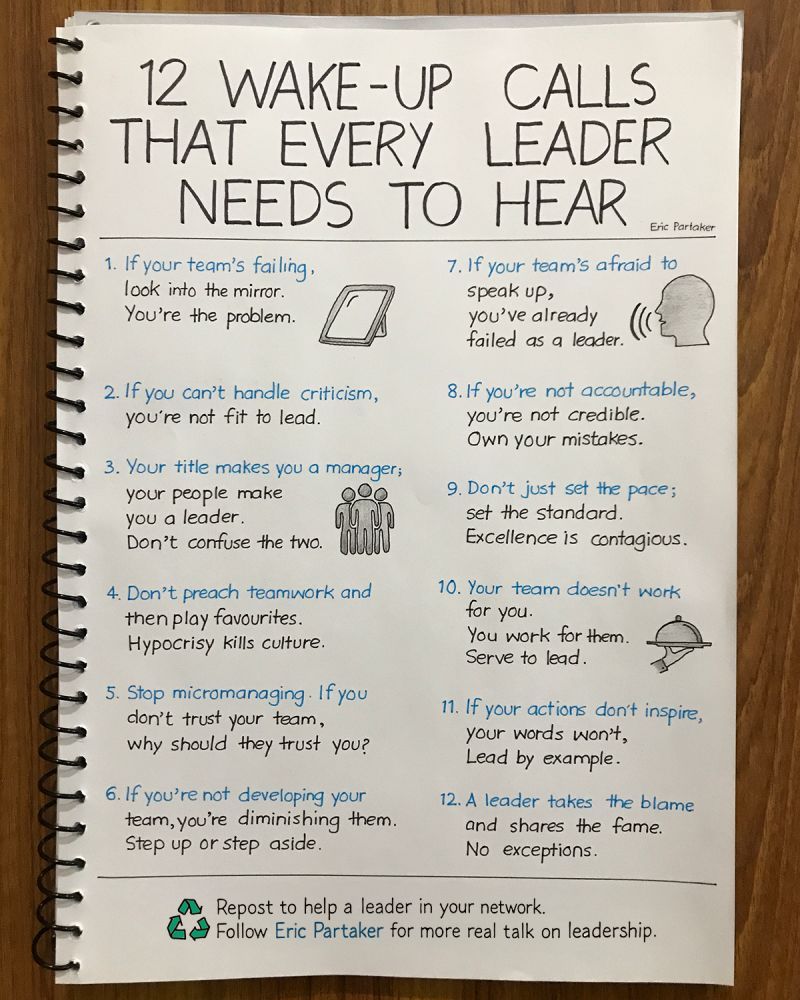
In a recent LinkedIn post, Eric Partaker offers a series of pointed “wake-up calls” for leaders at all levels, emphasizing that true leadership is a daily commitment rather than a mere title. Partaker, a noted entrepreneur and investor, lays out twelve critical reminders designed to foster self-reflection and accountability among those in leadership positions. He asserts that even successful leaders need regular doses of candid feedback to maintain effectiveness and integrity.
The Mirror Test: Accountability Starts at the Top
A core theme in Partaker’s post is the leader’s ultimate responsibility for their team’s performance. He challenges the notion of external factors being solely to blame for team failures, urging leaders to look inward. As Eric Partaker states:
If your team is failing, look into the mirror.
You’re not unlucky. You’re the problem.
This direct assertion underscores a fundamental principle of effective leadership: self-awareness and accountability. Partaker argues that leaders must own their role in both successes and failures, fostering an environment where issues are addressed proactively rather than being attributed to misfortune.
Beyond the Title: Building Trust and Culture
Partaker also delves into the distinction between management and leadership, highlighting that a title alone does not confer true leadership status. He emphasizes that leadership is earned through actions and the development of trust within a team. According to Eric Partaker:
Your title makes you a manager.
Your people make you a leader.
Never confuse the two.
This point is crucial for understanding how organizational culture is shaped. Partaker warns against hypocrisy, stating that inconsistent actions, such as preaching teamwork while playing favorites, can erode culture over time. He also addresses the detrimental impact of micromanagement, suggesting it signals a lack of trust that inevitably damages the leader-team relationship.
Developing and Empowering Teams
Furthermore, Partaker stresses the leader’s role in the growth and development of their team members. He posits that failing to invest in employee development is a form of diminishment. Eric Partaker advocates for leaders to actively step up in supporting their teams or to consider stepping aside if they are unwilling or unable to do so.
The Power of Inspiration and Service
The post also touches upon the importance of inspiration and service-oriented leadership. Partaker suggests that leaders should set high standards through their own actions rather than simply mandating them. He believes that people are more likely to follow examples than slogans. This aligns with his view that leaders ultimately work for their teams, not the other way around.
People follow examples, not slogans.
This emphasis on modeling behavior is reinforced by Partaker’s final point: a true leader accepts blame and shares credit. This principle, he concludes, is non-negotiable and forms the bedrock of genuine leadership, which is ultimately a daily choice.
📝 About This Content
This article is based on insights shared by Eric Partaker on LinkedIn.
📅 Originally posted on February 21, 2026 | View original post on LinkedIn →