
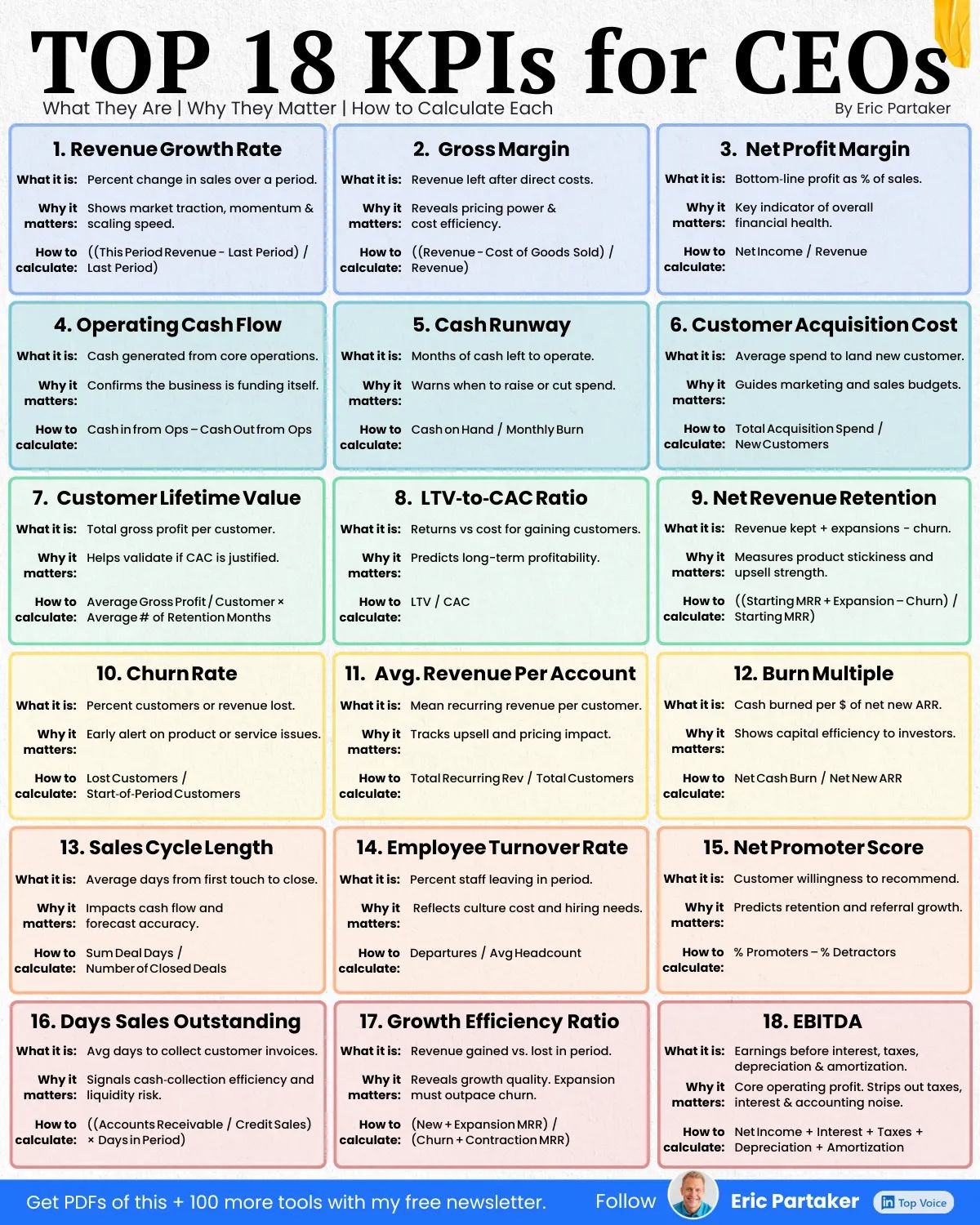
In a recent LinkedIn post, Eric Partaker highlights a critical oversight he believes many chief executives make: tracking the wrong business metrics. Partaker, drawing from personal experience, suggests that a significant number of CEOs are operating without clear direction, leading to stalled growth and reactive decision-making. He asserts that focusing on a specific set of 18 Key Performance Indicators (KPIs) can provide the necessary clarity for confident leadership.
Partaker begins by stating the core problem:
“9 out of 10 CEOs are tracking the wrong metrics.
(I learned this the hard way.)”
He elaborates on the consequences of this misstep, noting that many leaders are left “making gut decisions. Wondering why growth feels so hard.” According to Partaker, the solution lies not in accumulating more data, but in identifying and consistently monitoring the most impactful metrics.
The Core Metrics Every CEO Should Monitor
Eric Partaker categorizes the essential 18 KPIs into several key areas, providing a comprehensive framework for business health assessment. He emphasizes that these metrics are designed to cut through the noise of less important data points.
Revenue and Profitability
Partaker identifies three crucial metrics in this category. Revenue Growth Rate is presented as an indicator of market momentum. Gross Margin, he explains, reveals a company’s pricing power, while Net Profit Margin offers a true picture of overall financial health. As Partaker notes, understanding these figures is fundamental to sustainable business operations.
Cash Flow and Runway
For leaders concerned with financial stability and future planning, Partaker points to metrics like Operating Cash Flow, which confirms a company’s ability to fund its operations. He also stresses the importance of Cash Runway, a metric that warns when capital might be running low and strategic decisions about spending or fundraising are needed. The Burn Multiple is also highlighted for its role in demonstrating capital efficiency to potential investors.
Customer-Centric Metrics
Understanding customer value is paramount, and Partaker outlines key metrics for this. Customer Acquisition Cost (CAC) is vital for guiding marketing expenditures. He argues that Customer Lifetime Value (LTV) must be considered to validate if the CAC is justified. The LTV-to-CAC Ratio, in his view, is a powerful predictor of long-term profitability. He states:
“The magic isn’t in tracking everything. It’s in tracking the RIGHT things consistently.”
Retention and Growth Indicators
Partaker also delves into metrics that predict ongoing success. Net Revenue Retention is presented as a measure of product stickiness and customer satisfaction. Churn Rate, he explains, serves as an early warning system for potential product issues, while Net Promoter Score (NPS) is a key predictor of future retention and customer referrals.
Operational and Financial Health
Beyond customer and revenue metrics, Partaker includes measures of operational efficiency and overall financial integrity. Sales Cycle Length impacts cash flow forecasting, and Days Sales Outstanding signals the efficiency of collections. Employee Turnover Rate, he suggests, reflects underlying issues with company culture and hiring practices. Finally, metrics like EBITDA, Growth Efficiency Ratio, and Average Revenue Per Account (ARPA) provide further depth into a company’s financial performance and growth quality.
Partaker concludes his post by reiterating the value of focusing on these core indicators. He believes that by consistently monitoring these 18 KPIs, CEOs can gain the clarity needed to make better decisions and achieve greater peace of mind. He encourages leaders to save this list, review it regularly, and share it with others who might benefit.
📝 About This Content
This article is based on insights shared by Eric Partaker on LinkedIn.
📅 Originally posted on November 26, 2025 | View original post on LinkedIn →