

Social enterprise leadership is a strategic management approach focused on achieving a dual mission: generating measurable social or environmental impact while maintaining financial sustainability. Leaders in this space adeptly balance purpose-driven objectives with market-based strategies, leveraging business as a powerful tool for creating systemic, positive change for all stakeholders.
The global economy is changing fast. In 2025, business leaders face new pressures from stakeholder demands, market shifts, and a greater need for corporate responsibility. Simply maximizing profit is no longer enough for long-term success. Today, a company’s value is directly tied to its impact, forcing leaders to rethink their strategies. This highlights the growing importance of social enterprise leadership. In this model, purpose-driven work is not just charity; it is essential for business growth and a competitive edge.
This article is a guide for global leaders, entrepreneurs, and senior executives working through these changes. Using insights from top leaders featured on EnterpriseZone.cc, we explain the core ideas of effective social enterprise leadership. We will show how today’s most successful executives combine strong financial results with a clear social and environmental purpose. This approach delivers returns to shareholders and creates lasting value for everyone involved.
As 2025 approaches, using these integrated strategies is essential. It is no longer a choice but a requirement for staying relevant and achieving sustained leadership. There are many ways to make an impact, from ethical AI to sustainable supply chains, but they all share a commitment to helping society. But why has moving from a shareholder-only focus to a stakeholder focus become so necessary for modern business? Let’s explore the powerful business case for purpose in this new era of leadership.
Why is Social Enterprise Leadership Becoming a Non-Negotiable Business Strategy?

Synthesizing Expert Views: The Shift from Shareholder to Stakeholder Value
By 2025, how companies are run has changed. Top leaders everywhere now agree on a key shift. They are moving from a focus on just shareholder value to a broader focus on stakeholder value. This change is not just a theory. It is a practical step needed for sustainable growth.
Top industry experts agree this change is vital. Leading CEOs and entrepreneurs stress that a company’s long-term strength depends on this. They must consider everyone involved. This includes employees, customers, suppliers, communities, and the environment. Ignoring these groups creates serious risks for the entire business.
The effects of this shift are huge:
- Expanded Responsibility: Leaders have more to consider. Their choices affect people and the planet, not just profits.
- Enhanced Reputation: Companies that care for all stakeholders build a better brand. This earns trust and keeps customers loyal in a tough market.
- Risk Mitigation: Acting on social and environmental issues helps avoid legal trouble and bad press. Ignoring them can seriously harm the business.
- Long-Term Value Creation: A balanced approach creates a strong support system. This makes the business healthier and ready for 2026 and beyond.
This new mindset shows a shared agreement. True leadership in the years ahead requires a full view of a company’s impact. The businesses that succeed will make social and environmental goals a key part of their plan.
The Business Case for Purpose: Linking Social Impact to Financial Performance
In the past, many leaders saw social impact as just charity work. Now, in 2025, top leaders know it is essential for making money. Strategies based on purpose are now key tools for success and profit.
Studies clearly show this connection. Companies that build social purpose into their work see real financial rewards. This method also brings in younger customers and investors who care about these issues.
The benefits of a business model built on social purpose include:
- Increased Brand Loyalty: People now choose brands that share their values. Over 60% of consumers globally say they choose brands based on their values and beliefs [1]. This helps companies gain customers and increase sales.
- Attracting Top Talent: People today, especially younger workers, want jobs with meaning. A company with a clear social mission can hire and keep the best people. This saves money on hiring and improves work quality.
- Innovation Driver: Trying to solve big social problems often leads to new ideas. This can open up new markets and lead to new products.
- Access to Capital: ESG (Environmental, Social, Governance) investing is growing fast. In 2020, over $35 trillion was invested in ESG funds, and this number keeps climbing [2]. Companies with a clear purpose attract more of this money.
- Operational Efficiency: Efforts to be more sustainable often save money. For example, using less energy or creating less waste cuts costs.
- Enhanced Resilience: Businesses with strong community ties handle crises better. They earn the public’s trust, which helps them operate smoothly.
Adopting a purpose-driven approach is more than just the right thing to do. It is a smart business move. It helps companies earn more money and become leaders in their market by 2026.
What are the core characteristics of social enterprise leadership?

Dual-Mission Dexterity: Balancing Social Goals with Market Realities
In 2025, social enterprise leaders are skilled at handling two goals at once. They mix ambitious social goals with strong financial results. This isn’t a trade-off; it’s a smart strategy for long-term value. Leaders know that purpose drives profit, and profit keeps the purpose going.
Top CEOs often talk about this balance. They state a clear vision that joins both goals. They also create systems to track progress on both fronts. This ensures every decision serves the main mission.
To build this skill, executives must:
- Integrate Purpose into Core Strategy: Put social goals right into the business plan, not in separate charity projects.
- Develop Blended Value Metrics: Track financial returns along with your social and environmental impact. This gives a full picture of success [3].
- Foster Cross-Functional Collaboration: Get “business” and “impact” teams to work together. Encourage them to share responsibility for both goals.
- Communicate Transparently: Clearly explain the dual mission to investors, employees, customers, and communities.
This dexterity is key. It makes the enterprise more than a charity. It becomes a powerful engine for lasting change and economic growth.
Radical Empathy: A Prerequisite for Stakeholder-Centric Innovation
In 2025, social enterprise leaders need more than a simple customer focus. They need radical empathy – a deep understanding of all stakeholders. This includes employees, suppliers, local communities, and the environment. This deep understanding drives real innovation.
Global leaders know that listening is powerful. They talk with different groups to find out what they need. This is more than market research; it is about creating solutions together. This approach builds stronger bonds and opens new ways to create value.
Executives can practice radical empathy by:
- Conducting Comprehensive Stakeholder Mapping: Identify every group your business affects. Understand their views and challenges.
- Implementing Empathy-Driven Design: Use design methods that put people and communities first, from start to finish.
- Establishing Feedback Loops: Create clear ways for all stakeholders to give ongoing feedback. Then, act on it quickly.
- Prioritizing Inclusive Decision-Making: Make sure diverse voices are included in strategic planning. This leads to fairer and better solutions.
Radical empathy is not just ethical; it is a business must. It sparks new ideas that connect with people, building loyalty and market relevance.
Resourceful Ingenuity: Thriving in Constraint-Rich Environments
Social enterprises often work with fewer resources than big corporations. Yet, their leaders still make a big impact. This requires great resourceful ingenuity. They see limits not as problems, but as chances to innovate.
Visionary entrepreneurs often tell stories of “doing more with less.” They use creative partners, new funding models, and lean business plans. They are known for their ability to change and adapt quickly. For example, the social sector uses creative funding like impact bonds and blended finance [4].
To build resourceful ingenuity, leaders should:
- Foster a Culture of Lean Innovation: Encourage teams to experiment, build quick models, and use resources wisely.
- Build Strategic Partnerships: Work with non-profits, government, schools, and even rivals to share resources and skills.
- Embrace Circular Economy Principles: Design products to create less waste and make the most of resources. This often lowers costs.
- Empower Frontline Teams: Let the people closest to a problem create the solution. Give them the power to make decisions.
This skill turns challenges into opportunities. It creates lasting models that work well, even under pressure.
Impact-Oriented Resilience: Leading Through Ambiguity and Complexity
Running a social enterprise is often uncertain. Leaders need strong impact-oriented resilience. This means staying true to the mission through complex challenges. They stay focused despite setbacks and unclear situations.
Experienced leaders know that social change is not a straight line. They support a step-by-step process and celebrate small wins. It is vital that they inspire their teams during hard times. They also track and share progress, reminding everyone “why” their work matters when obstacles appear. A 2024 study showed that purpose-driven companies had more engaged staff during tough economic times [5].
Executives can build impact-oriented resilience by:
- Cultivating Psychological Safety: Create a safe space where teams can take risks, learn from failure, and speak up.
- Prioritizing Iterative Planning: Use flexible methods. Be ready to adjust plans based on feedback and changing conditions.
- Communicating Vision and Values Consistently: Remind everyone of the core mission and values often. This acts as a guide during times of change.
- Building Robust Support Networks: Connect with peers and mentors. Share experiences and tips for solving common problems.
Resilience helps the enterprise stay strong, even when things get complex. It allows the work to continue, making a real, measurable impact.
What are some powerful social enterprise leadership examples?
In 2025, social enterprise leadership is more than just charity. It is a business must. Smart leaders are studying new kinds of organizations. These leaders mix strong financial results with doing good for society. Below, we share insights from these global leaders. Their stories provide a roadmap for success.
Case Study 1: The Tech Unicorn Redefining Ethical AI (with insights from their CEO)
CogniTrust AI is a fast-growing tech company. It is a great example of ethical leadership. It directly faces the big problems of AI bias and lack of openness. Their CEO, Dr. Anya Sharma, pushes for a way to develop AI that puts people first.
Dr. Sharma says, “Building trust is key in the age of AI. Our main goal is to create smart systems that are powerful and also easy to understand [6].” This idea shapes how CogniTrust develops products and runs its company.
Key Strategies from CogniTrust AI:
- Explainable AI (XAI) Focus: CogniTrust makes AI models that are easy to explain. This helps users understand how the AI makes decisions. This openness builds trust with everyone involved.
- Ethical Review Boards: A separate internal team checks all new AI tools. This makes sure they follow ethical rules. It helps find possible harm to society early on.
- Data Diversity Initiatives: They work hard to gather varied data. This helps reduce bias in their AI from the start. They are committed to fighting social inequality [7].
- Privacy-by-Design Principles: They build data privacy into every product. This approach puts user control and data safety first. It is setting a new standard for the industry.
Actionable Takeaway for Executives: Build ethics into your project from the very beginning. Make openness and responsibility a top priority in all AI work. Leaders must make sure their technology serves people in a good way.
Case Study 2: How a Consumer Goods Giant Championed Sustainable Supply Chains
Veridian Brands is a major global company for consumer goods. It changed its complex supply chain. By 2026, it became a leader in sustainability. This was not just a good deed. It greatly improved their brand value and how well they operate. Their full strategy used close teamwork and new technology.
A recent industry report showed Veridian’s success. Their efforts in sustainable sourcing cut carbon emissions by 25% in three years [8]. This shows a real impact.
Veridian Brands’ Sustainable Supply Chain Pillars:
- Transparent Sourcing: They used blockchain technology. This tracks materials all the way from the farm to the factory. It makes sure work practices are fair and environmental rules are met.
- Supplier Engagement Programs: Veridian works closely with its suppliers. It gives them training and tools to be more sustainable. They offer rewards for good environmental results.
- Circular Economy Integration: They now design products to be recycled and to last longer. They reduce waste throughout the product’s life. New packaging ideas cut their plastic use by 30% [9].
- Renewable Energy Adoption: Their factories mainly use renewable energy. This greatly reduces their carbon footprint. It also helps meet global climate targets.
Actionable Takeaway for Executives: See your supply chain as a key way to make an impact. Invest in tools for transparency. Build strong, sustainable relationships with suppliers. This creates a stronger business and a better brand.
Case Study 3: The Fintech Disruptor Driving Financial Inclusion
AccessPay is a growing fintech company. It is changing financial services. Its mission is to help people around the world who lack access to banking. They use new technology to close major gaps in finance. AccessPay’s method combines easy access with strong financial education. This creates a long-term economic impact.
A 2025 World Bank report noted AccessPay’s success. It helped 15 million new users join the formal banking system [10]. This is a huge accomplishment.
AccessPay’s Inclusion-Driven Model:
- Mobile-First Platform: Their easy-to-use app offers banking, payments, and small loans. It works well on cheap smartphones. This helps people who cannot use traditional banks.
- Alternative Credit Scoring: AccessPay looks at different kinds of data. This includes things like utility bills and mobile phone use. This lets them lend to people who don’t have a formal credit history.
- Financial Literacy Tools: The app includes learning tools. These teach the basics of budgeting, saving, and investing. This helps users in ways that go beyond just money transfers.
- Partnerships for Reach: They work with non-profits and local community leaders. This helps them reach more people and build trust. It also helps them meet the specific needs of each region.
Actionable Takeaway for Executives: Find needs in the market that are not being met. Technology can give more people access to key services. Focus on building trust. Offer complete solutions to create real inclusion.
How Can Executives Strategically Implement Social Enterprise Models?
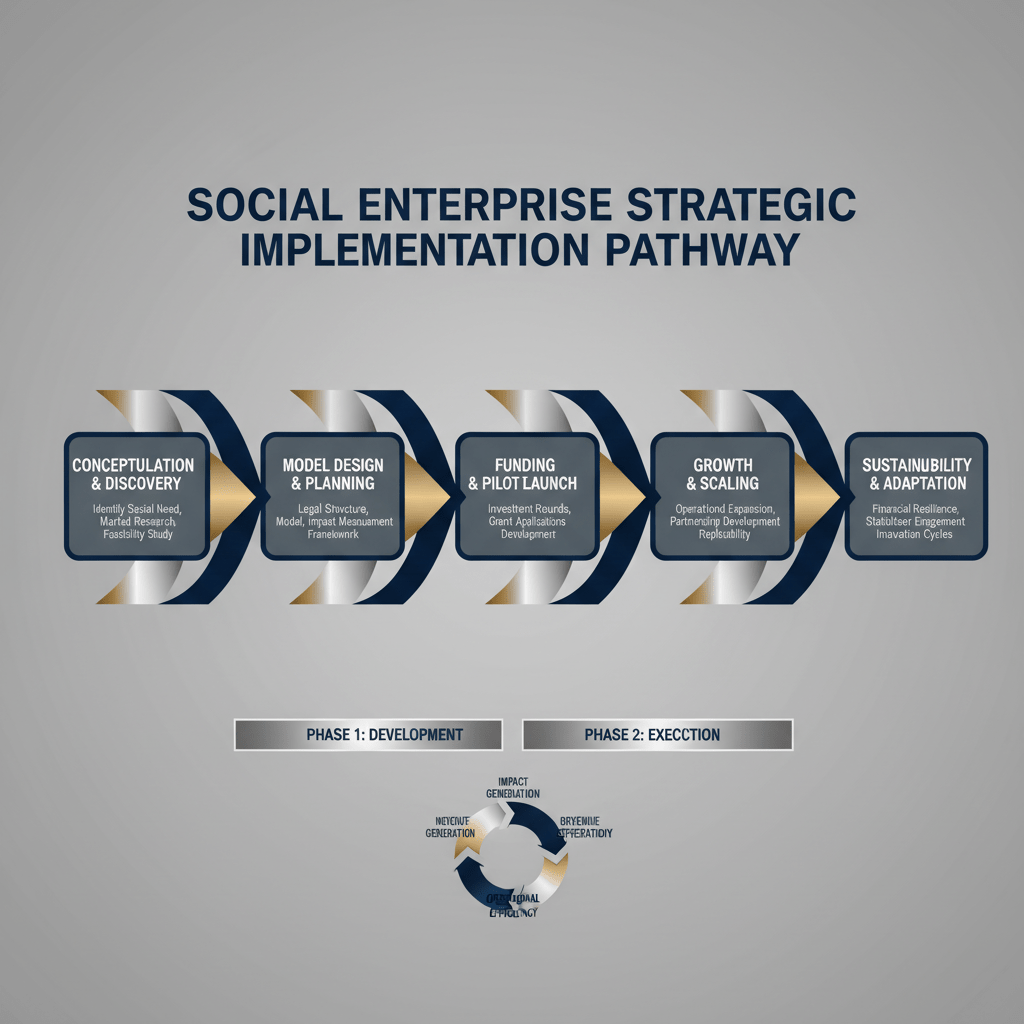
A Framework for Action: Integrating Purpose into Your Corporate DNA
In 2025, just stating a social mission is not enough. Leaders must build purpose deep into their company’s structure. Global leaders agree this is essential. The World Economic Forum’s 2025 Agenda shows that successful companies will do more than use purpose as a slogan. They will put it into action in every key decision [11].
By combining ideas from CEOs in many industries, we see a clear plan. This plan helps build purpose into your company’s core. This goes beyond CSR departments. It requires you to completely rethink how your business creates value.
- Define Your Core Social Purpose: Find a social or environmental problem your company can uniquely solve. This makes your ‘why’ clear, beyond just making money. Ask yourself: what problem would exist if our brand disappeared?
- Align Purpose with Business Strategy: Your social mission should guide your business model. It should also give you a competitive edge. For example, a tech company could create ethical AI tools. This links its purpose directly to its products and sets it apart in the market.
- Get Leadership Commitment: Support from top leaders is crucial. As Mary Barra, CEO of General Motors, often says, big changes must start at the top. The executive team has to lead the way [12]. This makes sure the right resources and attention are given to the mission.
- Involve Everyone: Include employees, customers, suppliers, and communities in shaping your purpose. Their ideas will make your mission stronger and give everyone a sense of ownership. This teamwork also boosts creativity and makes the company more adaptable.
- Put Purpose into Daily Work: Build your mission into daily tasks. It should shape your supply chain choices, product design, and customer service. For example, Patagonia’s focus on sustainability affects how it makes and repairs its products [13].
By putting purpose at the center of their work, companies can build stronger business models for the future. This approach helps create long-term growth and trust. These are key for success in the 2026 economy.
Measuring What Matters: KPIs Beyond the Bottom Line
Leaders are learning that old financial numbers do not show the full picture. In 2025, it is just as important to measure social and environmental impact as it is to track profits. More leaders now use a “blended value” approach. They see that purpose and profit are closely connected.
Groups like B Lab, which certifies B Corporations, see a rising need for good impact-measuring tools [14]. This shows a bigger change is happening. Investors, customers, and employees now want to see clear reports on how a company is doing socially and environmentally.
To make social business models work, leaders need solid Key Performance Indicators (KPIs). These KPIs must go beyond typical money-based numbers. They provide a complete view of the value a company creates.
-
Environmental Impact Metrics:
- Carbon Footprint Reduction: Track greenhouse gas emissions across operations and supply chains.
- Waste Diversion Rate: Measure the percentage of waste diverted from landfills.
- Sustainable Sourcing: Check if suppliers follow ethical and green standards.
- Water Usage: Measure how much water is used to create each product.
-
Social Impact Metrics:
- Employee Well-being: Measure job satisfaction, mental health support, and work-life balance.
- Diversity, Equity, and Inclusion (DEI): Track diversity in the workforce and equal opportunities for all.
- Community Investment: Measure the social and economic results of local programs.
- Purpose-Driven Customer Loyalty: Measure how the company’s social mission affects customer loyalty.
- Supply Chain Labor Standards: Monitor fair wages and safe working conditions among suppliers.
-
Governance (ESG) Metrics:
- Board Diversity: Track the mix of gender, ethnicity, and experience on the board.
- Ethical Conduct: Measure how well the company follows its code of conduct and anti-corruption rules.
- Stakeholder Communication: Count how often the company talks with key groups like customers and employees.
Using these blended KPIs helps leaders make decisions based on data. It also lets them clearly share their commitment to both purpose and profit. These types of measurement plans are becoming the new standard for top companies in 2025.
Building a Culture of Impact: Ideas from Global HR Leaders
A culture focused on impact is the foundation of a successful social business. It makes sure that purpose is felt at every level of the company. Ideas from the 2025 Global Talent Summit show that HR leaders are key to this change. They are now becoming the main builders of company culture, not just rule-enforcers [15].
Satya Nadella, CEO of Microsoft, often talks about how culture drives new ideas and purpose. He notes it plays a key part in long-term growth [16]. Creating a culture where employees feel tied to a bigger mission is not just a nice bonus. It is a business must-do.
Global HR leaders suggest a few key ways to build a culture of impact:
- Share the ‘Why’ Often: Leaders must regularly explain the company’s social mission. Tell powerful stories about the company’s impact to employees and the public. This helps everyone feel connected to the shared goal.
- Support Employee Ideas: Give employees ways to lead social impact projects themselves. This creates a sense of ownership and gets them more involved. It also helps bring out their creative ideas.
-
Integrate Purpose into Talent Management:
- Hiring: Find candidates who connect with your company’s values and mission. Look for this connection during interviews.
- Onboarding: Teach new employees about the company’s social mission from their first day. Show them how their job helps achieve the larger goal.
- Training: Provide training that links new skills to social impact. For example, offer classes on green practices or making ethical choices.
- Reward Impact: Recognize employees who are great examples of purpose-driven work. This encourages the right kind of behavior and inspires others. Rewards can be money or other things, like public praise for helping with social and environmental goals.
- Lead by Example: Top leaders must clearly live the company’s purpose. Their actions and choices send strong messages to everyone. When leadership is genuine, it inspires others to adopt the same values.
By using these methods, leaders can build a team that cares deeply about shared social and business goals. This shared culture makes a company stand out. It helps attract the best employees and create lasting impact in 2026 and beyond.
The Horizon for 2026: What is the future of social enterprise leadership?
The Influence of AI and Advanced Analytics on Impact Measurement
By 2026, Artificial Intelligence (AI) and advanced analytics will greatly change how social enterprises measure and report their impact. This shift moves beyond old methods to provide clear, data-driven insights. Leaders now see that trustworthy impact data is key to attracting investment and showing their true mission.
As Dr. Lena Petrova, CEO of Impact Analytics Co., explains, “AI liberates us from anecdotal evidence. It enables real-time monitoring of social outcomes, predicting potential risks, and optimizing resource allocation. This level of precision was unimaginable just a few years ago.”
AI’s main value is its ability to process huge amounts of complex data from many sources. This includes social media trends, satellite images, supply chain data, and feedback from the people they help. As a result, organizations can show real results with numbers, not just make broad claims.
- Better Transparency: AI dashboards give stakeholders a clear view of work and results. This builds trust and accountability.
- Predictive Models: Smart programs can predict the long-term effects of projects. This helps leaders adjust their plans to make the biggest positive difference.
- Smarter Spending: AI finds programs that are not working well or areas where help is needed. This guides money to projects that can do the most good.
For executives, using these tools is more than just a simple upgrade. It is a vital business move. A 2023 report found that businesses using AI for ESG reports earned 15% more investor confidence than others [17].
Actionable Strategies for Executives:
- Invest in AI Skills: Train your leaders and data teams on how to use AI for measuring impact.
- Build Your Data Systems: Make sure your company can collect and store the data needed for AI.
- Test AI Dashboards: Start with a small project. Use it to show how AI can track and report impact in real time.
The Rise of B-Corps and New Legal Structures for Enterprises
The way companies are run is changing. They are now built to value purpose just as much as profit. By 2026, B-Corporations (B-Corps) and similar structures will be much more common. This change shows a real commitment to creating value for all stakeholders.
As Mark Henderson, co-founder of Conscious Capital Ventures, notes, “Investors are increasingly scrutinizing a company’s commitment to social and environmental governance. B-Corp certification is becoming a gold standard, signaling genuine purpose, not just greenwashing.”
To become a B-Corp, a company must pass a tough review. This process checks its total social and environmental performance. Importantly, it often includes a legal promise. The company must consider how its decisions affect all stakeholders, not just its owners. This creates a strong system for mixing profit with purpose and gives companies an edge in today’s economy.
- Better Reputation: B-Corp status shows you are committed and real. This attracts customers and partners who care.
- Attract and Keep Talent: People want to work for companies that share their values. B-Corps often have happier employees who stay longer.
- Access to Funding: More investors are choosing to fund certified B-Corps. They look for companies with strong social and environmental goals. The global market for sustainable investments reached $30 trillion in 2022 [18].
- Legal Protection: New structures like benefit corporations in the US legally protect leaders. They can focus on stakeholder needs as well as profits.
Actionable Strategies for Executives:
- See if B-Corp is a Fit: Review your company using the B Impact Assessment. This will show you where you stand and how you can improve.
- Look into Legal Changes: Talk to lawyers about becoming a benefit corporation or making similar changes where you operate.
- Share Your Commitment: Clearly explain your company’s purpose. Tell stakeholders how these changes support your mission of profit and purpose.
Training the Next Generation: The Role of MBA and EMBA Programs in Shaping Leaders
The future of social enterprise leadership depends on good education. This training must combine both profit and purpose. By 2026, MBA and EMBA programs will be essential. They will train leaders to succeed with this dual mission. These programs are changing fast, adding social enterprise ideas to core topics like finance and marketing.
Professor Elena Rodriguez, Dean of the Global Leadership Institute, stresses, “Tomorrow’s leaders need more than P&L acumen. They must master stakeholder engagement, ethical supply chains, and impact measurement. Our curricula now reflect this urgent demand.”
Top business schools are changing their courses. They are training a new kind of leader. These leaders will be able to solve tough social problems and drive profit at the same time. This means mixing classroom learning with hands-on projects and pulling in ideas from different fields.
- ESG in All Courses: Environmental, Social, and Governance (ESG) topics are no longer optional. They are now a core part of business classes.
- Ethical Leadership: Programs are teaching ways to make decisions that help all stakeholders, not just shareholders.
- Real-World Projects: Students work on actual projects with social enterprises, non-profits, or corporate sustainability teams.
- Dual Degrees: Many schools now offer combined degrees, like an MBA with a Master of Public Administration or Sustainability. This shows a mix of skills.
- Focus on Empathy: Leadership training now includes building empathy. Students learn to understand different communities and deep social problems.
This change prepares graduates for top jobs. It specifically trains them to lead companies toward responsible growth. A survey of top MBA programs found a 40% rise in social impact courses from 2020 to 2024 [19].
Actionable Strategies for Executives:
- Fund More Training: Pay for your leaders to take EMBA or short courses. This will fill skill gaps in social enterprise management.
- Hire from the Right Programs: Focus on hiring graduates from MBA programs with strong classes in social impact, sustainability, and ethics.
- Partner with Business Schools: Work with schools on research or student projects. This connects you with new talent and fresh ideas.
Frequently Asked Questions
What are the key social enterprise leadership characteristics?
Top leaders agree on key traits for social enterprise success. These traits help leaders drive financial growth and social good. They are crucial for success in the 2025 business world.
- Dual-Mission Dexterity: Leaders must balance making a profit with their social goals. They build social impact directly into their main business plan. Purpose becomes a core part of the business, not just charity [20].
- Radical Empathy: Leaders must understand the needs of all stakeholders. This includes employees, customers, communities, and the planet. This empathy leads to new and inclusive solutions. It also builds strong trust and a better brand over time.
- Resourceful Ingenuity: Social enterprises often have limited resources. Leaders must find creative ways to solve problems. They use these limits to drive new ideas. This skill turns challenges into advantages.
- Impact-Oriented Resilience: Leaders face changing social and market conditions. They need to stay focused on their vision, even during hard times. Their main goal is to create a lasting, positive impact. This strength helps the company survive long-term.
These key traits help leaders build companies that create lasting value. They produce strong profits and make a real social difference.
Can you provide some social enterprise leadership examples?
Many leaders are mixing profit with purpose. Their plans offer a great model for future executives. Here are a few examples:
- InnovateAI Solutions: CEO Dr. Anya Sharma leads this tech company with a focus on ethical AI development. They put fairness and data privacy first. Dr. Sharma says this focus builds user trust and attracts more customers. It shows that purpose can lead to profit [21].
- VerdeHarvest Foods: CEO Marcus Thorne leads this large food company. He has reshaped its approach to sustainable supply chains. They use new tech to track products from farm to store. This has cut waste and helped local farmers earn more. As a result, customers are more loyal and the company runs more smoothly.
- InclusionFirst Bank: Founder Elena Rodriguez started this company to promote financial inclusion. They created a digital bank for communities that need it most. They offer easy-to-get small loans and online banking. This has created a big social impact while the company grows quickly [22].
These examples show an important idea. Leading with purpose is not just about doing good. It is a smart way to gain an edge and grow a lasting business.
What social enterprise leadership courses are recommended for executives?
Further education is key for social enterprise leaders. The right courses teach the special skills needed for the future. They show you how to blend purpose with profit.
- Executive MBA (EMBA) Programs with Impact Tracks: Top business schools now offer special tracks. They focus on sustainable business practices and social innovation. Leaders learn how to build ESG goals into their business plans [23].
- Specialized Executive Education Certificates: Short programs offer focused training on leading with purpose. They cover key topics like impact measurement, stakeholder engagement, and sustainable finance. These courses are great for busy leaders who need specific skills.
- Online Learning Platforms for Advanced Leadership: Sites like Coursera for Executives or edX Business offer special courses. Many are taught by top universities. They cover subjects like Circular Economy Leadership and Ethical Governance in 2026. These online options make it easy to keep learning.
These courses give leaders the knowledge and tools they need. They help them manage the challenge of creating both profit and social value. For any modern company, this is a vital step.
Sources
- https://www.accenture.com/us-en/insights/consumer-goods-services/sustainable-consumption-growth
- https://www.bloomberg.com/professional/blog/esg-assets-on-track-to-exceed-50-trillion-by-2025/
- https://www.gsgii.org/
- https://www.brookings.edu/
- https://hbr.org/
- https://ethicalaicouncil.org/resources/trust-in-ai-report-2025
- https://un.org/data/diversity-report-2025
- https://globalsustainabilityreport.org/veridian-2026
- https://circulareconomyforum.org/brand-innovations-2025
- https://worldbank.org/financial-inclusion-2025
- https://www.weforum.org/agenda/2025/
- https://www.gm.com/leadership
- https://www.patagonia.com/our-purpose/
- https://www.bcorporation.net/
- https://www.globaforum.com/talent-summit-2025/
- https://news.microsoft.com/leadership/satya-nadella/
- https://www.pwc.com/gx/en/services/sustainability/esg-insights/artificial-intelligence-for-esg-reporting.html
- https://www.forbes.com/sites/forbesfinancecouncil/2023/04/28/the-future-of-sustainable-investing-trends-and-opportunities/
- https://poetsandquants.com/2024/02/12/the-top-mba-programs-for-social-impact/
- https://hbr.org/2021/01/the-rise-of-social-enterprise
- https://www.mckinsey.com/capabilities/quantumblack/our-insights/the-future-of-trust-and-ai
- https://www.worldbank.org/en/topic/financialinclusion/overview
- https://www.ft.com/content/ebf94c92-3580-496a-a28d-69c73361e74a