
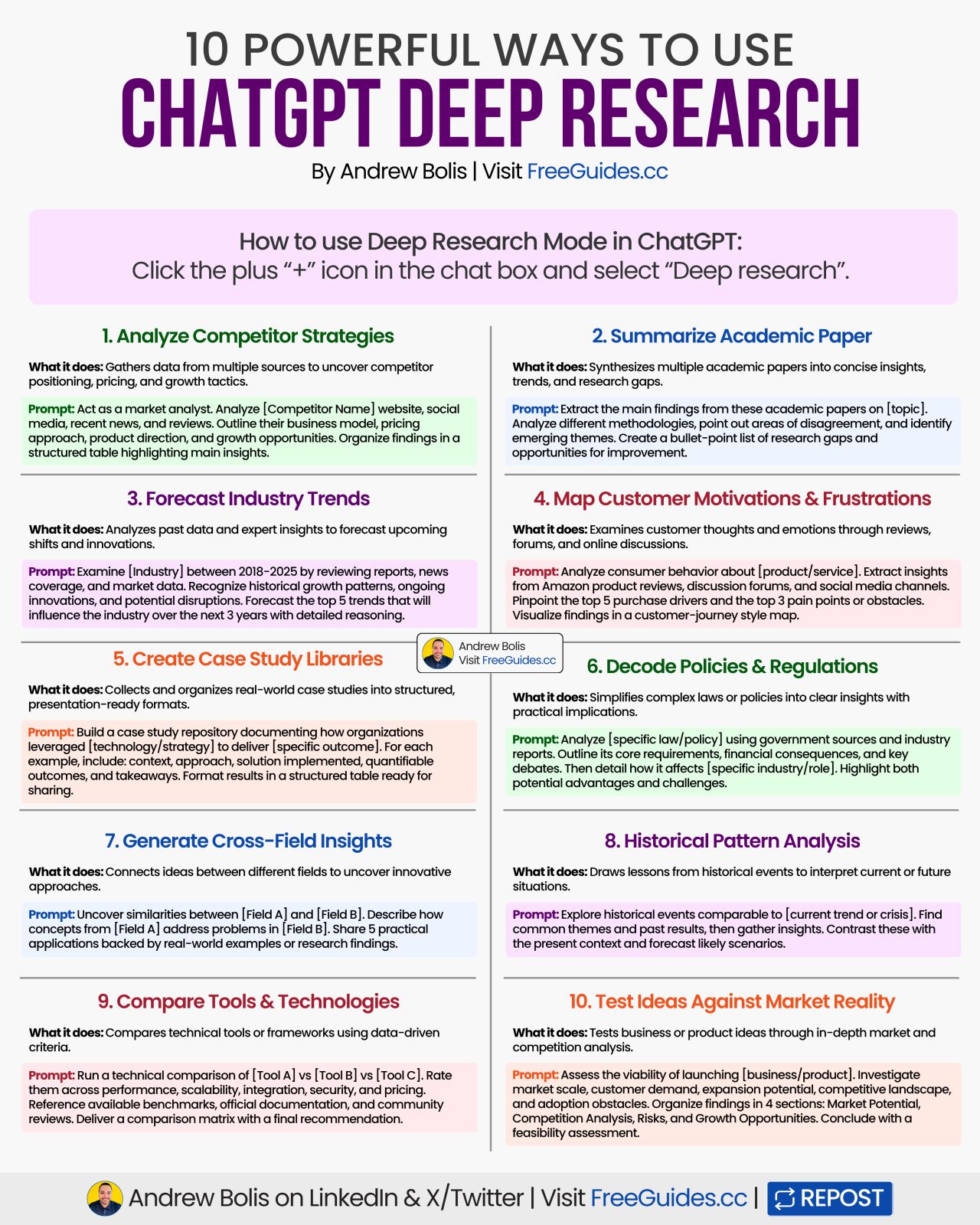
In a recent LinkedIn post, Andrew Bolis highlights the untapped potential of ChatGPT’s ‘Deep Research’ mode, arguing that it transforms basic queries into sophisticated analyses.
Bolis observes that many users interact with AI tools at a superficial level, missing out on their advanced analytical capabilities. He emphasizes that ChatGPT, when prompted correctly, can perform complex tasks like comparing market trends and analyzing competitive landscapes in mere minutes.
“Most people stop at surface-level answers. But with Deep Research, ChatGPT can think, compare, and analyze market trends in minutes.”
The post outlines ten powerful use-cases for this advanced mode, accompanied by specific prompts designed to guide users toward more in-depth results. Bolis frames these prompts as tools for unlocking expert-level insights that would typically require significant human effort and time.
Strategic Analysis and Market Intelligence
One key area Bolis identifies is leveraging ChatGPT for competitor analysis. He provides a detailed prompt designed to act as a market analyst, dissecting a competitor’s online presence, recent news, and customer feedback.
As Andrew Bolis notes, this can involve:
- Analyzing a competitor’s business model and pricing approach.
- Outlining their product direction and identifying growth opportunities.
- Organizing findings in a structured table to highlight main insights.
Bolis suggests that this capability allows businesses to gain a comprehensive understanding of their competitive environment rapidly.
Academic Research and Trend Forecasting
Another significant application discussed by Bolis is the summarization and analysis of academic research. The prompts provided aim to extract key findings, compare methodologies, and identify research gaps from complex papers.
“Extract the main findings from these academic papers on [topic]. Analyze different methodologies, point out areas of disagreement, and identify emerging themes.”
Furthermore, Bolis details how ChatGPT can be used for industry trend forecasting. By analyzing historical data, news coverage, and market reports, the AI can help predict future industry shifts.
Mapping Customer Motivations
Bolis also explores the use of AI in understanding customer sentiment. He offers a prompt to analyze consumer behavior related to a specific product or service by examining reviews and social media discussions.
According to Andrew Bolis, this process can pinpoint critical customer motivators and pain points, visualizing them in a customer-journey style map. This offers businesses a clearer picture of their target audience’s needs and frustrations.
Decoding Regulations and Cross-Field Innovation
The post further outlines the utility of ChatGPT in decoding complex policies and regulations. Bolis suggests prompts that can break down legal texts, assess their financial implications, and detail their impact on specific industries or roles.
“Outline its core requirements, financial consequences, and key debates. Then detail how it affects [specific industry/role].”
Additionally, Andrew Bolis highlights the potential for generating cross-field insights. By prompting ChatGPT to find similarities between different domains, users can uncover novel applications and solutions by transferring concepts from one field to another, supported by real-world examples or research findings.
Bolis concludes by encouraging users to save his post for future reference and shares a link to an advanced ChatGPT guide, reinforcing his role as a resource for leveraging AI effectively.
📝 About This Content
This article is based on insights shared by Andrew Bolis on LinkedIn.
📅 Originally posted on December 2, 2025 | View original post on LinkedIn →