
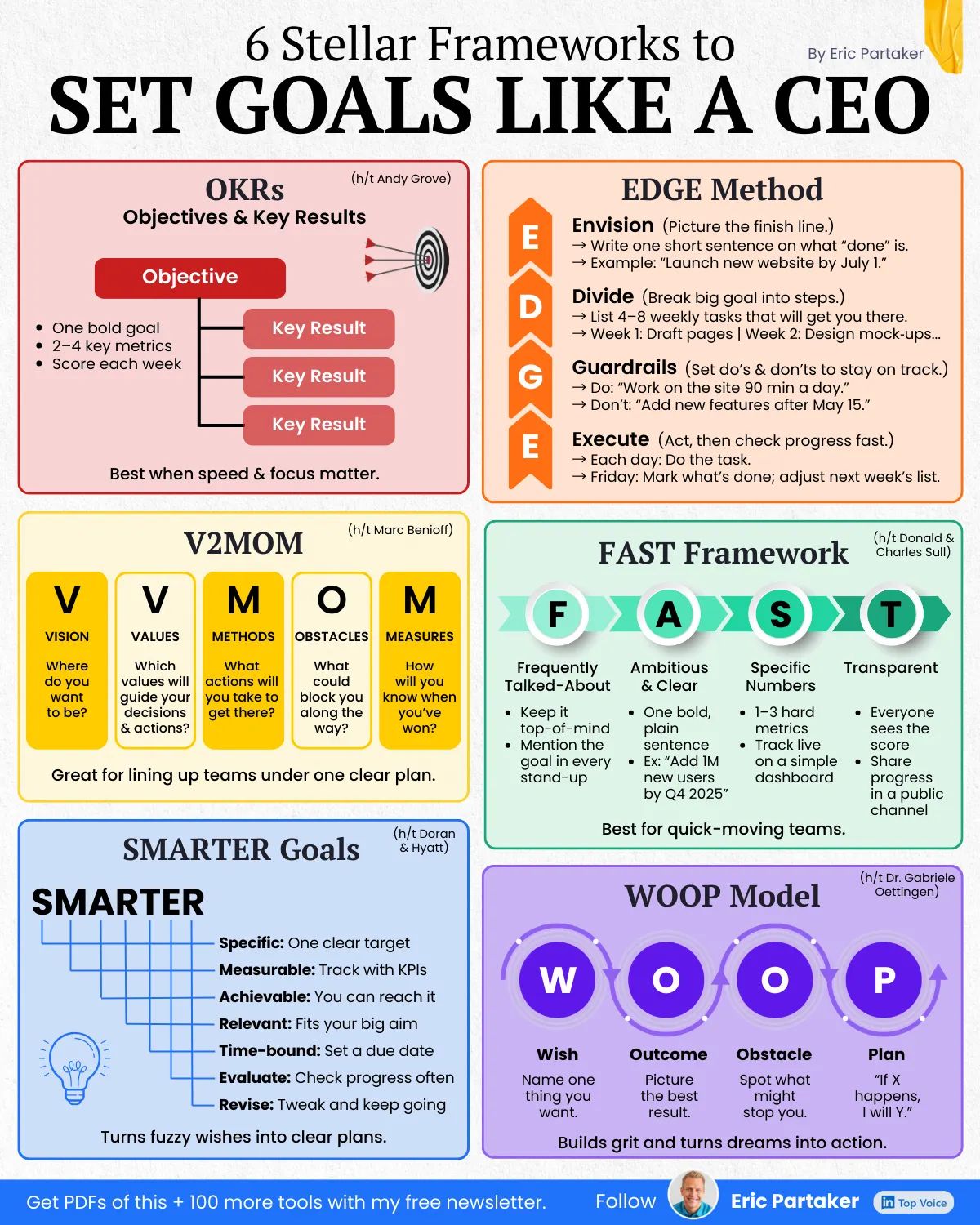
In a recent LinkedIn post, Eric Partaker discusses the common pitfalls of overcomplicated goal-setting frameworks and offers a selection of six effective, simplified methods used by high-performing leaders. Partaker emphasizes that the complexity of many systems leads to team disengagement and a focus on the wrong priorities.
Partaker argues that the key to successful goal setting lies in adopting a clear framework that is exceptionally easy to follow. He states:
“Most goal-setting frameworks are overcomplicated. That’s why teams ignore them. Leaders give up halfway through. Or worse — everyone works hard… on the wrong things.”
The post outlines six distinct frameworks, each tailored for different contexts and team dynamics. Partaker presents these as practical tools for driving action and achieving results, rather than mere theoretical exercises.
Analyzing the Six Frameworks Presented by Partaker
Eric Partaker introduces a range of goal-setting methodologies, each designed to simplify execution and enhance focus. He highlights that these systems are not just about setting goals, but about creating an environment where action becomes inevitable.
1. OKRs (Objectives & Key Results)
Partaker notes that OKRs are best suited for situations demanding speed and sharp focus. This framework involves defining one bold objective supported by 2-4 key metrics, with a regular weekly scoring cadence.
2. EDGE Method
Designed for solo founders and agile teams, the EDGE method encourages envisioning the end goal, breaking it down into weekly tasks, setting guardrails, and executing daily with a weekly review. Partaker suggests this method:
“Built for solo founders & fast-moving teams”
3. V2MOM (Vision, Values, Methods, Obstacles, Measures)
According to Partaker, V2MOM is ideal for aligning larger teams. It clarifies the team’s direction, potential roadblocks, and how success will be measured, ensuring everyone is working towards a unified plan.
4. FAST Goals
Partaker positions FAST goals as perfect for high-growth, high-accountability environments. The criteria include being Frequently talked-about, Ambitious & clear, having Specific numbers, and Transparent tracking.
5. SMARTER Goals
This adaptation of the classic SMART goals adds an ‘Evaluate & Revise’ component. Partaker explains its utility:
“Turns fuzzy wishes into real plans”
6. WOOP Model
The WOOP model (Wish, Outcome, Obstacle, Plan) is presented as a tool for building resilience and making dreams tangible. It encourages a structured approach to anticipating and overcoming challenges.
The System Over Motivation Approach
A central theme in Partaker’s post is the idea that effective leadership relies on robust systems rather than solely on motivation. He asserts:
“You don’t need more motivation. You need a system that makes action inevitable.”
Partaker encourages readers to save the post for future planning sessions, framing these frameworks as a ‘cheat code’ for emulating CEO-level thinking and execution. He also promotes a free masterclass on goal setting and accountability, along with resources for a PDF cheat sheet and an accelerator program for founders and CEOs.
📝 About This Content
This article is based on insights shared by Eric Partaker on LinkedIn.
📅 Originally posted on December 2, 2025 | View original post on LinkedIn →