
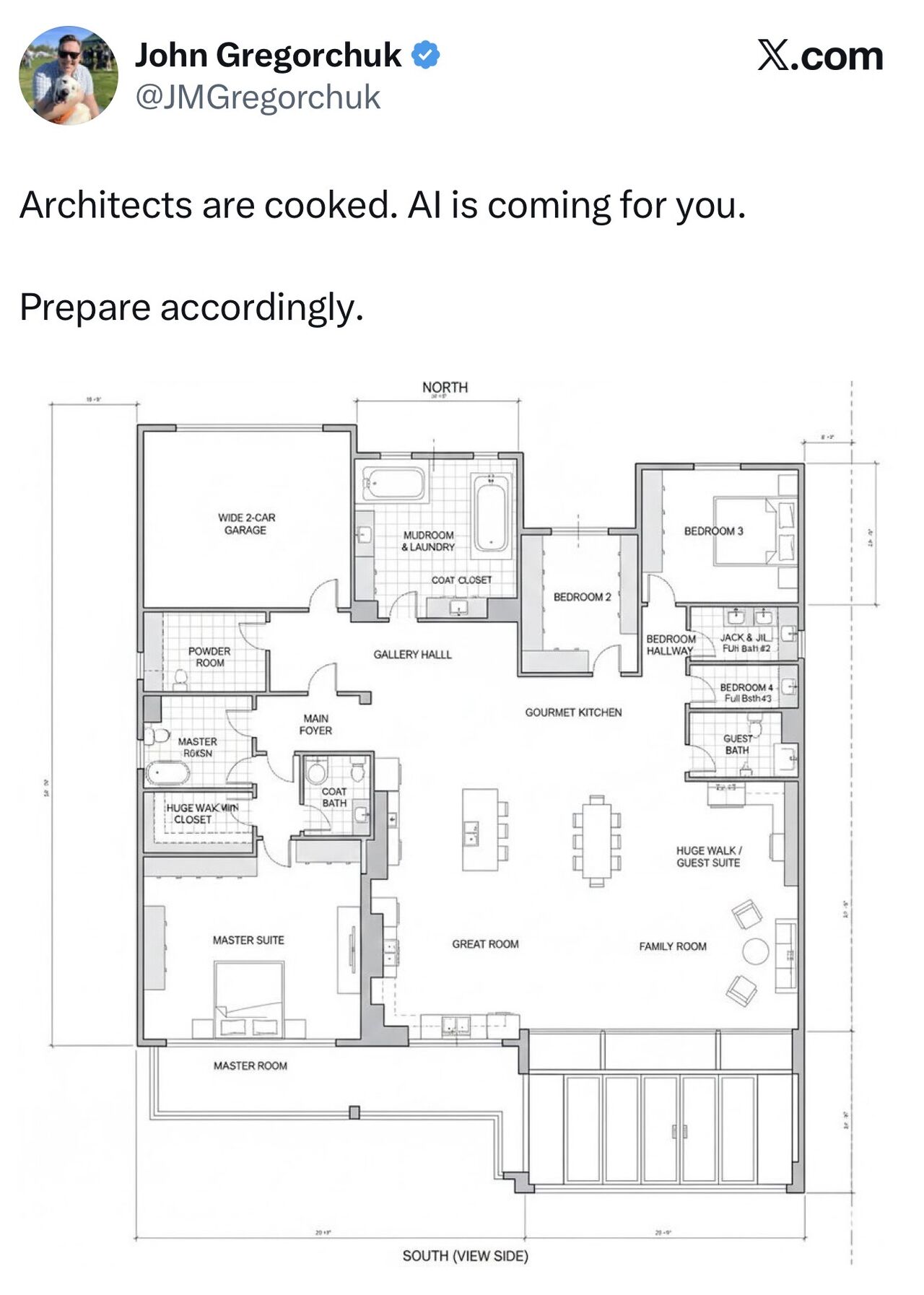
In a recent LinkedIn post, Linas Beliūnas humorously critiques the current limitations of Artificial Intelligence, particularly in creative and practical fields like architecture. Beliūnas uses a striking example of an AI-designed house to illustrate his point that while AI can generate forms, it fundamentally lacks the human understanding necessary for functional design.
AI’s Design Dilemma: Form Over Function
Beliūnas opens his post by recounting an AI’s attempt at designing a house, which resulted in a structurally bizarre and impractical dwelling. He highlights the absurdity of features like:
“Epic: AI just designed a house with 5 bathrooms and zero ways to escape 👏😂”
This initial observation sets the stage for Beliūnas’s broader argument about the gap between AI’s generative capabilities and its understanding of real-world constraints and human needs. He points out other design flaws, such as
“There’s also a walk-in closet you can’t walk into and 3 toilets closer than most VC partnerships.”
According to Beliūnas, this illustrates a common pitfall where AI can mimic the appearance of a solution without grasping its underlying purpose or practical application. “It looks like architecture until you try to live in it,” he states, emphasizing the disconnect between AI-generated aesthetics and livable reality.
Beyond Drawing Shapes: The Human Factor in Expertise
Beliūnas contends that AI’s current abilities are largely confined to the superficial aspects of design. “Yes, AI can draw shapes,” he writes, before elaborating on its fundamental shortcomings. He argues that AI still struggles with core human concepts, physics, and basic functional requirements, citing the example of bathrooms needing doors.
To underscore his point, Beliūnas draws parallels to other tech and finance scenarios where AI, despite impressive initial results, fails when confronted with real-world complexity:
- “Tech people know this energy – the copilot fixes your bug by deleting your repo.”
- “Finance people know it too – the AI model that backtests perfectly then collapses the second it touches reality.”
These analogies serve to demonstrate a pattern: AI can excel in controlled environments or with well-defined parameters but falters when faced with the nuances and unpredictability of the real world. This leads Beliūnas to firmly reject the notion that professions requiring deep human understanding and complex problem-solving are imminently at risk from AI.
Why Architects Remain Indispensable
The core of Beliūnas’s message is a reassurance to professionals in fields like architecture: AI is not poised to replace them. He asserts that the essence of architectural work extends far beyond mere visual generation.
“So no, architects aren’t cooked, and they most definitely aren’t getting replaced by AI. Not even slightly.”
Beliūnas elaborates on this by stating, “Because architecture is 1% drawing boxes and 99% everything AI can’t do.” This 99% encompasses critical thinking, understanding client needs, navigating regulations, problem-solving unforeseen issues, and integrating complex systems – all areas where human expertise and intuition are paramount. While AI might generate an image of a house, it cannot, in its current state, fulfill the role of a human architect who must ensure the structure is safe, functional, and meets the needs of its inhabitants.
In conclusion, Linas Beliūnas’s LinkedIn post serves as a timely reminder that while AI is a powerful tool with rapidly advancing capabilities, it currently lacks the nuanced understanding, contextual awareness, and practical reasoning that define true expertise. The humorous example of the ill-designed house ultimately reinforces the irreplaceable value of human professionals in fields that require more than just the ability to draw shapes.
📝 About This Content
This article is based on insights shared by Linas Beliūnas on LinkedIn.
📅 Originally posted on December 6, 2025 | View original post on LinkedIn →