
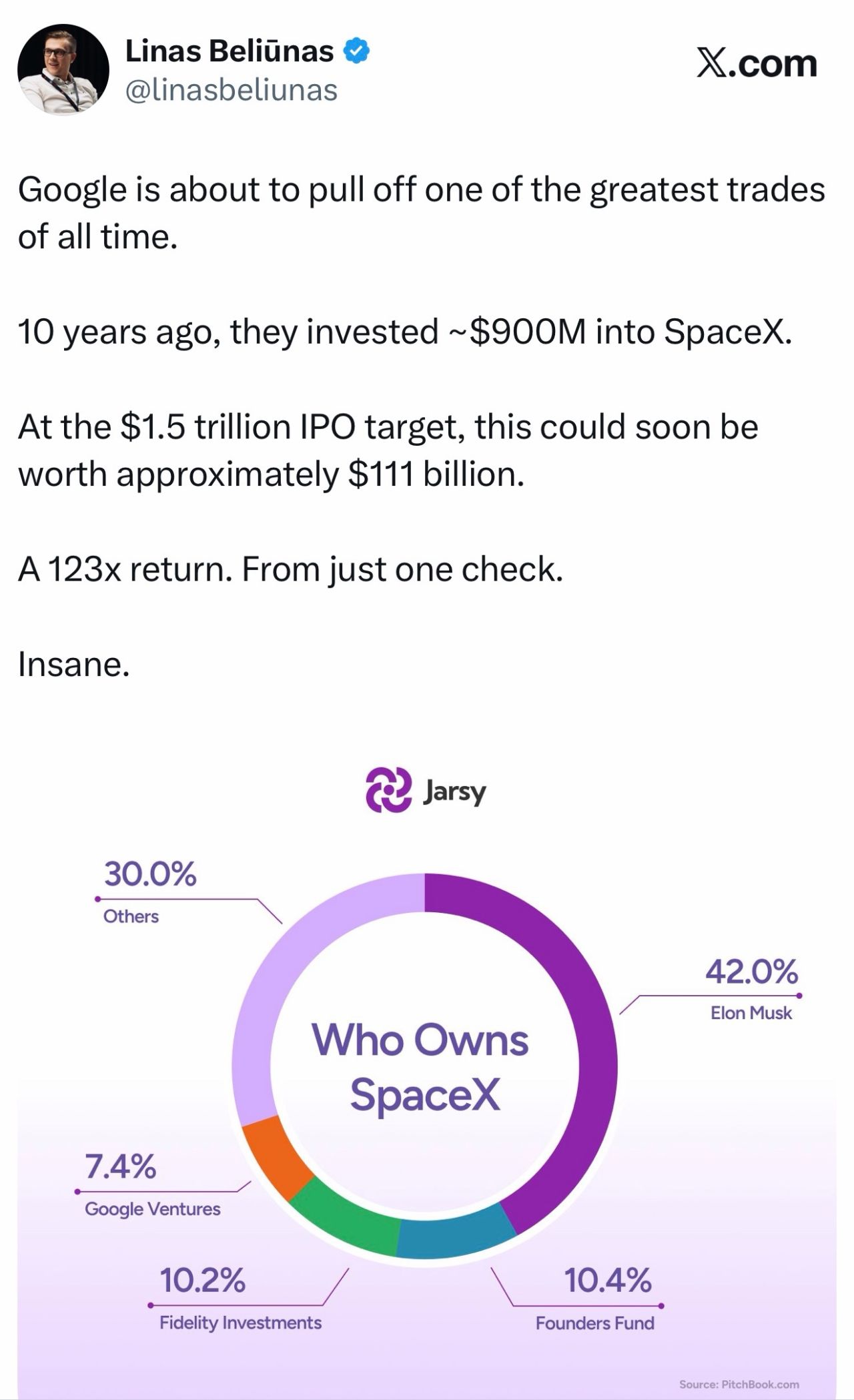
In a recent LinkedIn post, Linas Beliūnas explores what he terms Google’s “greatest investments of all time,” focusing on the tech giant’s 2015 stake in SpaceX. Beliūnas argues that this investment was far more than a financial play, positioning it as a strategic, long-term bet on the future of computing infrastructure, particularly for artificial intelligence.
Beliūnas highlights the potential financial returns, noting that Google’s approximately $900 million investment for a 7.4% stake at a $12 billion valuation could be worth around $111 billion if SpaceX achieves its rumored $1.5 trillion valuation. This represents a potential 123x return, which Beliūnas states “would make it one of the greatest venture investments ever.” However, he quickly pivots to what he believes is the more significant aspect of the investment: what Google actually acquired beyond just equity.
“Over the last decade, SpaceX quietly stopped being “just” a rocket company.”
SpaceX’s Evolution Beyond Aerospace
Linas Beliūnas details how SpaceX has transformed over the past decade, evolving from a pure rocket company into a provider of planetary-scale infrastructure. He points to several key developments:
- Starlink’s rapid growth, now boasting approximately 8 million subscribers.
- Projected revenues for Starlink reaching $11.8 billion in 2025.
- SpaceX’s dominance in orbital payload mass, holding about 90% of the global market.
- The advancement of reusable rockets, with some flying over 20 times.
- An operational capacity of over 150 launches per year.
“This isn’t aerospace anymore. It’s planetary-scale infrastructure,” Beliūnas asserts, framing SpaceX’s current operations as foundational for future technological expansion.
The AI Energy Problem and Space as a Solution
The core of Beliūnas’s analysis lies in the intersection of SpaceX’s infrastructure capabilities and the burgeoning demands of artificial intelligence. He identifies a critical bottleneck for AI development: energy. According to Beliūnas, AI models are not hindered by a lack of sophistication but by a severe energy limitation.
“AI doesn’t have a model problem. It has an energy problem. Data centers are hitting hard limits: power, cooling, land, and grid approvals.”
He elaborates on the challenges faced by current data centers, including constraints on power availability, cooling systems, land acquisition, and the lengthy process of obtaining grid approvals. Beliūnas argues that while developing better AI models is relatively straightforward, securing the immense electricity required to run them is becoming increasingly difficult on Earth.
Space as the Next Frontier for Compute
This is where Beliūnas sees SpaceX’s space-based infrastructure becoming crucial. He outlines how the space environment offers potential solutions to the energy and logistical problems plaguing terrestrial data centers.
- Constant Solar Power: Space offers uninterrupted access to solar energy.
- Easier Cooling: The vacuum of space provides a more efficient medium for cooling.
- Collapsing Launch Costs: Reusable rockets significantly reduce the cost of deploying infrastructure into orbit.
Beliūnas draws a parallel between SpaceX’s success with Starlink and the potential for deploying compute infrastructure in orbit. “Starlink already proved you can deploy and operate massive networks in orbit,” he writes, suggesting that compute is the logical next step.
“Which is why Google’s SpaceX stake was never just financial. It was a long-dated option on a future where AI infrastructure no longer fits on Earth.”
In conclusion, Linas Beliūnas posits that Google’s investment in SpaceX was a visionary move, anticipating a future where the computational demands of AI will necessitate solutions beyond Earth’s limitations. He frames this foresight as akin to playing “3D chess,” demonstrating a strategic understanding of technological evolution and infrastructure needs.
📝 About This Content
This article is based on insights shared by Linas Beliūnas on LinkedIn.
📅 Originally posted on December 13, 2025 | View original post on LinkedIn →