
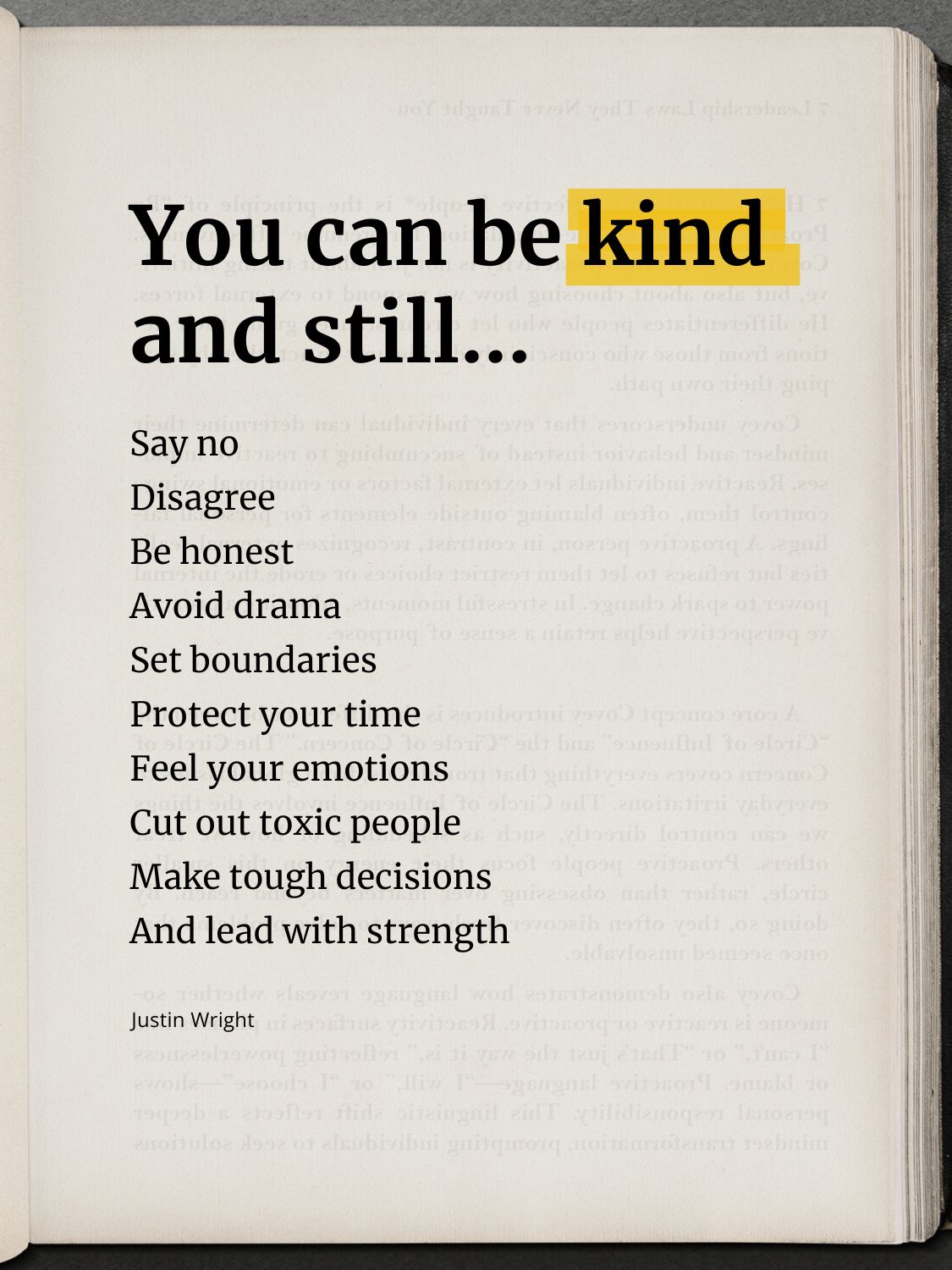
In a recent LinkedIn post, Justin Wright challenges conventional notions of kindness, arguing that true benevolence requires strength, clear boundaries, and self-respect, rather than mere people-pleasing. Wright, a prominent voice in personal development and leadership, uses his platform to articulate a more robust and authentic definition of kindness, emphasizing its power when rooted in self-awareness and intention.
The post begins by recounting a past misconception: “I used to think being kind meant saying yes to everything. Never disappointing anyone. Putting everyone else’s needs before my own.” Wright immediately counters this by stating, “I was wrong.” He asserts that this understanding of kindness is a misinterpretation, leading to depletion rather than genuine positive impact.
Kindness as Backbone, Not Weakness
Wright pivots to redefine kindness not as a passive virtue, but as an active, courageous stance. He argues that genuine kindness necessitates the willingness to engage in difficult conversations and to protect one’s own energy reserves. This self-preservation, he explains, is crucial for being able to show up fully for what truly matters, both for oneself and for others.
According to Wright, this reframed understanding allows individuals to embrace a more powerful form of kindness that coexists with personal strength and assertiveness. He highlights that this approach enables individuals to:
- Set firm boundaries
- Disagree constructively, even with superiors
- Prioritize mental health and well-being
- Exit unhealthy relationships
- Make decisions that may not be universally understood
Wright encapsulates this idea with a strong statement:
“Real kindness requires backbone.”
This notion suggests that empathy and compassion are most effective when paired with conviction and the courage to uphold one’s own needs and values.
The Power of Saying ‘No’
A significant theme in Wright’s post is the strategic use of the word ‘no.’ He posits that saying no to good opportunities or requests is not an act of unkindness, but a necessary step to reserve capacity for truly great things. This selective prioritization is framed as an essential component of authentic self-care and effective living.
Wright elaborates on the personal benefits of this mindset shift, encouraging readers to:
- Stop apologizing for protecting their peace.
- Cease feeling guilty for prioritizing their own growth.
- Refrain from shrinking themselves to make others comfortable.
He powerfully states,
“The kindest thing you can do for yourself? Stop apologizing for protecting your peace.”
This sentiment underscores his core message that self-advocacy is not selfish but a prerequisite for sustainable, impactful kindness.
Authenticity and Impact
The core of Wright’s argument culminates in the idea that acting from a place of strength and intention, rather than obligation or depletion, amplifies the positive effects of one’s kindness. He suggests that true impact comes from authenticity and respect, not from a desire to be universally liked.
Wright concludes by asserting that the world needs individuals who are authentically themselves, complete with their boundaries and whole selves, rather than those who constantly seek external validation through people-pleasing. He advocates for a form of kindness that is both strong and unapologetic.
As Wright puts it:
“When you act from a place of strength, not depletion. When you lead with intention, not obligation. When you choose respect over being liked. That’s when your kindness becomes powerful.”
His message resonates as a call for leaders and individuals to cultivate a robust, authentic kindness that benefits both themselves and their communities, ultimately fostering healthier relationships and more impactful contributions.
📝 About This Content
This article is based on insights shared by Justin Wright on LinkedIn.
📅 Originally posted on December 18, 2025 | View original post on LinkedIn →