
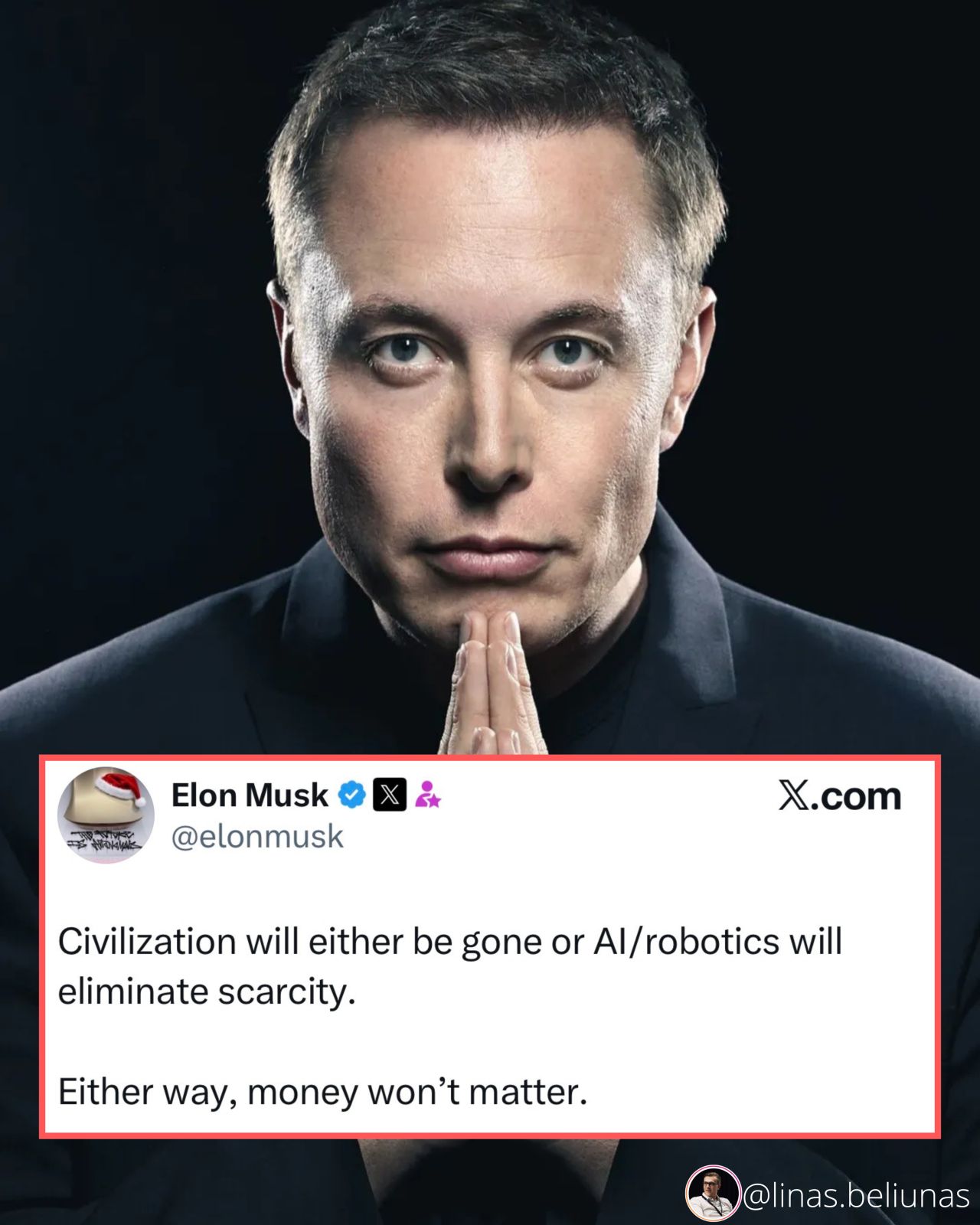
In a recent LinkedIn post, Linas Beliūnas explores a provocative idea recently touched upon by Elon Musk: the potential obsolescence of traditional money within the next 18 years. Beliūnas frames this not as a concern about inflation or poor investment, but as a fundamental shift driven by the rapid advancement of artificial intelligence. He highlights Musk’s reaction to the concept of small investment accounts for newborns, which sparked a discussion about whether money itself will remain relevant.
Beliūnas outlines two extreme scenarios presented by Musk:
1️⃣ Collapse
Supply chains break.
Institutions fail.
Savings don’t matter.
The alternative, as detailed by Beliūnas, is a future of unprecedented technological advancement:
2️⃣ Extreme AI abundance
Machines do the work.
Goods get absurdly cheap.
Scarcity economics breaks.
Money fades.
The Accelerating Impact of AI
Beliūnas emphasizes that these are not gradual changes but stark, diverging paths, rejecting any notion of a simple continuation of current trends. He posits that the speed of AI development is the critical factor, explaining the causal chain:
“AI scales intelligence. → Intelligence scales production. → Production breaks old economic rules.”
This rapid scaling, according to Beliūnas, fundamentally challenges existing economic paradigms. The core of the issue, as he sees it, shifts from individual wealth accumulation to a more critical question of control and distribution.
Distribution: The Crucial Determinant
While acknowledging the immense potential of AI to generate wealth rapidly, Linas Beliūnas argues that the ultimate outcome hinges on who governs the systems creating that wealth. He states:
“Sure, AI can create wealth super fast, but distribution decides everything.”
This perspective suggests that the societal implications of AI-driven abundance are less about the technology itself and more about the human systems and decisions that will manage its output. The focus, therefore, moves from the creation of value to the equitable or inequitable distribution of that value.
Rethinking the Value of Money
Beliūnas concludes by offering his personal takeaway from this discussion. While he doesn’t anticipate money disappearing entirely in the immediate future, he suggests its significance may diminish considerably. He proposes that other factors could become far more important:
“My takeaway is this: Money probably won’t disappear anytime soon. But it may matter less than access, compute, and power.”
This insight challenges conventional thinking about economic security and future prosperity, urging a consideration of what truly constitutes value in an era of potentially limitless automated production and intelligence. Beliūnas’s analysis on LinkedIn serves as a timely prompt to consider the profound, and perhaps disruptive, transformations that advanced AI could usher in.
📝 About This Content
This article is based on insights shared by Linas Beliūnas on LinkedIn.
📅 Originally posted on December 23, 2025 | View original post on LinkedIn →