
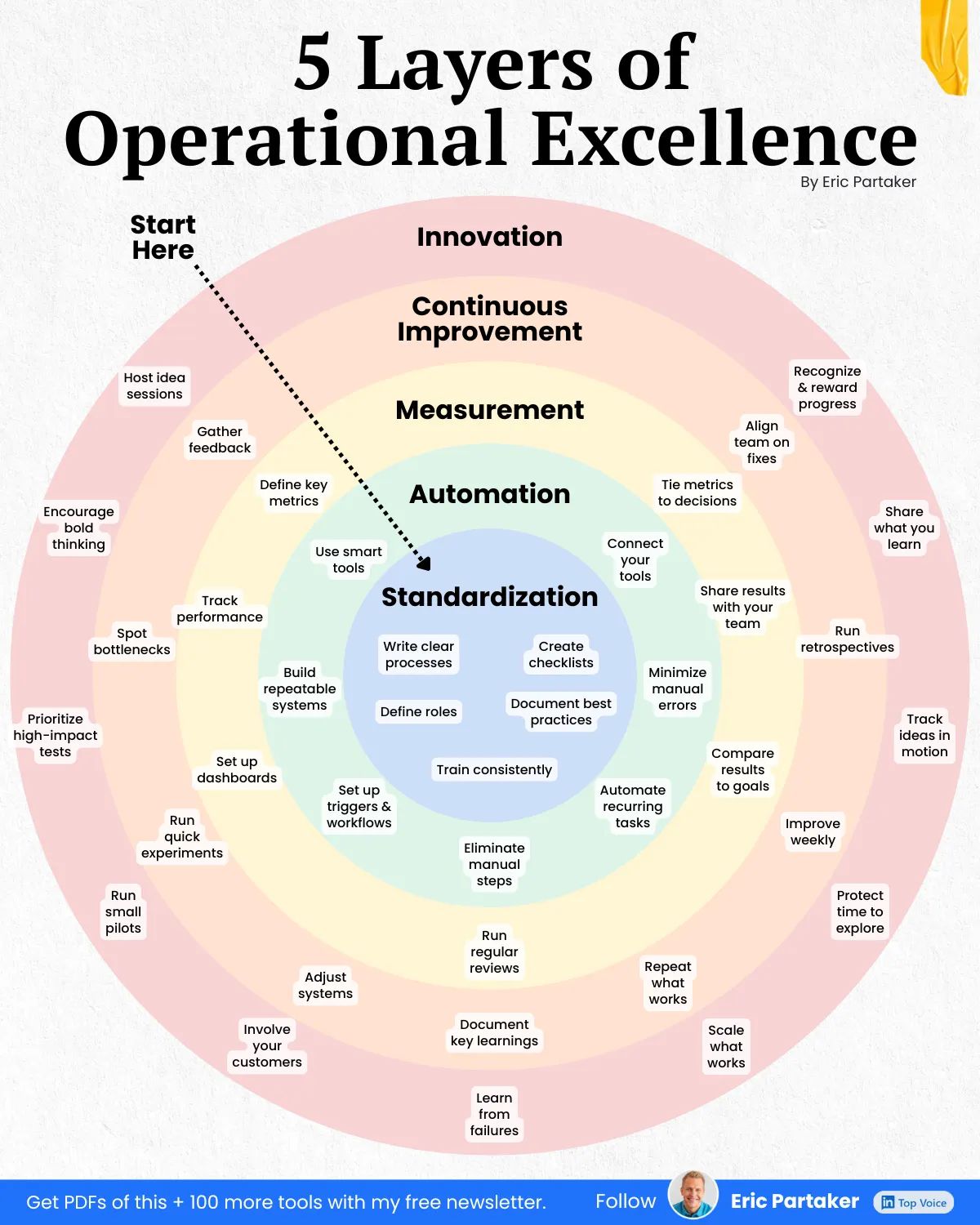
In a recent LinkedIn post, Eric Partaker identifies a common yet often overlooked reason why businesses fail to scale: their operations cannot keep pace with growth. Partaker, a seasoned business leader, argues that despite strong vision, capable teams, and favorable market conditions, many companies hit a ceiling due to underdeveloped operational structures.
He highlights a prevalent issue where the CEO remains overly involved in decision-making, processes are tribal knowledge, and execution lacks consistency. This environment, Partaker explains, leads to a state of constant firefighting rather than focused progress.
“The CEO is still making too many decisions. Processes live in people’s heads. Everyone’s working hard, but execution is inconsistent.”
The Root Cause: Stalled Operations
Eric Partaker contends that the perceived need for more effort or ‘hustle’ is often a misdiagnosis when growth stalls. Instead, he advocates for ‘operational discipline’ as the critical solution. Partaker emphasizes that achieving operational excellence is not a single grand gesture but a sequential, layered process that must be built methodically.
The Layers of Operational Excellence
According to Partaker, this layered approach begins with fundamental steps:
1. Standardization
The initial phase involves establishing a single, clear method for performing tasks. Partaker stresses the importance of moving away from fragmented approaches where ‘everyone has their own method.’
2. Automation
Once processes are standardized, the next step is to automate repetitive tasks. Partaker suggests this frees up valuable time for employees to engage in more strategic and impactful work.
“Eliminate repetitive tasks. Free up time for deeper work.”
3. Measurement
With standardization and automation in place, Partaker advises focusing on measurement. This involves tracking key metrics and making data visible to guide decision-making, ensuring that actions are informed by performance rather than intuition alone.
4. Continuous Improvement
The fourth layer involves fostering a culture of ongoing enhancement. Partaker advocates for implementing small, weekly fixes and engaging in rapid iterations to promote constant learning and adaptation.
“Small weekly fixes. Fast iterations. Constant learning.”
Innovation as the Final Layer
Partaker posits that only after these foundational layers are firmly established can a company effectively pursue true innovation. He distinguishes genuine innovation from ‘chaos disguised as creativity,’ asserting that the preceding operational discipline allows for bold ideas that can be reliably scaled and contribute meaningfully to business advancement.
He concludes by reiterating that this structured approach is not theoretical but a practical pattern observed in successfully scaling companies, from startups to those generating eight figures in revenue. Partaker’s advice is to build these operational layers in the correct sequence, akin to ‘tighten[ing] the engine before you step on the gas,’ to ensure sustainable growth.
📝 About This Content
This article is based on insights shared by Eric Partaker on LinkedIn.
📅 Originally posted on December 28, 2025 | View original post on LinkedIn →