
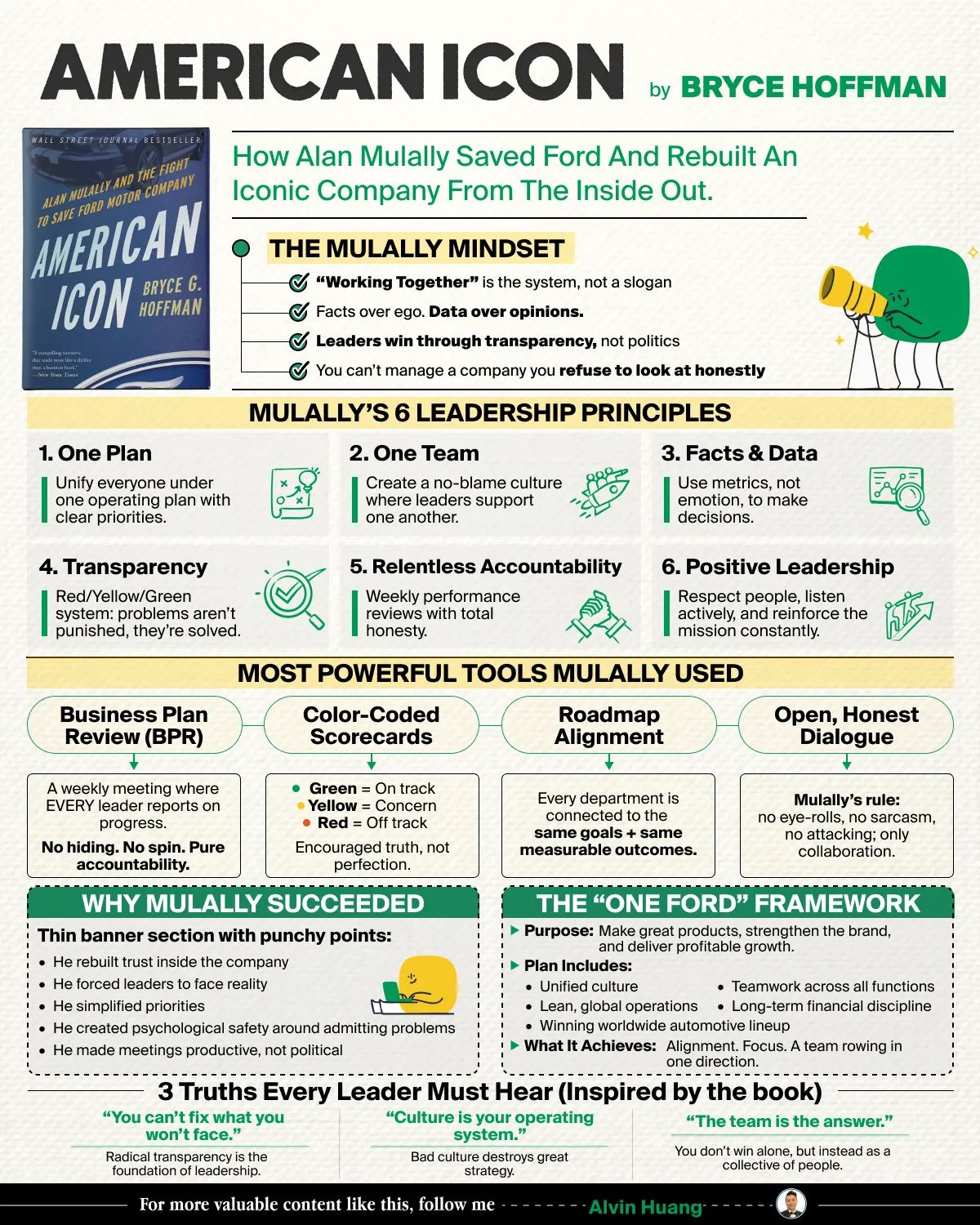
In a recent LinkedIn post, Alvin Huang highlights the transformative leadership principles employed by Alan Mulally during his tenure at Ford, suggesting the lessons extend far beyond the automotive giant. Huang frames the book ‘American Icon’ by Bryce Hoffman, which chronicles Mulally’s work, as essential reading for leaders seeking to rebuild trust and fix systemic issues within their organizations.
The Core of Mulally’s ‘Operating System’
Huang emphasizes that Mulally’s success at Ford was not merely a result of charisma or cost-cutting measures. Instead, as Huang points out, the true engine of change was a meticulously rebuilt company culture. This involved establishing new rhythms, expectations, and mindsets, coupled with a degree of transparency that is often avoided in corporate environments.
“He rebuilt the culture from the inside out: New rhythms, expectations, ways of thinking, And a level of transparency most leaders avoid.”
According to Huang, Mulally implemented a structured approach, which he refers to as an ‘operating system,’ to drive this cultural transformation. This system was built upon a set of core leadership principles designed to foster alignment, collaboration, and data-driven decision-making.
Mulally’s Six Leadership Principles
Alvin Huang breaks down Mulally’s foundational principles, as detailed in Hoffman’s book, into six key tenets. These principles, Huang suggests, form the backbone of effective leadership and organizational alignment:
- One Plan: Establishing a singular operating plan that ensures universal alignment across the organization.
- One Team: Cultivating a blame-free environment where leaders actively support one another.
- Facts & Data: Grounding all decisions in measurable metrics rather than emotional responses.
- Transparency: Creating a culture where problems are surfaced and addressed, rather than punished.
- Relentless Accountability: Implementing weekly reviews that demand full honesty and progress reporting.
- Positive Leadership: Demonstrating respect for individuals, active listening, and consistent reinforcement of the company’s mission.
Tools for Implementing Cultural Change
Huang further details the practical tools Mulally utilized to embed these principles into Ford’s daily operations. These instruments were crucial for maintaining momentum and ensuring that the cultural shift was not just aspirational but actionable.
“Mulally didn’t rescue Ford with charisma or one-off cost cuts.”
Key among these tools, as highlighted by Huang, are:
- Business Plan Review (BPR): Weekly sessions where leaders publicly report their progress, fostering accountability.
- Color-Coded Scorecards: A visual system using green (on track), yellow (concern), and red (off track) to quickly assess project and departmental status.
- Roadmap Alignment: Ensuring that every department’s objectives are directly connected to the overarching company outcomes.
- Open Dialogue Rules: Establishing clear guidelines for communication, prohibiting sarcasm, personal attacks, or political maneuvering to encourage honest discussion.
In his analysis, Alvin Huang posits that the strategies employed by Mulally offer a universal blueprint. “This isn’t just a Ford story,” Huang writes, “It’s a blueprint for any leader trying to align a team, rebuild trust, Or fix a system that’s breaking under its own weight.” The insights shared by Huang suggest that the principles of transparent communication, data-driven decisions, and unified planning are critical for success in any leadership context.
📝 About This Content
This article is based on insights shared by Alvin Huang on LinkedIn.
📅 Originally posted on January 4, 2026 | View original post on LinkedIn →