
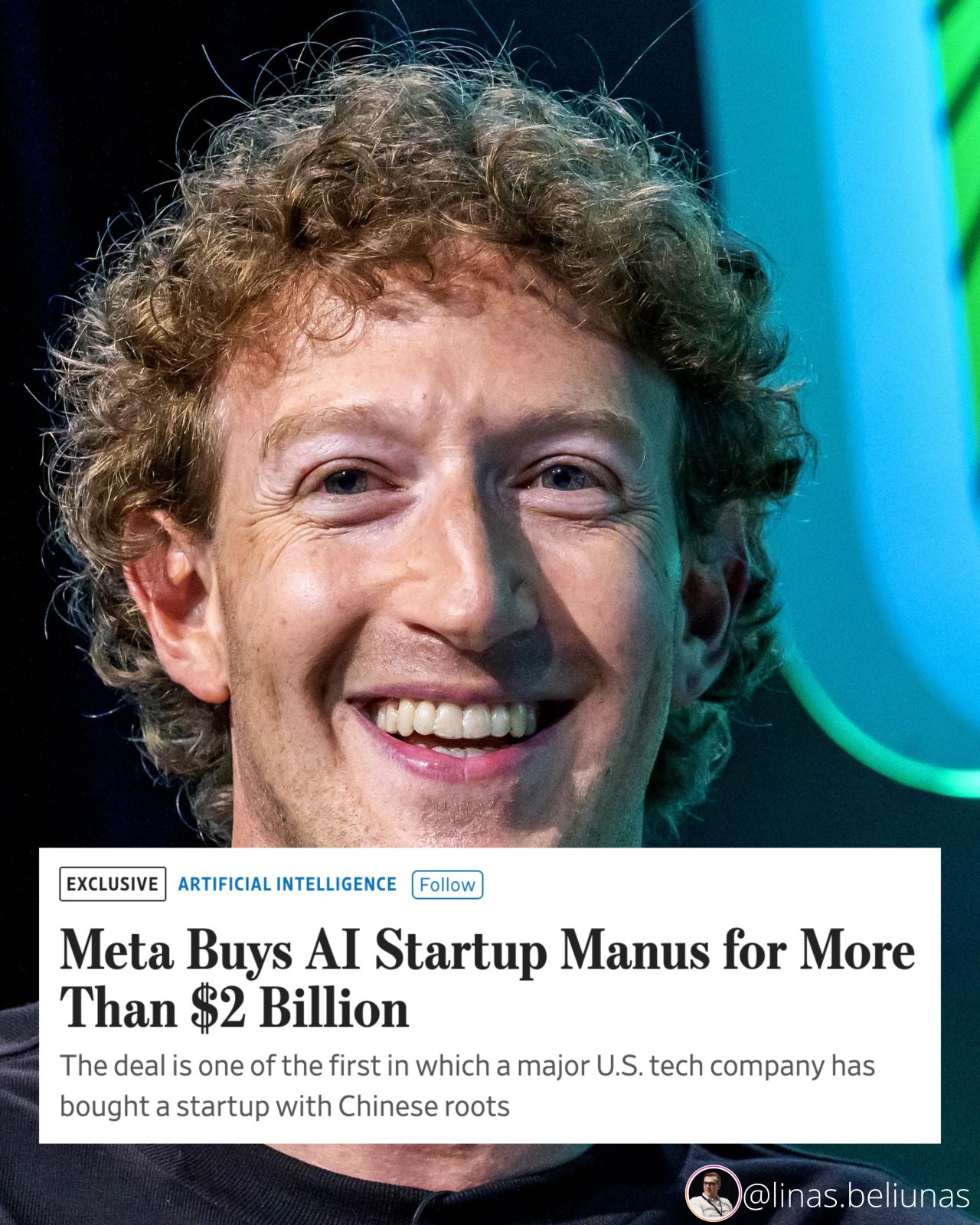
In a recent LinkedIn post, Linas Beliūnas explores the significant implications of Meta Platforms’ acquisition of autonomous agents startup Manus AI for over $2 billion, positioning it as a pivotal moment signaling a fundamental shift in the trajectory of artificial intelligence.
Beliūnas highlights the strategic importance of this acquisition, which is Meta’s third-largest M&A to date, suggesting it underscores a move beyond conversational AI towards agents capable of executing complex tasks. He notes that Manus AI developed technology that can perform work, not merely engage in dialogue. This capability is rooted in an AI operating within a sandboxed virtual computer, equipped with memory, tools, internet access, and the ability to write and execute code.
“You give it a task → It completes it end to end. That capability changes the category.”
From Assistance to Action: The Core of the Manus AI Acquisition
Beliūnas emphasizes that Manus AI distinguished itself by its capacity to handle real-world workflows, a key factor in its rapid ascent. These workflows included tasks such as market research, portfolio analysis, job candidate screening, trip planning, full application builds, and business process automation. These are tasks that traditionally demand significant human coordination and time.
A particularly striking aspect for Beliūnas was Manus AI’s commercial traction. The company reportedly achieved over $100 million in Annual Recurring Revenue (ARR) in less than eight months, driven by a simple subscription model. This success, characterized by millions of users, heavy usage, and a genuine willingness to pay, stands out in an environment where many AI products prioritize growth over immediate revenue. As Beliūnas points out:
“At a time when most AI products prioritize growth over revenue, Manus proved autonomous agents can sustain a business.”
Meta’s Strategic Play: Integrating Execution into its Ecosystem
According to Beliūnas, Meta’s acquisition is a deliberate move to integrate this execution-grade AI capability into its vast ecosystem. The company has already made substantial investments in AI infrastructure and open-source models like Llama. The Manus AI acquisition provides the crucial layer needed to translate intelligence into tangible actions across Meta’s platforms.
Beliūnas outlines several potential applications:
- Agents that can manage marketing campaigns and business operations.
- Agents that coordinate scheduling and communication within WhatsApp.
- Agents that execute shopping and other workflows on Instagram.
- AI systems functioning as persistent operators rather than reactive assistants.
This integration, Beliūnas argues, represents a significant pathway from what is currently conceived as an “AI feature” to a true “AI worker.” He draws a parallel with Instagram’s impact:
“Instagram changed how people behaved on mobile, then scaled globally through Meta’s distribution. Manus has similar characteristics: viral adoption, practical utility, and early monetization but limited reach as a standalone product.”
Meta’s extensive user base of 3 billion effectively removes Manus AI’s previous reach limitations.
A Global Shift in AI Development
Beyond the immediate strategic benefits for Meta, Beliūnas also touches upon a broader global trend. He notes that Manus AI’s origins in China, its relocation to Singapore, and its superior performance on real-world agent benchmarks compared to many Western systems, indicate that the most capable AI development teams are no longer geographically concentrated.
The acquisition of Manus AI, in Beliūnas’s view, directly brings advanced execution-grade agent technology into a major Western tech platform, potentially reshaping the competitive landscape.
The Future of AI: From Answering to Doing
Linas Beliūnas concludes that this acquisition signifies a critical shift in the AI landscape. He posits that AI is moving from a role of assistance to one of execution, and from answering questions to completing work. If Meta successfully integrates this technology, autonomous agents may become an invisible, yet integral, part of how work and coordination happen at scale.
“This acquisition marks a shift,” Beliūnas states. “AI is moving from assistance to execution. From answering questions to completing work.”
He suggests that this quiet integration is precisely how major platform shifts typically begin.
📝 About This Content
This article is based on insights shared by Linas Beliūnas on LinkedIn.
📅 Originally posted on December 30, 2025 | View original post on LinkedIn →