
In a recent LinkedIn post, Ben Eubanks, an author and researcher with over a decade of experience studying AI’s effects on the workforce, offers crucial advice to recent graduates and early-career professionals on how to harness artificial intelligence without hindering their long-term development.
Eubanks frames the discussion around the transformative nature of work in recent years and the potential pitfalls of over-reliance on AI tools. He emphasizes that while AI is alluring and increasingly integrated into daily tasks, the initial struggle with foundational work is essential for building competence and a deep understanding of one’s profession.
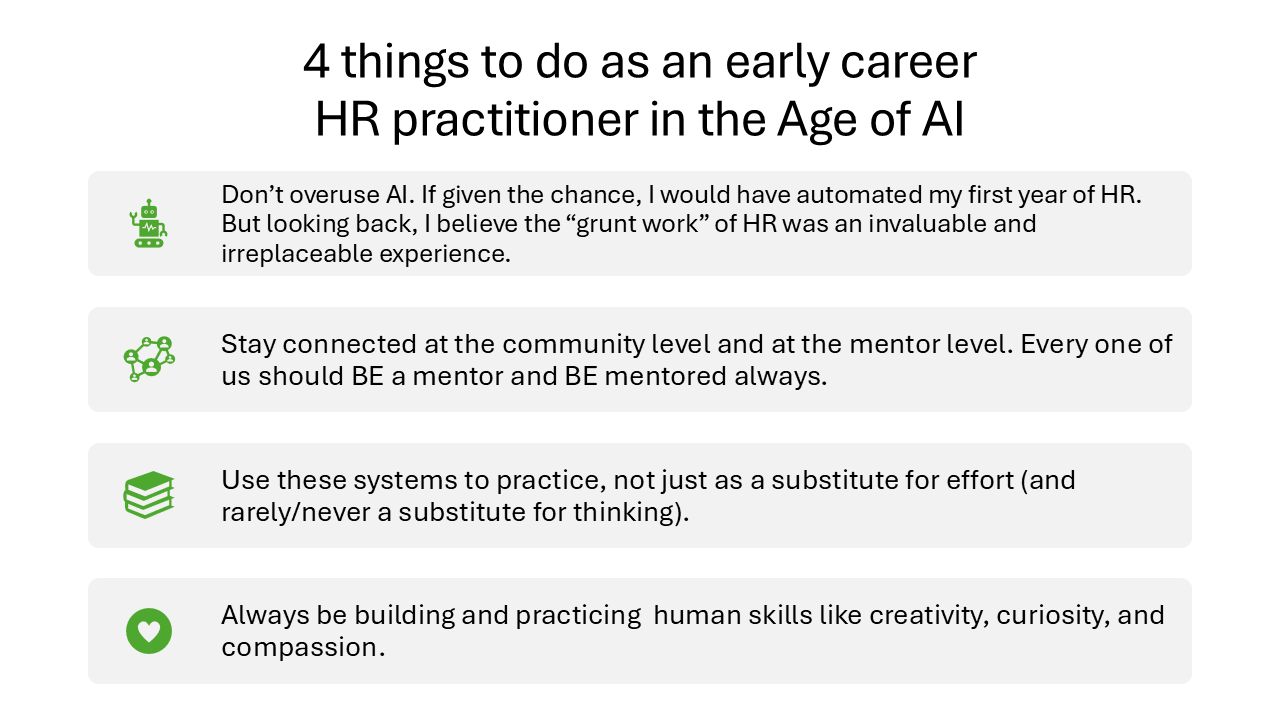
“I believe that the difficulty of doing the ‘grunt work’ of HR is how you build competence, a foundation of knowledge, and the ability to connect the dots. If I had AI as a young professional, I would have used it to skip over most of that work.”
The Importance of Embracing Discomfort in Skill Development
Eubanks argues that intentionally avoiding the challenging aspects of early career work, often facilitated by AI shortcuts, can stunt professional growth. He posits that the discomfort and difficulty inherent in mastering foundational tasks are where true character and capability are forged. As he puts it,
“Don’t take out all the discomfort or difficulty. It’s in those moments you really see what you are made of.”
This perspective suggests that while AI can offer efficiency, it should not replace the process of learning through struggle, which is vital for developing resilience and a robust skill set.
Cultivating Human Connections and Mentorship
Beyond the direct use of AI, Eubanks highlights the enduring importance of human relationships in professional life. He likens relationships to an ’emergency fund for life,’ underscoring their value in navigating career challenges.
The Role of Mentorship
Eubanks specifically advises new professionals to seek out mentors, ideally through in-person connections. He also advocates for a reciprocal mentorship dynamic, encouraging those who have gained some expertise to guide those who are a few steps behind them. This continuous cycle of learning and teaching, according to Eubanks, strengthens both the individual and the profession.
Strategic Use of AI for Practice, Not Replacement
A significant portion of Eubanks’s advice focuses on the *how* of AI integration. He strongly cautions against using AI tools merely to complete tasks or perform thinking on behalf of the user.
“Use AI tools to practice. To rehearse. To explore. Don’t just use them to do tasks for you. Don’t just use them to do your thinking for you, for heaven’s sake. It’s no different than going to the gym to work out and letting someone else step on the treadmill for you or lift the weights for you. You get zero benefit.”
Eubanks draws an analogy to physical training, stating that outsourcing the effort to AI yields no personal benefit, much like having someone else exercise for you at the gym. He believes that demonstrating the ability to perform tasks with minimal AI intervention is key to maintaining relevance.
Honing Irreplaceable Human Skills
While acknowledging AI’s superior capabilities in data analysis and pattern recognition, Eubanks stresses that AI cannot replicate core human attributes such as empathy, concern, curiosity, and genuine creativity. He argues that these are the skills that professionals must continuously develop and hone.
“AI can approximate some of them, but it can’t replicate them,” Eubanks notes. He concludes that focusing on building these uniquely human skills, rather than relying on AI to do the heavy lifting, offers a more promising path to long-term career success.
📝 About This Content
This article is based on insights shared by Ben Eubanks on LinkedIn.
📅 Originally posted on January 9, 2026 | View original post on LinkedIn →