
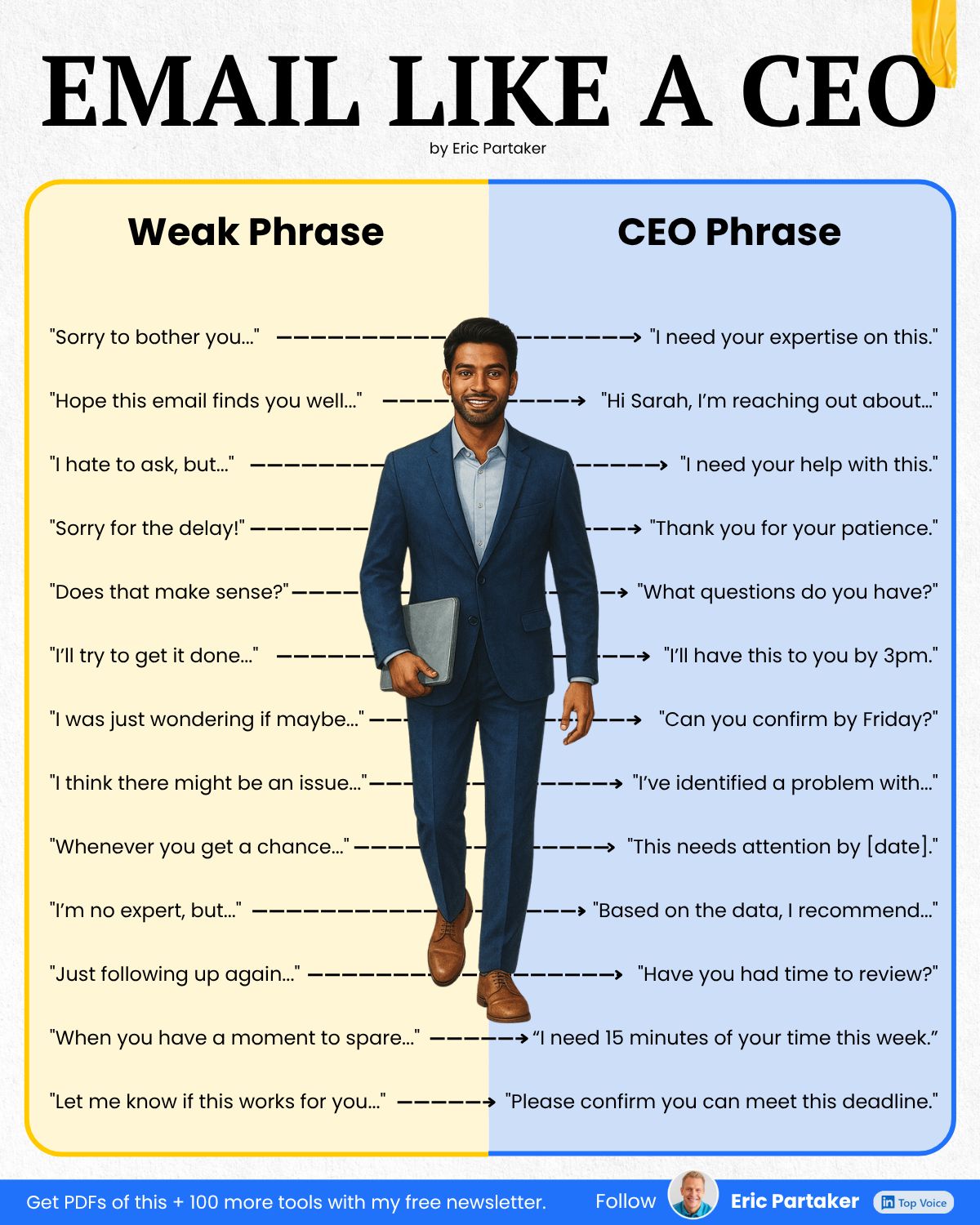
In a recent LinkedIn post, Eric Partaker explores a common yet often overlooked leadership pitfall: the way leaders communicate in their daily emails. Partaker, who has coached over 300 CEOs, argues that many leaders unintentionally undermine their authority and slow down their organizations through weak, permission-seeking language in their written communications.
According to Partaker, this isn’t merely a stylistic issue; it’s a fundamental leadership problem. He states:
“When a CEO’s language lacks clarity, the whole business slows down. Decisions stall. Priorities blur. Everything funnels back to the founder.”
This lack of clear, decisive communication, Partaker explains, creates bottlenecks and hinders efficient business operations. He draws a direct line between a leader’s communication style and the company’s ability to scale effectively.
The Cost of Uncertainty in Leadership Communication
Partaker highlights specific phrases that signal uncertainty and a lack of conviction. These phrases, he argues, inadvertently tell recipients that the message or request isn’t important. He lists several examples of such language:
- “Let me know if this works for you…”
- “I think there might be an issue…”
- “Whenever you get a chance…”
- “Sorry to bother you…”
These expressions, while perhaps intended to be polite or non-confrontational, ultimately dilute a leader’s message and authority. As Eric Partaker notes, they “scream uncertainty” and signal that the sender’s message isn’t worth the recipient’s immediate attention.
Leading with Clarity: The Alternative Approach
In contrast, Partaker presents a set of communication examples that demonstrate confidence and clear expectations. These phrases are designed to convey directness and purpose, fostering a more efficient and decisive environment. He provides examples such as:
“I need your help with this.”
Other examples shared by Partaker include:
- “I’ll have this to you by 3pm.”
- “Can you confirm by Friday?”
- “This needs attention by [date].”
The core difference, as Partaker emphasizes, lies in establishing clear expectations, using direct language, and avoiding unnecessary apologies. This approach, he clarifies, isn’t about being harsh but about being clear and effective.
The Impact on Business Operations
Partaker argues that when leaders communicate with conviction, the effects are tangible. People tend to respond faster, decisions are made more quickly, and ideas carry more weight. Conversely, watering down language leads to messages being deprioritized and decisions being delayed.
“Your communication style is your leadership brand. Every weak phrase dilutes it.”
He concludes by urging leaders to adopt a communication style that reflects their leadership stature, suggesting that a shift towards clarity can rapidly improve organizational dynamics. Partaker’s insights underscore the critical role of effective communication in leadership and organizational success.
📝 About This Content
This article is based on insights shared by Eric Partaker on LinkedIn.
📅 Originally posted on January 19, 2026 | View original post on LinkedIn →