
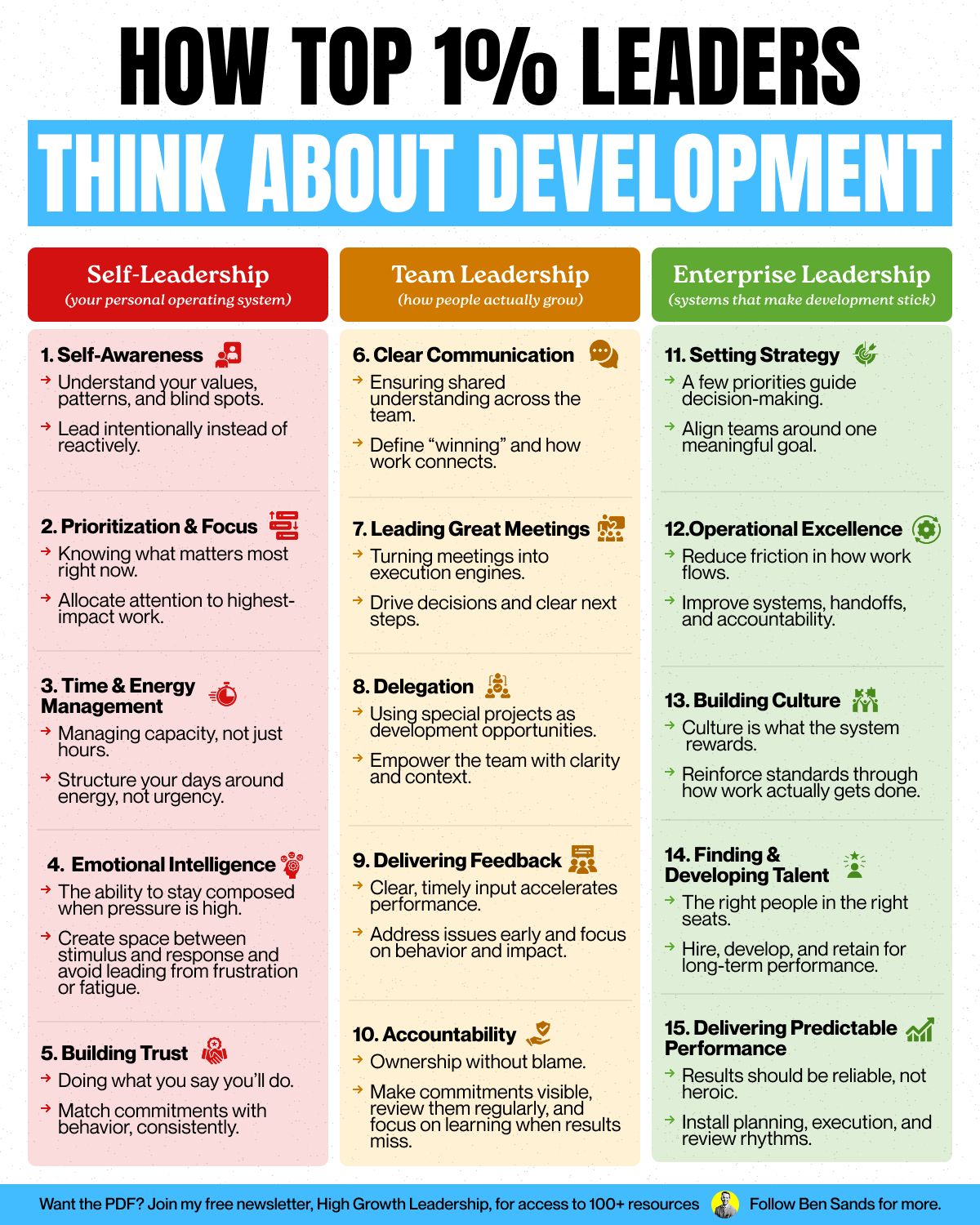
In a recent LinkedIn post, Ben Sands explores a comprehensive framework for developing leaders capable of driving scalable business growth. Sands distinguishes between companies that invest solely in the business and those that invest in the people running it, asserting that the most successful organizations excel at both. He introduces a three-domain model for leader development: Self, Team, and Enterprise, positing that neglecting any one area can impede progress.
“Most companies invest in the business. High-growth ones invest in the people running it. The best organizations do both.”
The Three Domains of Leadership Development
According to Ben Sands, effective leadership development must encompass three critical domains. He argues that true scalability and sustained performance, free from reliance on individual “heroics,” emerge when leaders are strong across all three.
Self-Leadership: The Foundation
Sands emphasizes that foundational leadership begins with mastering oneself. This domain focuses on how individuals manage their own capacities and reactions. Key skills highlighted include:
- Self-Awareness: Understanding personal values, patterns, and blind spots to move from reactive to intentional leadership.
- Prioritization & Focus: Identifying and allocating attention to the most impactful work.
- Time & Energy Management: Recognizing that managing capacity and energy levels is more crucial than simply managing hours.
- Emotional Intelligence: Maintaining composure under pressure and creating space for thoughtful responses.
- Building Trust: Ensuring actions align with commitments.
Team Leadership: Scaling Through Others
The second domain, Team Leadership, focuses on a leader’s ability to multiply their impact through their team. Sands points out that effective team leadership enables the organization to scale beyond the capacity of any single individual.
“If one area is lacking, progress slows. When all three are strong, performance scales without heroics.”
Essential skills in this area include:
- Clear Communication: Fostering shared understanding and aligning the team around goals.
- Leading Great Meetings: Transforming meetings into productive sessions that drive decisions.
- Delegation: Empowering team members by assigning projects with clarity and context.
- Delivering Feedback: Providing timely and constructive input to accelerate performance.
- Accountability: Establishing ownership and learning from outcomes without resorting to blame.
Enterprise Leadership: Building Sustainable Systems
The highest level of leadership, according to Sands, is Enterprise Leadership, which involves building systems that consistently produce results. This domain is crucial for creating an organization that can thrive without constant intervention from top performers.
“Culture is what the system rewards. Reinforce standards in how work gets done.”
Key components of enterprise leadership are:
- Setting Strategy: Defining clear priorities that guide decision-making.
- Operational Excellence: Streamlining processes and improving workflows.
- Building Culture: Intentionally shaping the environment by reinforcing desired behaviors and standards.
- Finding & Developing Talent: Ensuring the right people are in the right roles for long-term success.
- Delivering Predictable Performance: Implementing rhythms for planning, execution, and review to ensure consistent results.
Sands concludes that by focusing on these skills across the three domains, leadership development becomes a practical, results-oriented process rather than a theoretical exercise. He also mentions a coaching program and a live session designed to help leaders implement these principles.
📝 About This Content
This article is based on insights shared by Ben Sands on LinkedIn.
📅 Originally posted on January 25, 2026 | View original post on LinkedIn →