
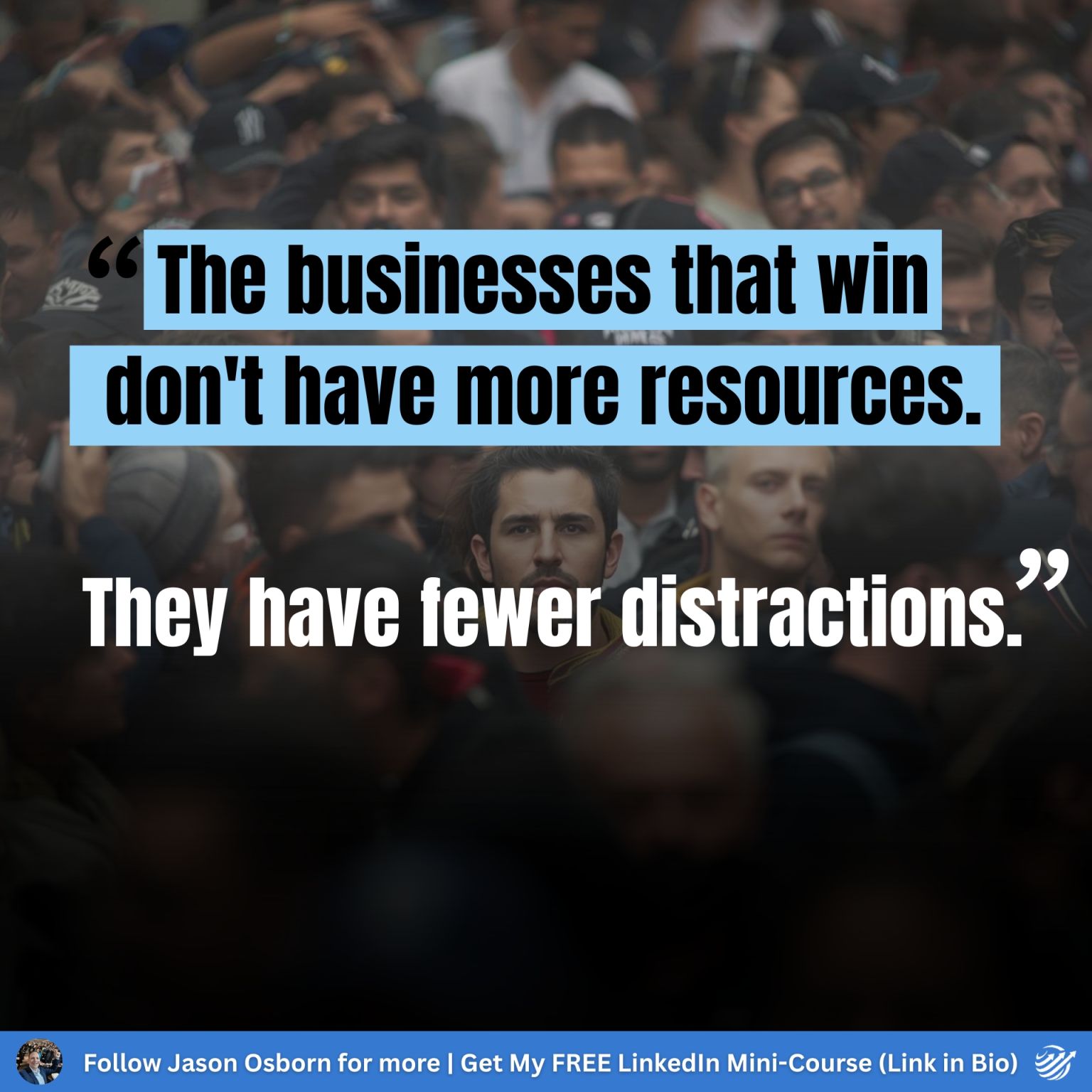
In a recent LinkedIn post, Jason Osborn argues that the key differentiator for winning businesses isn’t an abundance of resources, but rather a scarcity of distractions. Osborn challenges the conventional wisdom that success hinges on acquiring more budget, people, or tools, suggesting instead that sharp focus is the true engine of growth.
Osborn’s central thesis is that while many businesses chase what they perceive as necessary additions, those that truly excel do so by strategically eliminating non-essential elements. He writes:
“Everyone thinks success requires more. More budget. More people. More tools. They’re chasing the wrong thing. The businesses crushing it have the sharpest focus.”
The Power of Focused Execution
Osborn elaborates on why this focused approach is more effective than simply allocating more resources. He posits that resources, when spread too thinly across numerous priorities, yield minimal progress. According to Osborn, dedicating all available resources to a limited number of key objectives leads to significant breakthroughs.
He illustrates this point with a clear dichotomy:
- 100% resources on 10 priorities = 10% progress everywhere
- 100% resources on 2 priorities = breakthrough on what matters
“Focus multiplies resources. Distraction divides them,” Osborn states, emphasizing that clarity is a more potent asset than sheer volume of resources.
The Hidden Cost of ‘Yes’
A significant portion of Osborn’s analysis delves into the detrimental effects of overcommitment. He introduces the concept that “every yes is a hidden no,” meaning that agreeing to one opportunity often means foregoing others, especially the most critical ones. Osborn contends that businesses often fail not because they said no to the wrong things, but because they said yes to too many “right” things, leading to a state of mediocrity rather than excellence.
“The market rewards depth, not breadth.”
This principle extends to the compounding nature of distractions. Osborn points out that adding a new product line or entering a new market, while seemingly positive, can generate a cascade of new decisions and problems. This complexity, he argues, can shift a company’s focus from value creation to mere complexity management.
Clarity and Protection as Competitive Advantages
Osborn highlights clarity as a crucial competitive advantage in today’s business landscape. While competitors might be swayed by every emerging trend, a focused business has the discipline to cut away anything that doesn’t serve its core mission. This clarity, as Osborn explains, enables faster movement and superior execution.
The Strategic Value of Elimination
Shifting the focus from addition to subtraction, Osborn poses a critical question for businesses: “What should we stop doing?” He suggests that by identifying and eliminating unnecessary meetings, sunsetting underperforming projects, or even parting with certain clients, companies can reclaim focus and drive better results.
“Every eliminated distraction returns focus to what drives results.”
This philosophy extends to team dynamics. Osborn asserts that small, highly focused teams can outperform larger, less directed ones. Alignment, fostered by a shared, singular objective, is presented as a more powerful driver than the size of a team overwhelmed by competing priorities.
Attention as the Ultimate Constraint
Ultimately, Osborn identifies human attention as the most valuable and finite resource. While capital and talent can be acquired, attention cannot be manufactured. He powerfully concludes:
“Your attention is the real constraint. You can raise capital. You can hire talent. But you can’t manufacture more attention. Guard your attention like revenue. Because it is revenue.”
In Osborn’s view, the businesses that achieve dominance are not those with the most resources, but those disciplined enough to say no to good opportunities to protect the truly great ones. This strategic subtraction, he argues, creates the necessary space to excel in a chosen area.
📝 About This Content
This article is based on insights shared by Jason Osborn on LinkedIn.
📅 Originally posted on January 25, 2026 | View original post on LinkedIn →