
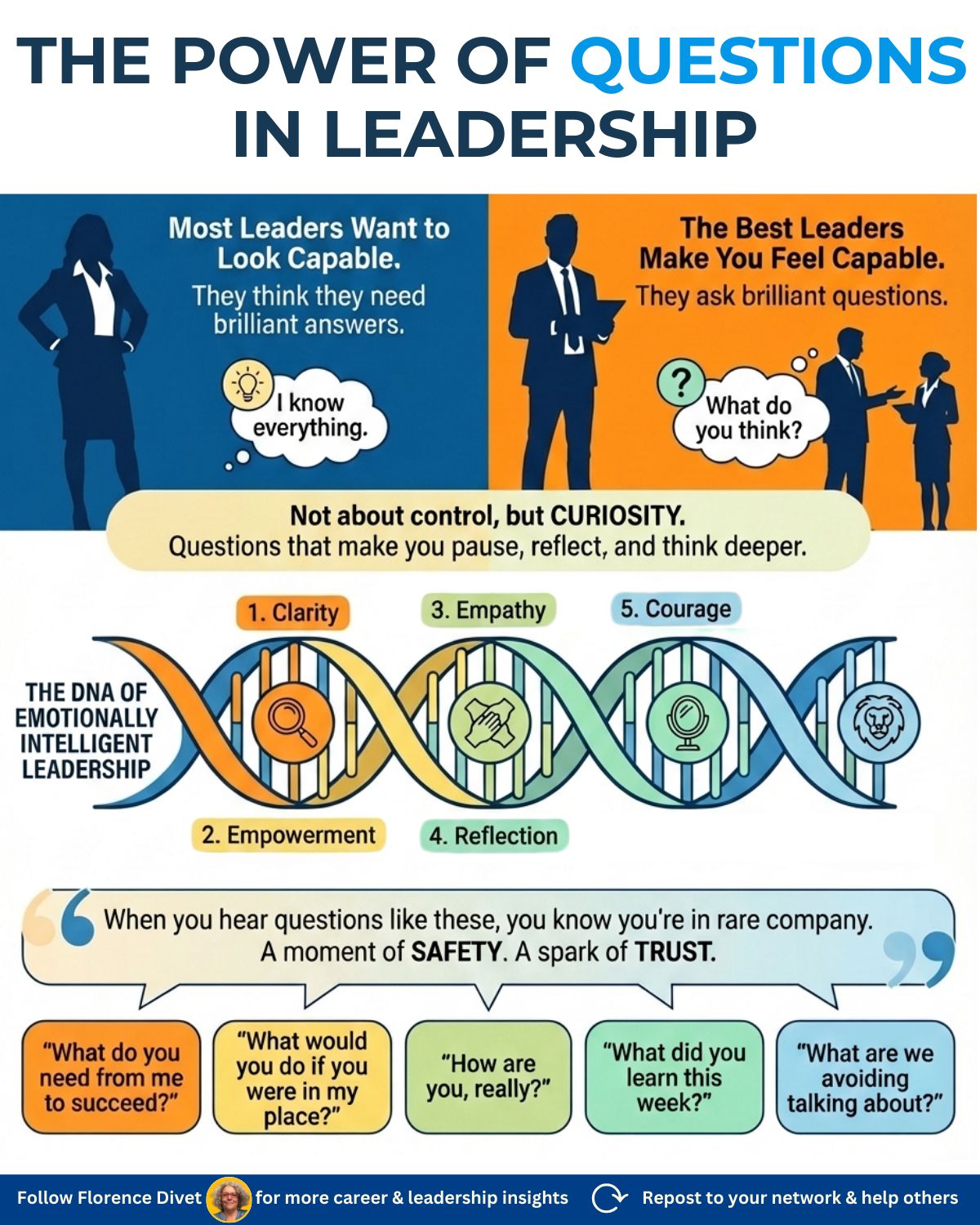
In a recent LinkedIn post, Florence Divet ☀️ explores the profound impact of questioning techniques on effective leadership, contrasting the common desire to appear capable with the rarer, more impactful skill of making others feel capable. Florence Divet ☀️ argues that true leadership is less about possessing all the answers and more about fostering an environment where others can easily think and contribute.
Drawing from experience coaching over 500 leaders, Florence Divet ☀️ observed a consistent pattern: the leaders people most want to follow are those who facilitate clear thinking for their teams. This distinction is rooted in the nature of the questions asked. As Florence Divet ☀️ points out:
“Because questions are never neutral. A good question says: I trust your judgement. A bad one says: I’m testing you.”
This highlights a fundamental aspect of leadership communication – the underlying message conveyed by inquiry. Florence Divet ☀️ emphasizes that well-crafted questions signal trust and respect, thereby building psychological safety.
The Five Pillars of Effective Leadership Questions
Florence Divet ☀️ identified five core types of questions that consistently appear among effective leaders across various industries and levels. These categories, according to Florence Divet ☀️, form the foundation of emotionally intelligent leadership and include Clarity, Empowerment, Empathy, Reflection, and Courage. When these types of questions are present in discussions, Florence Divet ☀️ suggests, it indicates a high-quality leadership environment.
The post provides concrete examples of these impactful questions:
“What do you need from me to succeed?”
“What would you do if you were in my place?”
“How are you, really?”
“What did you learn this week?”
“What are we avoiding talking about?”
Florence Divet ☀️ frames each of these as a “small act of leadership,” contributing to safety and trust. The core message is that leadership effectiveness is measured not by personal impressiveness, but by the ability to make team members feel valued and competent.
Shifting from Impressive to Empowering
Florence Divet ☀️ contrasts the common leadership tendency to focus on appearing knowledgeable with a more effective approach centered on empowering others. This is achieved through skillful questioning that invites contribution and demonstrates trust. According to Florence Divet ☀️, “great leadership isn’t about being impressive. It’s about making people feel important and capable.” This philosophy reframes leadership as a service-oriented practice focused on developing the capabilities of the team.
Florence Divet ☀️ also offers a practical resource, a checklist of 25 questions categorized by the five habits, available to those who comment on the original post. This initiative underscores Florence Divet ☀️’s commitment to practical leadership development.
In conclusion, Florence Divet ☀️’s insights on LinkedIn offer a compelling argument for prioritizing inquiry-driven leadership. By focusing on asking better questions, leaders can cultivate trust, enhance team capabilities, and ultimately achieve more impactful results. As Florence Divet ☀️ succinctly puts it in a postscript, “If your leadership depends on having the answers, you’re doing the job the hard way.” This perspective encourages leaders to embrace vulnerability and collaborative problem-solving.
📝 About This Content
This article is based on insights shared by Florence Divet ☀️ on LinkedIn.
📅 Originally posted on January 31, 2026 | View original post on LinkedIn →