
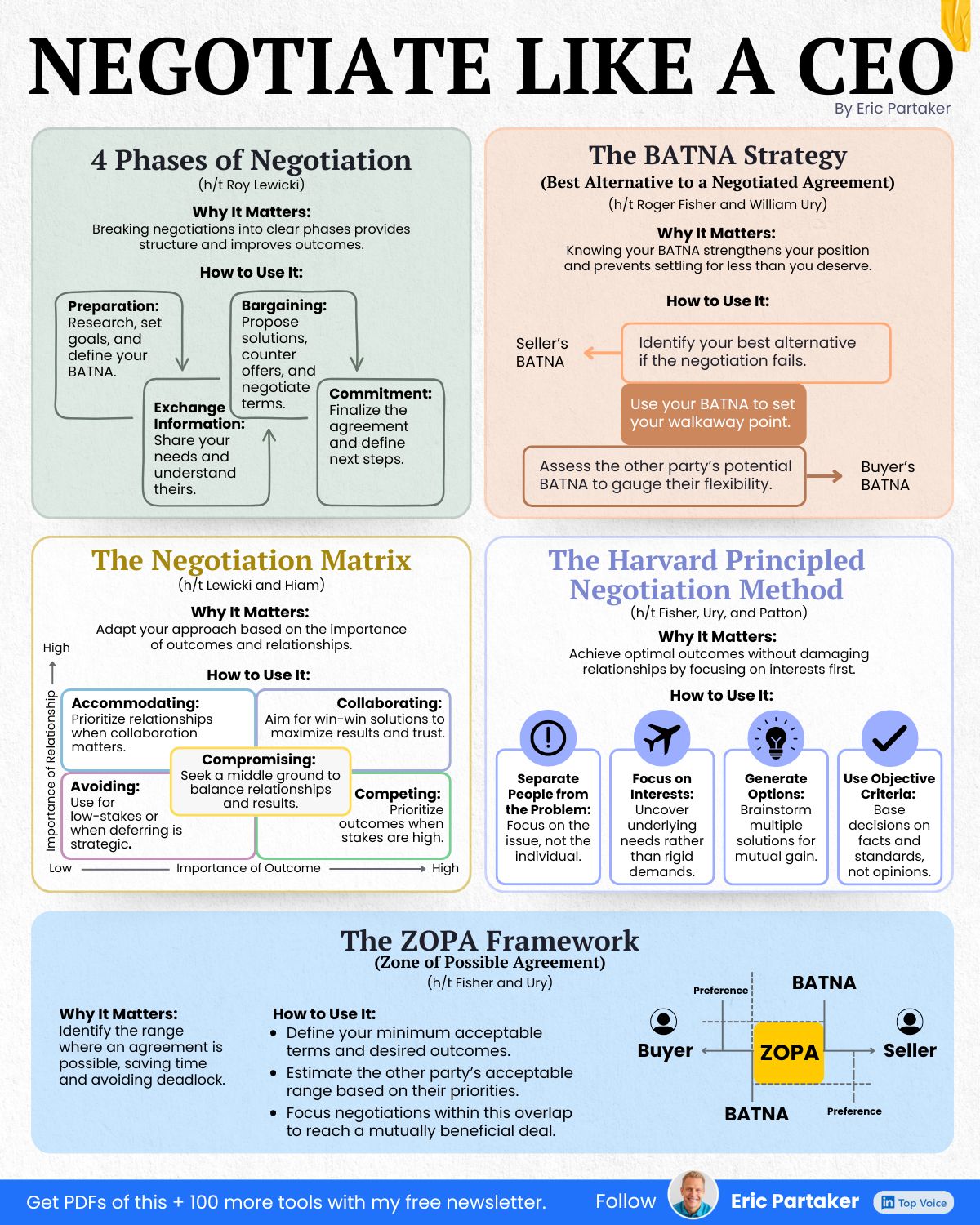
In a recent LinkedIn post, Eric Partaker shares valuable insights into the art and science of negotiation, reframing it from a confrontational exercise to a strategic process. Partaker emphasizes that effective negotiation hinges on developing the right frameworks rather than relying on aggression.
He introduces five key approaches that can significantly enhance deal-making effectiveness:
"Being a strong negotiator isn’t about confrontation. It’s about developing the right frameworks."
The Foundational Pillars of Effective Negotiation
Partaker begins by outlining the importance of a structured approach, highlighting The 4 Phases Framework, attributed to Roy Lewicki. This framework emphasizes that successful negotiators don’t rush into bargaining but rather adhere to a systematic process involving preparation, information exchange, bargaining, and commitment.
Preparation and Understanding
As Eric Partaker notes, the initial phase of Preparation is crucial for laying the groundwork. Following this, the Information Exchange phase is dedicated to building mutual understanding between parties. The Bargaining phase involves exploring potential solutions, and finally, the Commitment phase aims to secure the agreement.
Leveraging Power and Strategy
Central to Partaker’s advice is The BATNA Strategy, a concept he credits to Roger Fisher and William Ury. BATNA, or Best Alternative to a Negotiated Agreement, is presented as the primary source of power and confidence in any negotiation. Partaker stresses the importance of defining one’s BATNA before entering any discussion.
"Your power in any negotiation comes from knowing your Best Alternative to a Negotiated Agreement (BATNA). It’s your safety net, your source of confidence. Always define it before you start."
Furthermore, Eric Partaker introduces The Negotiation Matrix, inspired by Lewicki & Hiam. This tool suggests tailoring negotiation strategies to the specific situation. Partaker explains:
Adapting Strategies to Circumstances
According to Eric Partaker, a ‘Compete’ strategy is best for high-stakes situations, while ‘Collaborate’ is ideal for building long-term relationships. He also points out that ‘Avoidance’ can be suitable for minor issues, ‘Accommodate’ when the relationship is critically important, and ‘Compromise’ when both stakes and relationship importance are equal.
Focusing on Interests and Common Ground
A significant portion of Partaker’s post is dedicated to The Harvard Principled Negotiation Method, developed by Fisher, Ury, and Patton. This method advocates for focusing on underlying interests rather than rigid positions.
"This is a game-changer: Focus on interests, not positions. Instead of asking what they want, ask why they want it. That’s where real value creation happens."
Eric Partaker further elaborates on identifying the sweet spot for deals using The ZOPA Framework (Zone of Possible Agreement), also attributed to Fisher and Ury. Understanding the limits of all parties involved is key to finding common ground, as Partaker states, "Everything else? It’s just noise."
The Essence of Successful Negotiation
In conclusion, Eric Partaker’s message is clear: the most successful deals occur when both parties feel genuinely heard. He posits that the most effective negotiators are not necessarily the most aggressive, but rather the most thoroughly prepared.
📝 About This Content
This article is based on insights shared by Eric Partaker on LinkedIn.
📅 Originally posted on February 2, 2026 | View original post on LinkedIn →