
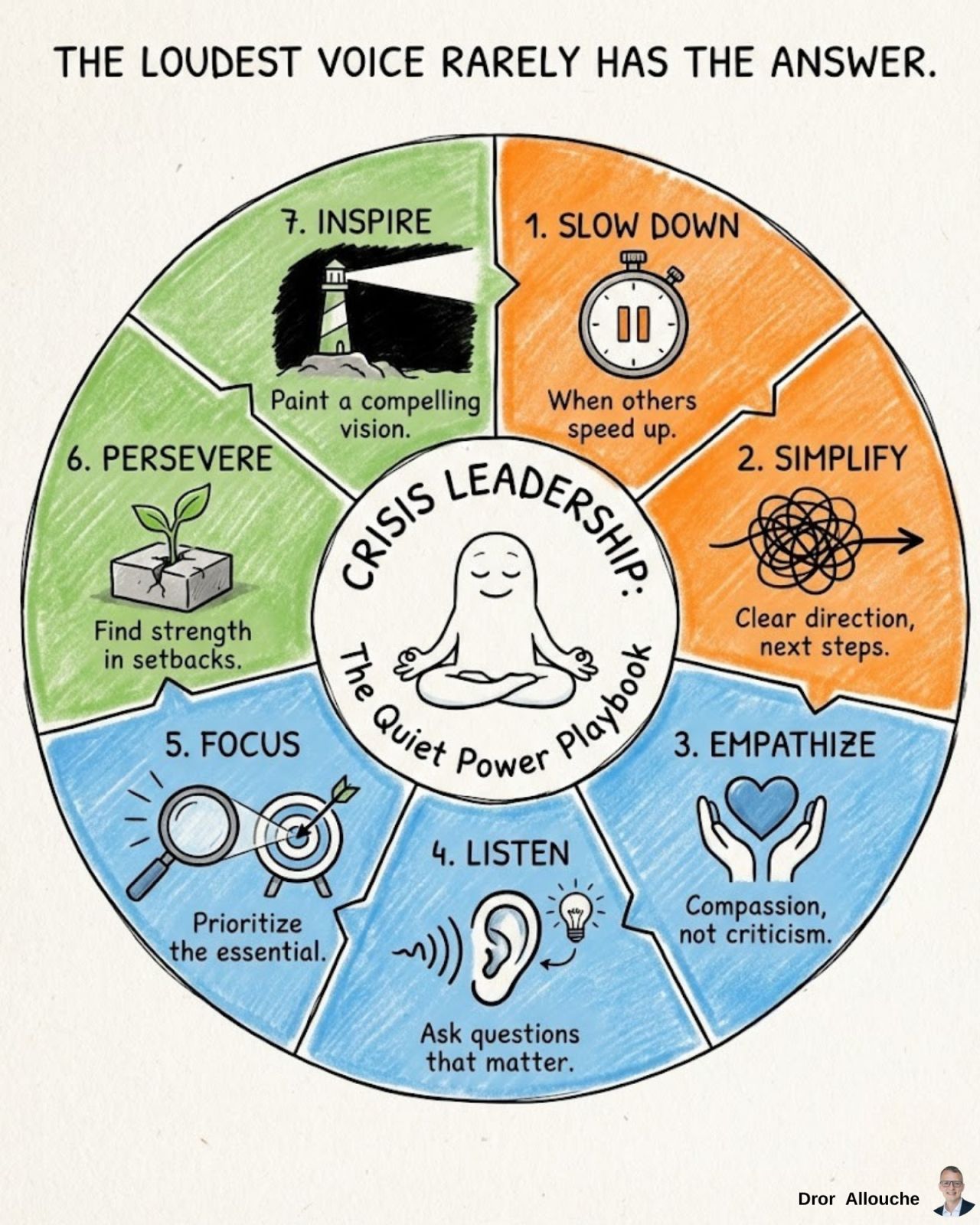
In a recent LinkedIn post, Dror Allouche discusses the critical importance of maintaining composure and strategic focus during times of crisis, offering a counter-intuitive approach to the typical heightened communication that often occurs under pressure. Allouche argues that while many react to crises by increasing their output of words, effective leaders choose a different, more deliberate path.
The post highlights common pitfalls during stressful periods, stating that under pressure, individuals often:
- Listen to answer, not to understand.
- Fight for their ego more than the outcome.
- Get lost in the details, forgetting the big picture.
According to Allouche, the consequences of these reactions include missing obvious solutions, creating confusion, and wasting energy on unproductive arguments. He emphasizes that this is precisely when great leaders differentiate themselves.
The Contrasting Path of Effective Crisis Leaders
Dror Allouche outlines seven key strategies that distinguish leaders who foster calm and clarity amidst chaos. These approaches are presented as direct responses to the common negative reactions observed during crises.
Allouche suggests that leaders should first choose to slow down when others speed up. Instead of succumbing to the pressure to make hasty decisions, effective leaders pause to ensure their actions align with the broader objectives. As Allouche notes:
“Crisis doesn’t rush their decisions. ‘Let’s take 5 minutes to reconnect with the bigger picture before we proceed.’”
Furthermore, Allouche advocates for simplifying when others complicate. This involves cutting through the noise with clear direction and actionable next steps, rather than lengthy explanations. He poses a key question leaders can ask themselves: “What’s the one thing we need to do right now?”
Empathy and Active Listening in Turbulent Times
A significant part of Allouche’s framework centers on emotional intelligence and communication. He points out that leaders should empathize when others judge, responding with compassion rather than criticism. Acknowledging the difficulty of the situation, as in the phrase, “I understand this is challenging,” can be crucial.
Allouche also stresses the importance of listening when others shout. This means actively seeking to understand by asking pertinent questions that encourage thoughtful responses. He provides an example of such a question: “Tell me more about that. What specific data supports your point?”
“The loudest voice rarely has the answer. The calmest mind usually does.”
This quote encapsulates Allouche’s core message: that measured thought and calm deliberation are more valuable than reactive clamor during a crisis.
Focus, Perseverance, and Inspiration
The leadership strategies continue with the principle of focusing when others disperse. Allouche argues that leaders must identify and prioritize essential tasks, momentarily setting aside less critical issues. The advice here is direct: “Let’s put aside everything else and focus on this point only.”
Moreover, persevering when others give up is presented as a vital trait. Leaders are encouraged to find strength in setbacks and motivate their teams to continue moving forward, even through small, incremental steps. Allouche suggests a rallying cry like, “We’ve come this far, we can keep going. Let’s tackle the next small step.”
Finally, Allouche emphasizes the power of inspiring when others dictate. This involves painting a compelling vision of a positive future and working collaboratively to achieve it. The inspirational approach, as suggested by Allouche, might sound like: “Imagine how great it will be when we achieve [positive outcome]. Let’s work together to make it happen.”
In summary, Dror Allouche’s LinkedIn post provides a practical guide for leaders, advocating for a calm, deliberate, and empathetic approach to crisis management, underscoring that measured thinking, not heightened reactivity, leads to effective solutions.
📝 About This Content
This article is based on insights shared by Dror Allouche on LinkedIn.
📅 Originally posted on February 5, 2026 | View original post on LinkedIn →