
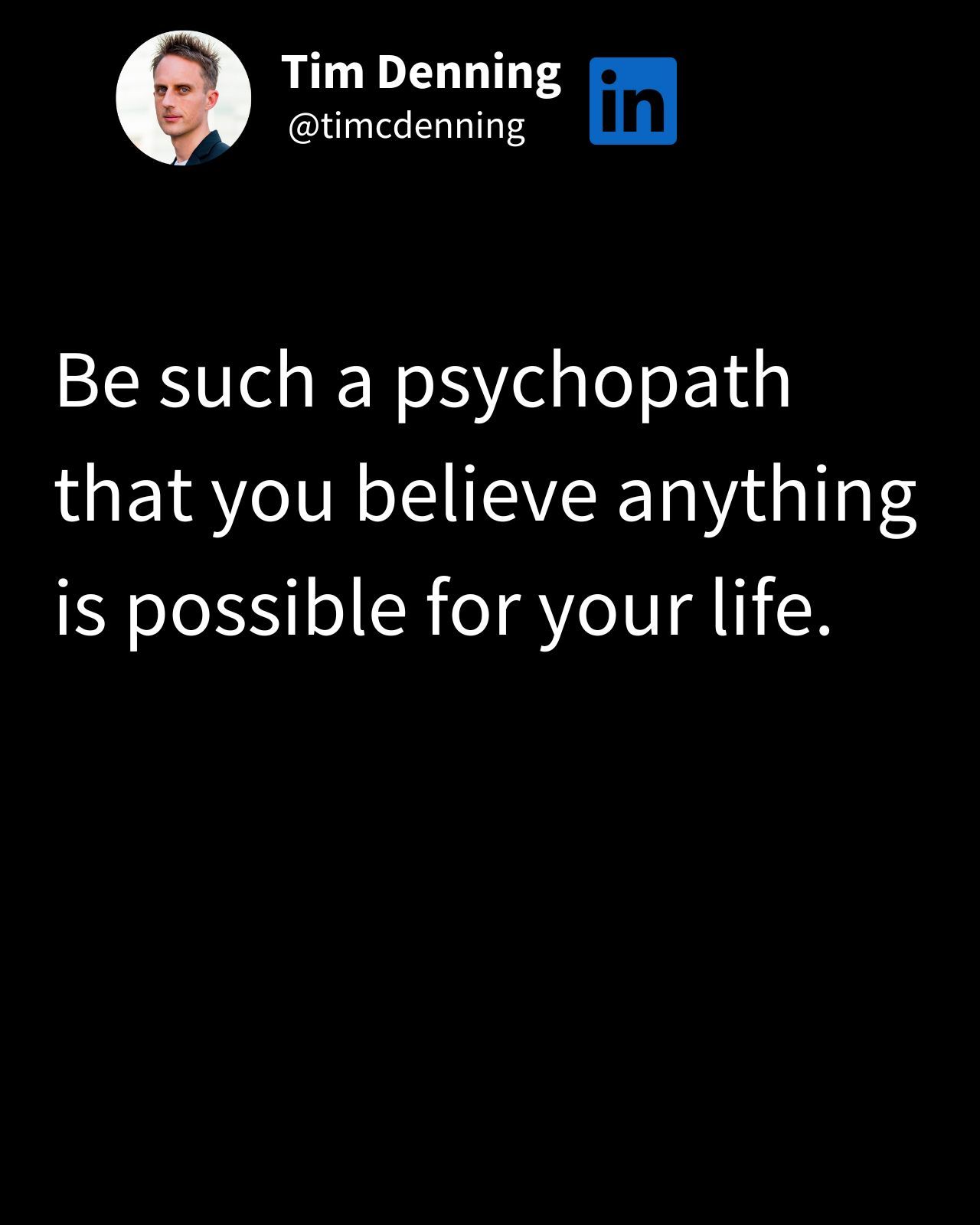
In a recent LinkedIn post, Tim Denning urges individuals to challenge the self-imposed limitations that prevent them from achieving extraordinary lives. Denning, a prominent voice on business and personal development, argues that societal conditioning and personal doubt often create invisible ceilings, stopping people from pursuing ambitious goals.
He begins by observing the common tendency to accept limitations, stating:
“Normal people don’t believe anything is possible for their lives. They think in limits. They accept ceilings. They let society, their upbringing, or their bank account tell them what they’re allowed to want.”
Denning draws from his own experience, recounting a decade spent in banking where his professional life was confined to a predefined salary range and career path. He describes how colleagues, much like himself, would discuss aspirations but seldom act on them, often deferring dreams to an uncertain “one day.” This period of conformity, he suggests, highlights how easily individuals can become accustomed to perceived boundaries.
The Catalyst of Being Fired
A pivotal moment in Denning’s perspective shift came in 2019 when he was fired from his banking job. This event, initially a source of fear, ultimately liberated him from the constraints he had accepted. He realized that the limits he perceived were not external realities but constructs he had internalized and that were reinforced by his environment.
“Suddenly I had no box. No ceiling. No corporate ladder telling me what the next step was supposed to be. I was terrified. But I was also free.”
This newfound freedom allowed Denning to re-evaluate the nature of personal achievement. He posits that individuals who build remarkable lives operate with a different mindset, one that embraces beliefs that may seem unrealistic to others.
The ‘Operating System’ of High Achievers
Denning contrasts the mindset of high achievers with that of the general population. He contends that those who accomplish the seemingly impossible possess an unwavering belief in their goals, even in the absence of external validation or evidence. This internal conviction, he argues, is the primary differentiator.
Belief as a Self-Fulfilling Prophecy
Drawing on his experience coaching thousands of aspiring entrepreneurs, Denning asserts that success is less about innate talent or resources and more about the intensity of one’s belief. According to Denning, this profound belief influences actions, leading individuals to take calculated risks, persevere through adversity, and discover innovative solutions.
“They believe when there’s no evidence. They believe when people laugh at them. They believe when everything around them says it’s not going to work.”
He further elaborates that this conviction becomes a self-fulfilling prophecy. When one truly believes in the possibility of their goals, their behavior naturally aligns with achieving them. This contrasts sharply with the common tendency to dismiss such ambitious thinking as naive or unrealistic.
The Danger of Playing Small
Denning warns against the long-term consequences of limiting one’s own potential. He describes the mindset of playing small due to fear as a form of “slow death,” a gradual acceptance of less than one is capable of achieving. In his view, the truly dangerous path is to reach later life with regrets about unpursued dreams.
Embracing Unreasonableness
The core message of Denning’s post is a call to radical self-belief, which he provocatively labels as becoming a “psychopath” in the context of one’s own life goals. This isn’t about literal psychopathy, but about adopting an unreasonable, unwavering commitment to one’s vision, regardless of external comfort or safety.
“Be such a psychopath that you believe anything is possible for your life. Not because it’s comfortable. Not because it’s safe. Because the alternative is a slow death of settling for less than you’re capable of.”
He concludes by encouraging readers to adopt this “unreasonable” stance, suggesting that the world ultimately rewards those who dare to defy conventional limitations and pursue what they truly desire.
📝 About This Content
This article is based on insights shared by Tim Denning on LinkedIn.
📅 Originally posted on February 9, 2026 | View original post on LinkedIn →