
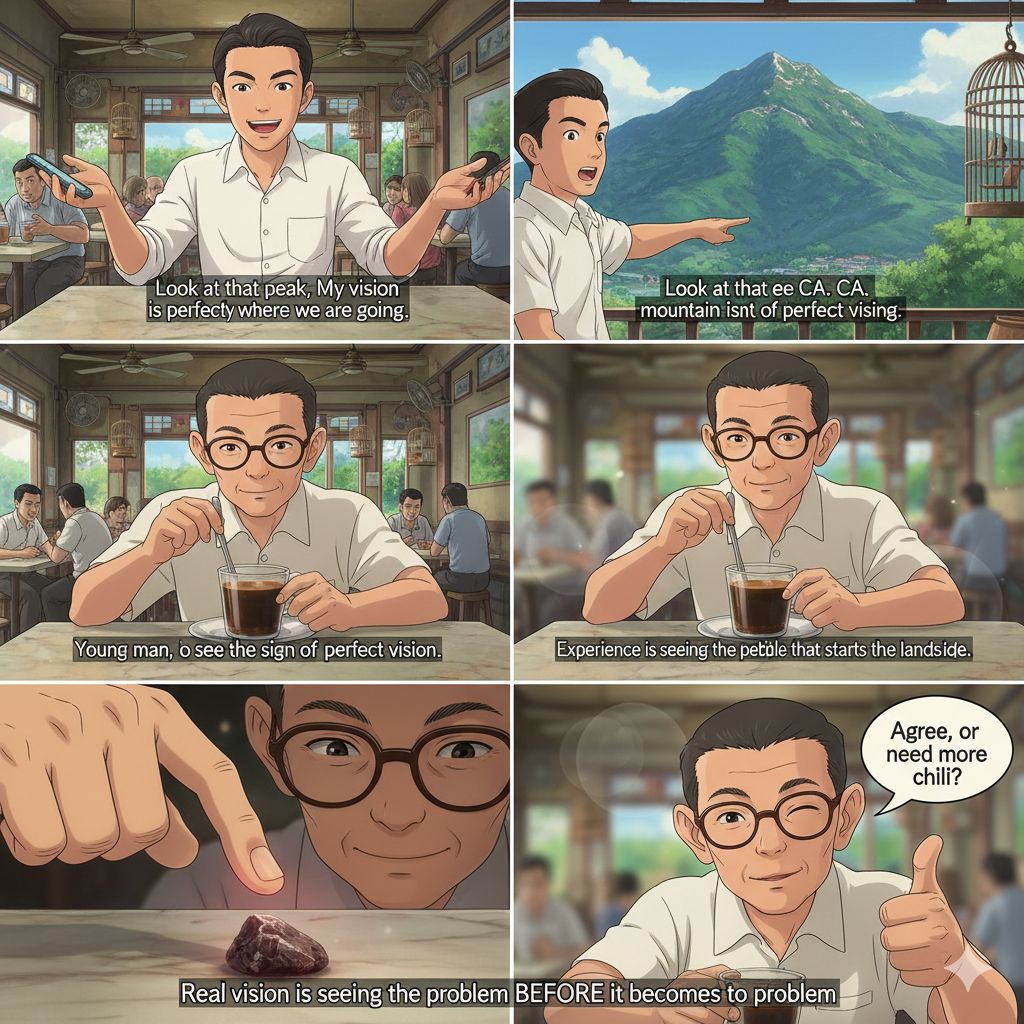
In a recent LinkedIn post, Choo Ann NGOH offers a compelling redefinition of entrepreneurial vision, contrasting superficial foresight with the deeper, proactive sense of impending challenges that defines true leadership. Choo Ann NGOH uses a vivid anecdote to illustrate the difference between merely observing a large, obvious obstacle and discerning the subtle, early indicators of future crises.
The post opens with a story about a young entrepreneur boasting about his “vision” simply because he could see a mountain. A veteran founder, as recounted by Choo Ann NGOH, challenges this notion, stating:
“Young man,” the veteran said, “Being able to see the mountain isn’t a sign of perfect eyesight. Anyone can see a mountain. It’s a giant rock blocking the horizon. If you can’t see the mountain directly in front of you, you must be blind.”
This exchange sets the stage for Choo Ann NGOH’s core argument: that genuine vision lies not in recognizing present, large-scale issues, but in anticipating future problems before they materialize.
The Pitfalls of ‘Seeing the Mountain’
Choo Ann NGOH critiques the common business tendency to rely on reactive strategies, particularly in the data-driven environment of 2026. The author points out that waiting for a dashboard to signal a crisis is often too late.
“In 2026, we are obsessed with ‘Data’,” Choo Ann NGOH writes. “We wait for the dashboard to turn red before we act. But by the time the dashboard is red, the landslide has already started.” This highlights a critical gap between data collection and actionable foresight.
Choo Ann NGOH identifies three common traps that ensnare businesses focused only on the obvious:
The “Everything is Fine” Trap
This occurs when organizations only examine their processes or systems in response to a failure. Proactive assessment is neglected until a breakdown forces attention.
The Dashboard Dependency
This trap describes an over-reliance on quantitative data, leading leaders to ignore qualitative signals like team morale, market whispers, or subtle operational friction. As Choo Ann NGOH notes, this can mean “You trust the numbers more than the ‘vibe’ in the pantry or the whispers in the market.”
The Ego Wall
This refers to the dangerous assumption that rapid progress equates to safety and success. Choo Ann NGOH cautions against this, stating, “Speed without direction is just a faster way to hit the rocks.”
Cultivating ‘Pebble-Watching’ Vision
The true differentiator for successful entrepreneurs, according to Choo Ann NGOH, is the ability to “see” the small, almost invisible signs of future trouble. This involves developing what the author calls “Big Ears” and “Sharp Eyes” to detect friction early.
“Real vision isn’t seeing the mountain,” Choo Ann NGOH explains, quoting the veteran founder. “It’s ‘seeing’ the loose pebble that will start the landslide next week. It’s ‘seeing’ the clouds on the other side of the peak that haven’t arrived yet. It’s seeing the problem BEFORE it becomes a problem.”
Choo Ann NGOH emphasizes that the best entrepreneurs are not just focused on the grand objectives (the peak) but are keenly aware of their immediate surroundings and the subtle environmental cues.
“They look at the ground. They listen to the wind. They respect the pebbles.”
The post concludes with a direct question to the reader, prompting reflection on their own approach to leadership and foresight: “Are you staring at the mountain, or are you watching the pebbles?” Choo Ann NGOH’s insightful post serves as a powerful reminder that true business acumen lies in proactive anticipation rather than reactive response.
📝 About This Content
This article is based on insights shared by Choo Ann NGOH on LinkedIn.
📅 Originally posted on February 11, 2026 | View original post on LinkedIn →