
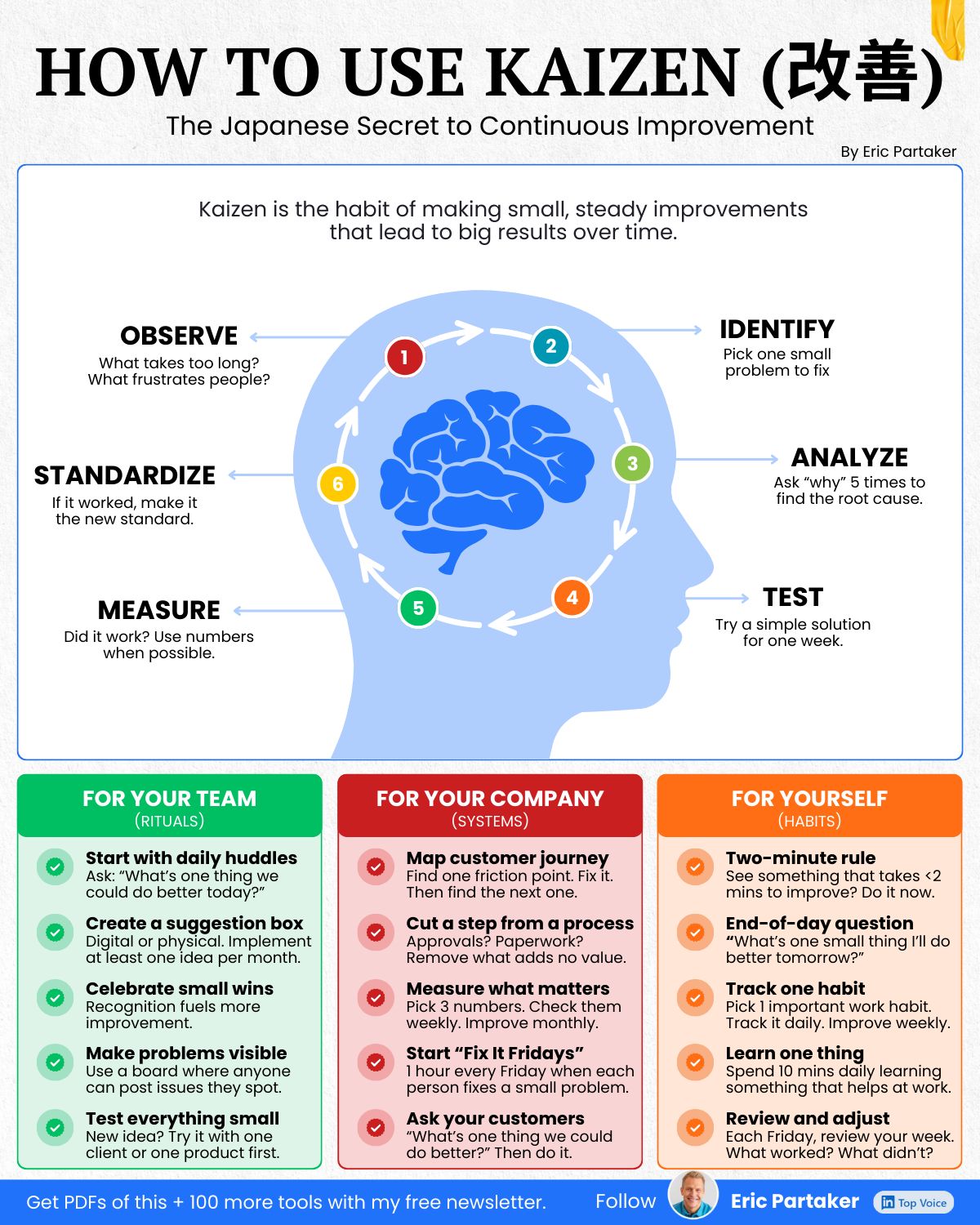
In a recent LinkedIn post, Eric Partaker delves into the Japanese philosophy of Kaizen, presenting it not as a fleeting trend but as a fundamental system for achieving operational excellence and sustainable growth within businesses.
Partaker emphasizes that Kaizen, the practice of making small, continuous improvements, is a cornerstone for the world’s most efficient companies. He contrasts this approach with the common corporate tendency to chase large-scale, disruptive transformations, suggesting that the latter often leads to team burnout rather than lasting success.
“Most CEOs chase the big win. Major transformations. Strategic change initiatives. Kaizen leaders focus on the next 1% improvement.”
Shifting Focus from Overhauls to Incremental Gains
According to Partaker, the allure of the “big win” can be a significant pitfall for leaders. He argues that while ambitious overhauls might seem appealing, they frequently place an unsustainable burden on teams. In contrast, the Kaizen methodology, which centers on consistently seeking out and implementing minor enhancements, fosters a more positive and productive environment.
“One burns out your team with unrealistic overhauls. The other builds momentum, alignment, and long-term gains,” Partaker writes, highlighting the divergent outcomes of these two leadership styles. He posits that the simplicity and sustainability of Kaizen are key to its effectiveness, making it a practice that “sticks.”
Building a Culture of Proactive Improvement
Partaker further elaborates on how Kaizen transcends mere problem-solving, positioning it as a preventative and systemic approach. He states that the philosophy is about “never letting them break in the first place,” underscoring its proactive nature. This continuous refinement, he explains, cultivates a corporate culture where improvement becomes the ingrained default rather than an occasional initiative.
Fostering Ownership and Early Problem Detection
A core benefit of Kaizen, as described by Partaker, is its ability to create a sense of ownership among all employees. When individuals are encouraged and empowered to make small improvements, they become more invested in the company’s overall success. This environment also facilitates the early detection of minor issues before they escalate into significant problems.
“Kaizen creates a culture where improvement becomes the default. Where every employee feels ownership. Where small problems surface early (before they grow legs).”
The Compounding Benefits of Kaizen
The ultimate payoff of adopting a Kaizen system, Partaker notes, extends beyond just streamlined processes. He identifies “speed, trust, and compounding results” as key advantages, all achieved “without compounding stress.” This suggests that consistent, small improvements lead to exponential growth and enhanced resilience without the detrimental side effects often associated with high-pressure change initiatives.
Partaker concludes his post with a call to action for leaders: instead of fixating on large, infrequent strategic shifts, they should focus on building businesses that possess an inherent capacity for self-improvement. He asserts that the companies that truly win in the long run are not necessarily the fastest movers, but those that demonstrate an unwavering commitment to continuous betterment.
“Because the companies that win? Aren’t the ones that move the fastest. They’re the ones that never stop improving.”
For those interested in a practical guide, Partaker offers a free PDF of his Kaizen Cheat Sheet, encouraging leaders to “repost to help a leader in your network” and to follow him for further operational insights.
📝 About This Content
This article is based on insights shared by Eric Partaker on LinkedIn.
📅 Originally posted on February 10, 2026 | View original post on LinkedIn →