
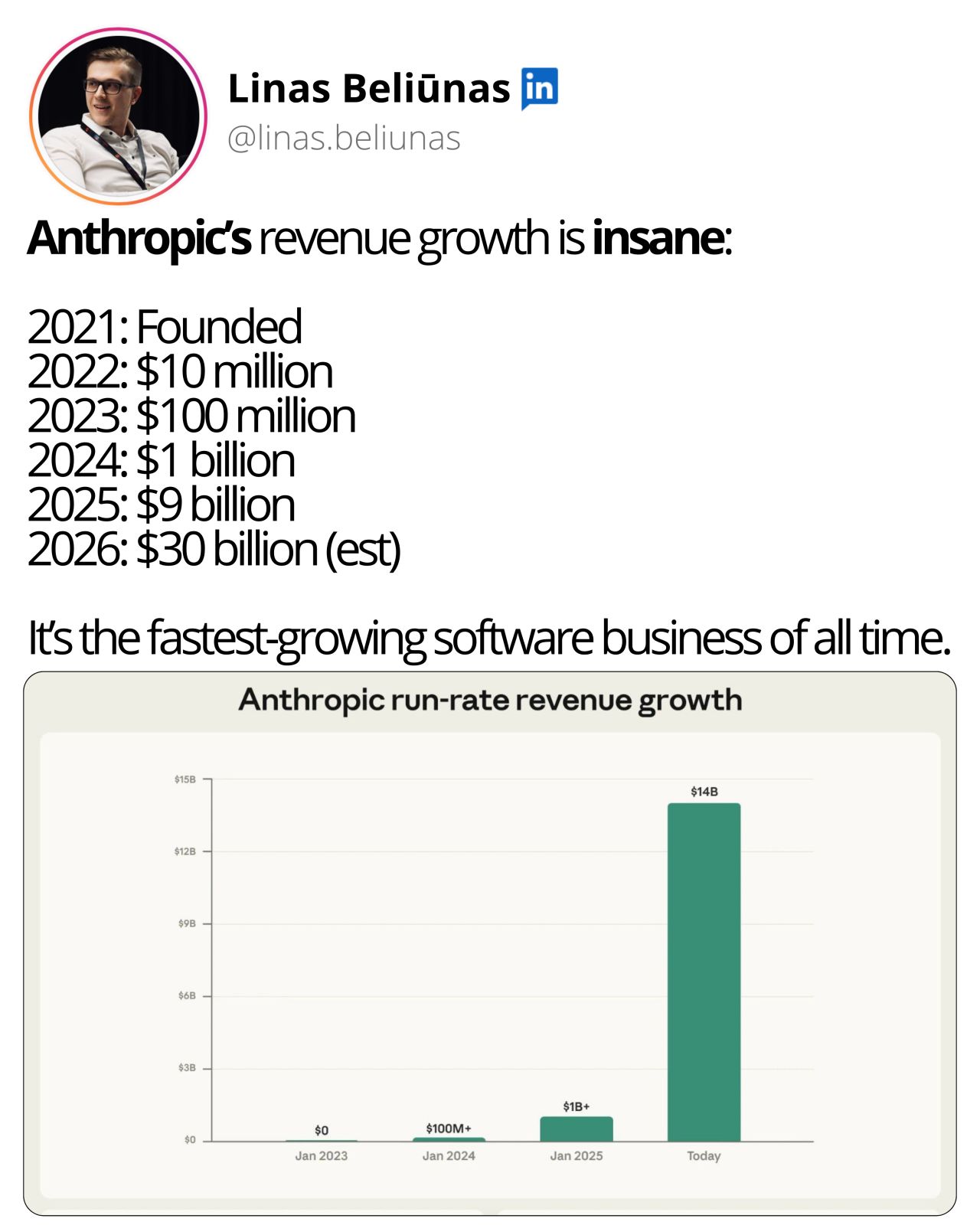
In a recent LinkedIn post, Linas Beliūnas highlights the staggering growth of AI company Anthropic, positing that its trajectory signals a fundamental shift in how software is developed and deployed. Beliūnas points out that Anthropic, despite not directly selling traditional software, has achieved an unprecedented revenue run rate, positioning itself as potentially the fastest-growing software business in history.
Anthropic’s Unprecedented Revenue Trajectory
Beliūnas underscores the remarkable financial milestones Anthropic has reached in an exceptionally short period. He notes the company’s rapid ascent from zero to a $14 billion revenue run rate, a feat achieved in approximately three years. This growth is primarily driven by its AI models, particularly ‘Claude Code,’ which alone is reported to be at a roughly $2.5 billion run rate in under a year.
The impact of Anthropic’s technology is further illustrated by its significant contribution to code development. According to Beliūnas,
It now generates ~4% of all GitHub commits 🤯
This statistic, Beliūnas suggests, is a powerful indicator of how AI is moving beyond being a mere feature within software to becoming an active participant in its creation.
Strategic Focus on Enterprise Workflows
A key element of Anthropic’s success, as analyzed by Beliūnas, is its strategic decision to focus on enterprise-level solutions rather than consumer-facing applications. While many AI companies pursued consumer virality, Anthropic targeted established enterprise codebases, recurring budgets, and critical workflows that are difficult for businesses to abandon.
Beliūnas elaborates on this strategic advantage:
While others chased consumer virality, Anthropic went straight for enterprise codebases, recurring budgets, and workflows that teams can’t turn off.
This approach has evidently resonated with large organizations. Beliūnas highlights significant customer growth metrics, including a sevenfold year-over-year increase in customers spending over $100,000, and a fortyfold growth in enterprises spending over $1 million annually.
The AI Model as the Engineer
The implications of Anthropic’s model, according to Beliūnas, extend beyond just business growth; they represent a paradigm shift in software engineering. He argues that the initial expectation of AI serving as an assistant or feature within existing software has been surpassed.
Beliūnas states:
We thought AI would be a feature inside software. Instead, the model became the engineer.
This perspective suggests that the future of software development might be dominated by AI systems capable of writing and managing code, fundamentally changing the role of human developers.
Looking Towards an IPO and the Future of AI Ownership
The post also touches upon Anthropic’s significant financial backing and its potential market debut. Beliūnas points to the company securing substantial capital at a high valuation and reports of preparations for an Initial Public Offering (IPO) in 2026. He speculates that if its current trajectory continues, Anthropic could be poised to stage the largest tech IPO in history.
Looking ahead, Beliūnas posits that the coming years will be defined by who controls the core AI layer responsible for code generation.
If this trajectory holds, 2026 won’t be about better prompts. It’ll be about who owns the AI layer writing the world’s code.
This outlook emphasizes the strategic importance of foundational AI models in shaping the future technological landscape.
📝 About This Content
This article is based on insights shared by Linas Beliūnas on LinkedIn.
📅 Originally posted on February 13, 2026 | View original post on LinkedIn →