
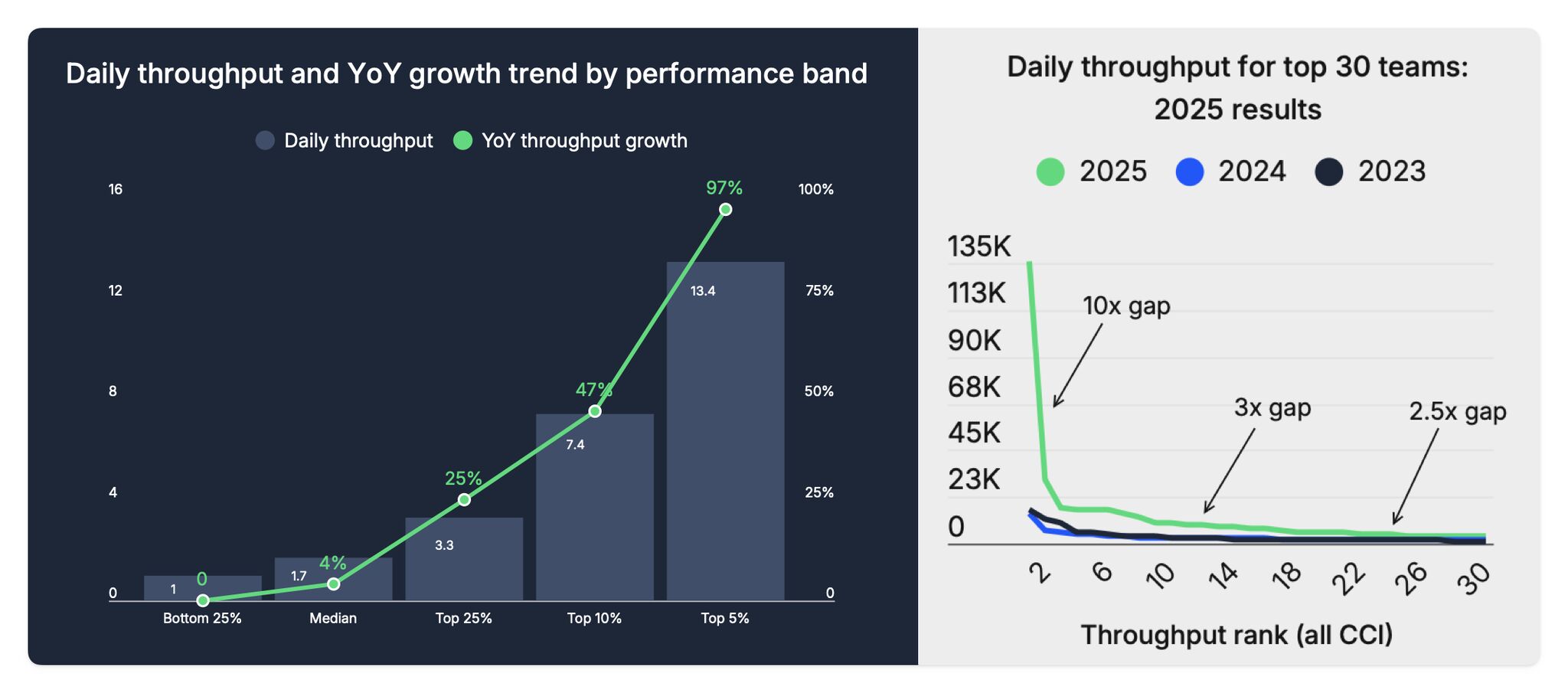
In a recent LinkedIn post, 🌀 Luca Rossi explores the burgeoning concept of the “Software Factory” and its implications for development teams in the age of artificial intelligence. Drawing insights from the latest State of Software Delivery report, which analyzes 28 million CI workflows, Rossi highlights a significant divergence between elite and average engineering teams.
Rossi points out that the report, compiled in collaboration with CircleCI, reveals a dramatic shift in software development dynamics. He notes that the top-performing teams are experiencing unprecedented gains, largely driven by AI.
“Elite teams are pulling away from the pack to a degree never seen before. For the Top 30 teams, AI has changed the fundamental *cost structure* of writing software, to the point where the dev process looks unrecognizable. Rob and I called it *The Factory Era*.”
Elite Teams Embrace the ‘Factory Era’
According to 🌀 Luca Rossi, the term “Software Factory” aptly describes the operational model of leading engineering organizations. These teams are not just incrementally improving; they are fundamentally transforming their development processes with AI. Rossi emphasizes that this transformation is not merely about speed but about a redefinition of the software development cost structure, making the process almost unrecognizable compared to previous methodologies.
The report’s findings suggest that AI acts as a powerful amplifier, magnifying the capabilities of teams that already possess strong engineering foundations. As 🌀 Luca Rossi articulates:
“The bottom line is that AI is not a universal equalizer: it’s an 𝗮𝗺𝗽𝗹𝗶𝗳𝗶𝗲𝗿. Teams that already had strong engineering fundamentals (fast pipelines, solid CI/CD, clean processes) are the ones reaping the most benefits.”
Struggles of Average Teams and the Role of CI/CD
In stark contrast to the elite, 🌀 Luca Rossi observes that average or median teams are facing significant challenges. While these teams show increased activity on development branches, their progress in production and release success rates are lagging. This trend raises questions about the actual impact of AI on their workflows.
Rossi highlights a key predictive indicator of future success: fast CI/CD pipelines. He notes that teams with CI pipelines under 15 minutes in 2023 were five times more likely to be in the top percentile in the current year. This correlation underscores the foundational importance of efficient development infrastructure.
The Importance of Foundational Practices
🌀 Luca Rossi argues that the widening gap between high-performing and average teams is a direct consequence of their respective approaches to foundational engineering practices. Teams with robust CI/CD, clean processes, and efficient pipelines are best positioned to harness the power of AI. Conversely, those with less mature infrastructures are falling further behind.
He posits that the pursuit of AI-driven productivity should not overshadow the necessity of solid engineering basics. As 🌀 Luca Rossi concludes in his post:
“In a way, the conclusion is obvious: before chasing AI productivity, invest in the basics. Fix your pipelines, tighten your feedback loops, and build the infrastructure that lets *humans* do their best work. AI will naturally follow.”
This perspective suggests a strategic imperative for organizations: prioritize and optimize core development processes before expecting transformative results from AI. The insights shared by 🌀 Luca Rossi underscore that a strong foundation is not just beneficial but essential for navigating the evolving landscape of software development and effectively leveraging advanced technologies like AI.
📝 About This Content
This article is based on insights shared by 🌀 Luca Rossi on LinkedIn.
📅 Originally posted on February 18, 2026 | View original post on LinkedIn →