
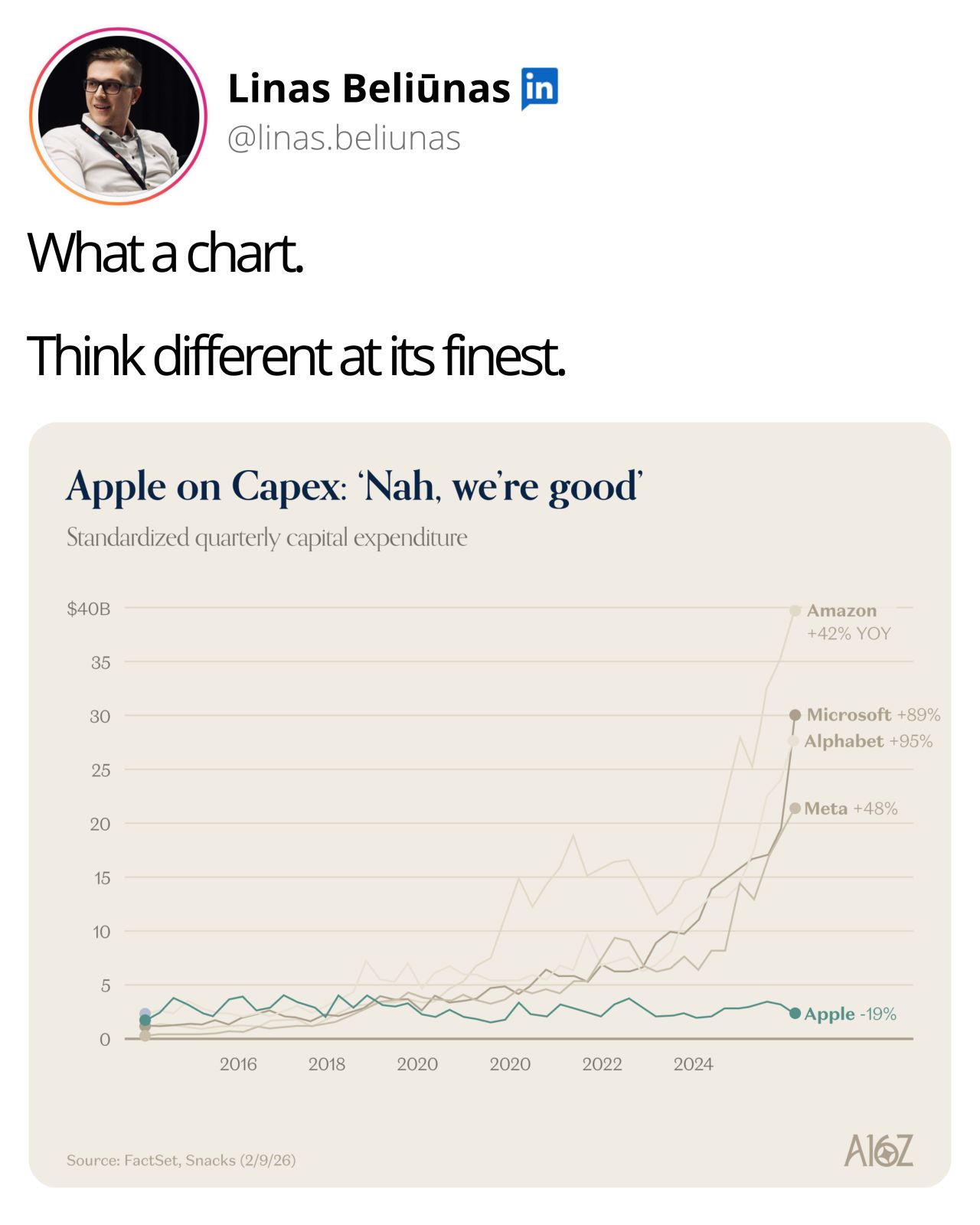
In a recent LinkedIn post, Linas Beliūnas offers a contrarian perspective on Apple’s approach to the artificial intelligence race, suggesting the company’s strategy of “doing nothing” in the traditional sense might be its most potent move. While competitors have plunged billions into developing frontier large language models (LLMs) and massive compute infrastructure, Beliūnas argues that Apple has strategically sidestepped this costly arms race.
Beliūnas highlights Apple’s decision to forgo developing its own foundational AI models or engaging in large-scale acquisitions, instead opting for a licensing deal with Google for its Gemini models. This approach, he contends, allows Apple to leverage AI capabilities without bearing the immense financial burden that other tech giants are facing.
“While everyone else sprinted into a $100 billion compute arms race, Apple stepped aside.”
As Linas Beliūnas points out, the financial projections for major AI players paint a stark picture of the costs involved. He notes that OpenAI is expected to report significant losses, while Anthropic, despite substantial revenue, is burning through tens of billions. Similarly, hyperscalers are making colossal investments in hardware and data centers.
The Power of the Ecosystem
Beliūnas argues that Apple’s true advantage lies not in proprietary AI models, but in its established ecosystem. He emphasizes the company’s control over its vast user base and hardware infrastructure.
Leveraging Existing Assets
According to Linas Beliūnas, Apple’s strategy is centered on its existing strengths:
- Over 2 billion active devices
- Control over the operating system layer
- The lucrative upgrade cycle
He suggests that Apple has effectively “written a check” for AI capabilities through its licensing deal, allowing it to focus resources on enhancing its hardware and software integration. Beliūnas anticipates that upcoming advancements, such as the M5 chips optimized for on-device inference, will enable the local execution of sophisticated AI models.
“Apple wrote a check, and focused on what it actually owns: 2B+ active devices. The OS layer. The upgrade cycle.”
A Different Kind of AI Game
Beliūnas draws an analogy between AI development and resource extraction, stating, “Frontier labs are drilling for oil. Apple is selling the iPhone that runs on it.” He posits that even a modest increase in the hardware refresh cycle, driven by AI integration, could generate billions in high-margin revenue for Apple. This approach, he believes, mitigates the risks associated with massive infrastructure investments and model development.
“It seems that the real moat was never the model. It was the ecosystem.”
In Linas Beliūnas’s view, Apple’s calculated restraint in the AI arms race, coupled with its focus on its ecosystem, represents a potentially more sustainable and profitable path forward. This strategy avoids the direct financial exposure of model development and infrastructure build-out, instead capitalizing on its existing market dominance.
📝 About This Content
This article is based on insights shared by Linas Beliūnas on LinkedIn.
📅 Originally posted on February 17, 2026 | View original post on LinkedIn →