
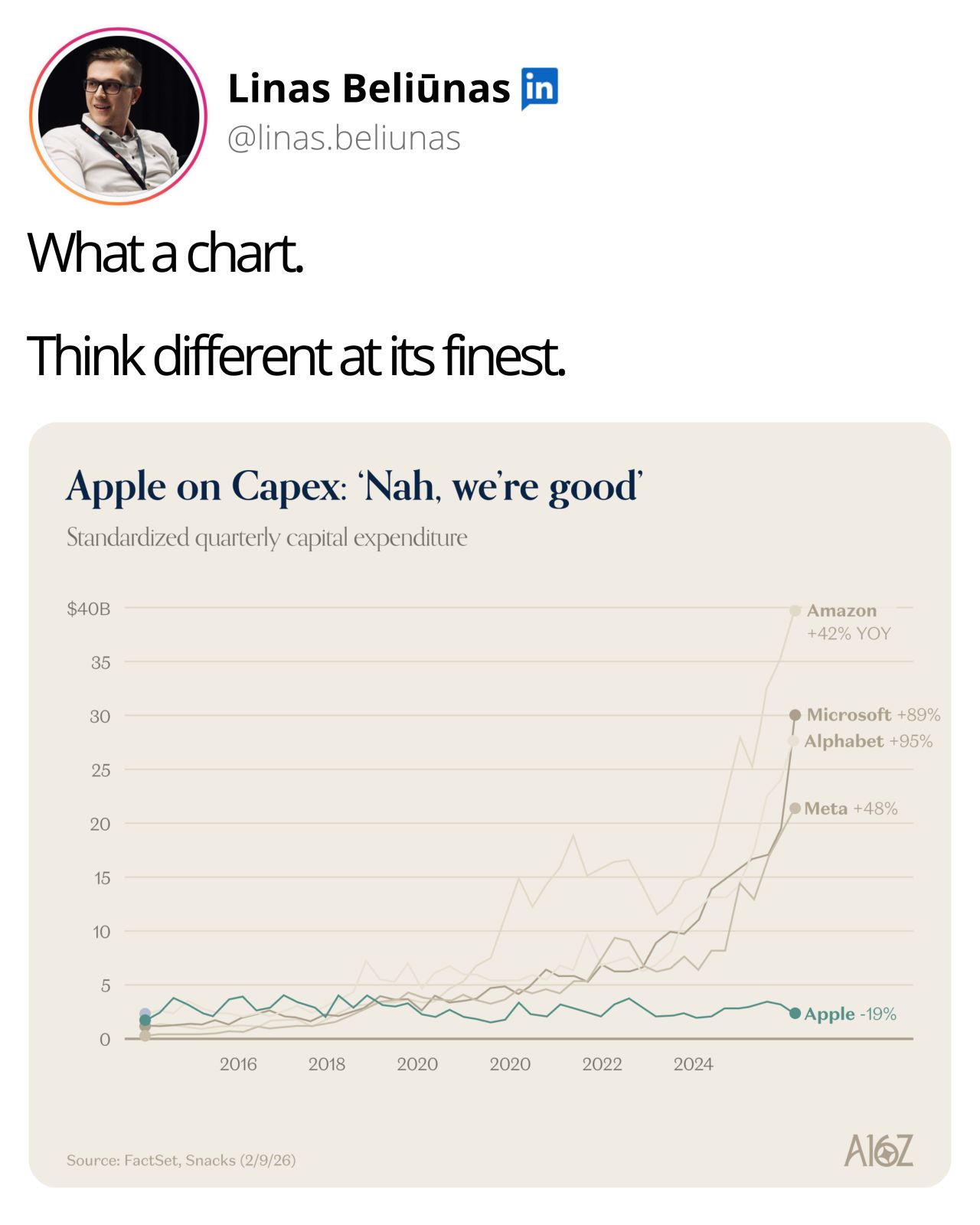
In a recent LinkedIn post, Linas Beliūnas discusses Apple’s distinctive approach to the burgeoning artificial intelligence landscape, suggesting the tech giant’s strategy focuses on its established ecosystem rather than engaging in a costly compute arms race.
Beliūnas highlights Apple’s decision to abstain from developing its own frontier large language models (LLMs) or making significant AI-focused acquisitions. Instead, the company reportedly entered into a licensing deal with Google for its Gemini AI. This contrasts sharply with the strategies of many other major tech players.
“While everyone else sprinted into a $100 billion compute arms race, Apple stepped aside.”
According to Beliūnas, this measured approach allows Apple to sidestep the immense financial burdens associated with AI development and infrastructure. He points to the substantial projected losses and ongoing massive investments by competitors.
The High Cost of the AI Arms Race
Linas Beliūnas details the financial strain on companies heavily invested in frontier AI development. He notes the significant expenditures required for training and inference, as well as the colossal investments in specialized hardware and data centers by hyperscalers.
- OpenAI is projecting a loss of approximately $14 billion in 2026.
- Anthropic, despite significant revenue, is still incurring tens of billions in costs for training and inference.
- Hyperscalers are investing over $100 billion in chips, data centers, and power infrastructure.
Beliūnas argues that these figures underscore the financial risks inherent in directly competing in the LLM development space.
“Hyperscalers are pouring $100B+ into chips, data centers, and power”
Apple’s Ecosystem Advantage
In contrast, Beliūnas posits that Apple’s strength lies in its existing user base and hardware. The company’s strategy, as outlined by Beliūnas, leverages its:
- Over 2 billion active devices.
- Control over the operating system layer.
- Management of the device upgrade cycle.
Beliūnas suggests that Apple’s upcoming M5 chips, optimized for on-device inference, will enable the local operation of advanced AI models, potentially transforming the user experience without the need for massive external cloud infrastructure.
“Apple wrote a check, and focused on what it actually owns: 2B+ active devices. The OS layer. The upgrade cycle.”
He draws an analogy, stating, “Frontier labs are drilling for oil. Apple is selling the iPhone that runs on it.” This implies that Apple profits from the AI revolution by providing the platform and hardware, rather than bearing the direct costs and risks of AI model development.
The Moat of Ecosystem and High-Margin Revenue
Linas Beliūnas concludes that Apple’s approach minimizes model risk and avoids the need for massive infrastructure bets. He suggests that even a modest increase in the hardware refresh cycle driven by AI capabilities could translate into substantial high-margin revenue for Apple.
“It seems that the real moat was never the model. It was the ecosystem.”
This perspective positions Apple’s strategy not as a lack of innovation, but as a calculated move to capitalize on its existing strengths, turning its vast ecosystem into a significant competitive advantage in the AI era.
📝 About This Content
This article is based on insights shared by Linas Beliūnas on LinkedIn.
📅 Originally posted on February 17, 2026 | View original post on LinkedIn →