
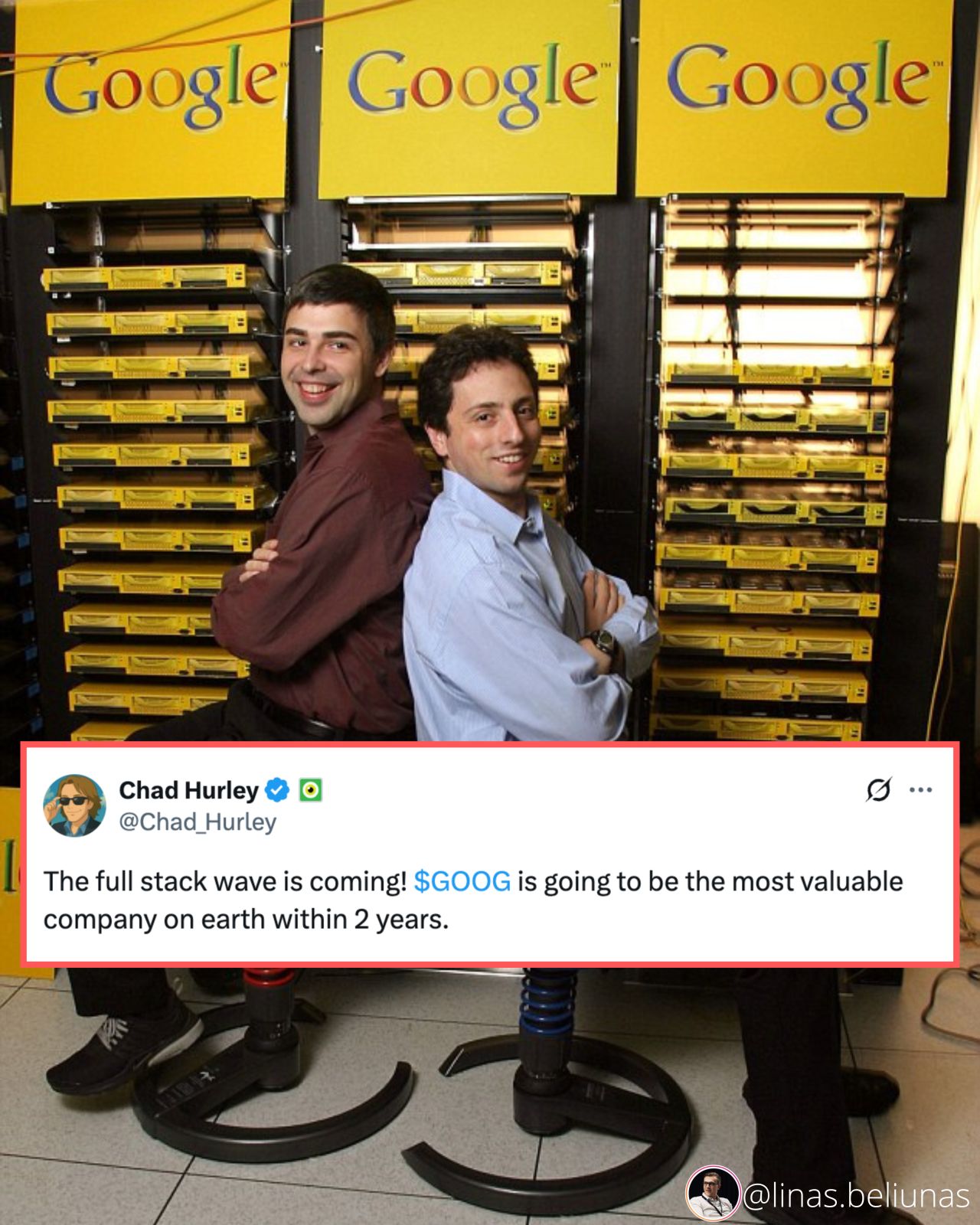
In a recent LinkedIn post, Linas Beliūnas delves into the foundational elements that he believes will propel Google to become the world’s most valuable company by 2027, attributing this potential dominance not to a single chatbot, but to its comprehensive technological infrastructure, or what he terms the ‘full stack’.
Beliūnas highlights a critical distinction between companies that rent essential AI components and Google, which he asserts builds them.
“Most AI players rent critical layers. Google builds them.”
Google’s Integrated Infrastructure Advantage
Linas Beliūnas breaks down Google’s ‘full stack’ into several key components, arguing that this integrated approach creates a significant competitive moat. He points to Google’s custom Tensor Processing Units (TPUs), now in their seventh generation, as a prime example of their silicon-level investment. According to Beliūnas, these TPUs power Google DeepMind’s Gemini models and are available via Google Cloud, offering a lower cost per compute compared to renting traditional GPUs at scale.
Beyond hardware, Beliūnas emphasizes the sophistication of Google’s AI models. He notes that Gemini is multimodal, boasts a context window exceeding one million tokens, and is trained on proprietary data at an unprecedented scale, referencing YouTube’s vast data repositories. He further supports this by mentioning Apple’s decision to partner with Google for Gemini over OpenAI.
“Gemini is multimodal, 1M+ token context, trained on data no one else has at YouTube scale.”
Financial Strength and Distribution Power
The financial underpinnings of Google’s AI ambitions are also a central theme in Beliūnas’s analysis. He points out that Google’s existing revenue streams from Search and YouTube generate over $90 billion in annual capital expenditures, a substantial sum that allows for massive investment without diluting equity.
However, Beliūnas identifies Google’s distribution network as its most potent weapon. He lists Google’s nine products that each command over a billion users, including Search, Android, Chrome, Gmail, YouTube, and Play Store. This extensive user base, as Beliūnas argues, provides instant global reach with no gatekeepers.
“Google has 9 products with over 1B users each… Instant global reach. Zero gatekeepers.”
He synthesizes these advantages, stating:
“Chips + Models + Data + Billions of Users 🤖 That’s the full stack. That’s the moat.”
Execution: The Lingering Question
While Linas Beliūnas is clearly bullish on Google’s potential, he acknowledges a critical caveat: execution. He references the observation by YouTube co-founder Chad Hurley, who believes Google’s infrastructure provides the rocket fuel for its ascent past competitors like NVIDIA, Microsoft, and Apple. Yet, Beliūnas echoes a sentiment that the company’s historical performance in executing major initiatives has been inconsistent.
The core question, as framed by Beliūnas, is not whether Google possesses the necessary components for AI supremacy, but whether the company can effectively leverage its ‘full stack’ without faltering. He concludes that in the AI race, where leverage is paramount, Google’s established infrastructure gives it an unparalleled advantage.
📝 About This Content
This article is based on insights shared by Linas Beliūnas on LinkedIn.
📅 Originally posted on February 22, 2026 | View original post on LinkedIn →