
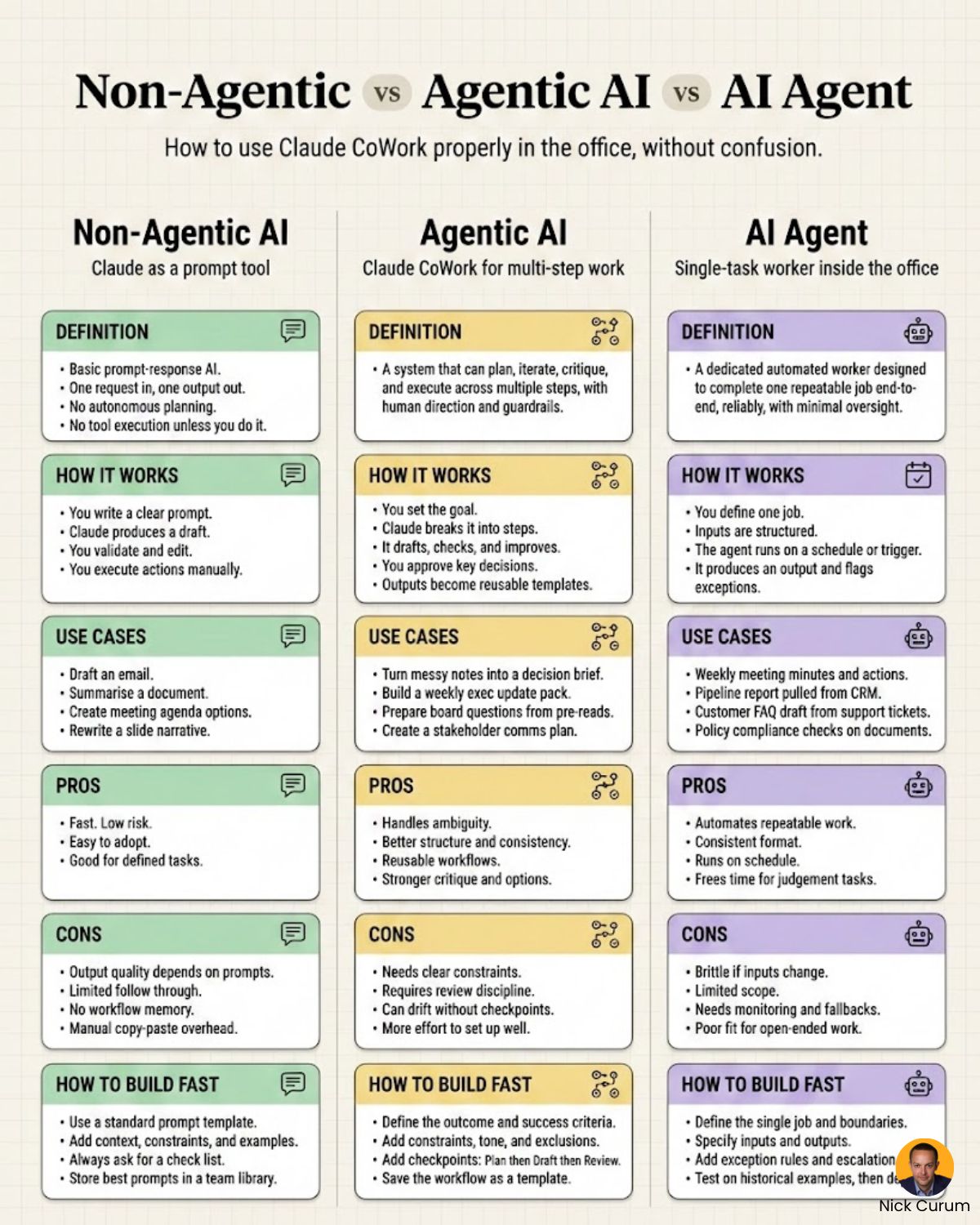
In a recent LinkedIn post, Nick Curum discusses the critical distinctions between different types of AI deployments and argues that many organizations are failing to govern them appropriately, leading to significant risk. Curum poses four direct questions to business leaders regarding their AI deployments, emphasizing the need for clarity on objectives, validation, kill conditions, and approved autonomy tiers.
Curum highlights a common misconception that all AI systems are the same, stating:
“most businesses are currently running three fundamentally different systems under one label: “AI.” Non-Agentic AI. Agentic AI. Autonomous AI Agents.”
The post meticulously breaks down these three categories, defining their characteristics, risks, and operational differences. According to Curum, Non-Agentic AI is essentially a sophisticated prompt tool where human oversight is constant, resulting in low risk but high overhead. He suggests that many organizations believe they are operating beyond this basic level, but are, in fact, still within it.
Understanding the Tiers of AI Autonomy
Curum further elaborates on the nuances of Agentic AI and Autonomous AI Agents. Agentic AI, he explains, is a multi-step workflow system where the AI plans and iterates, but human approval is required for key external decisions. While offering real leverage, Curum cautions that without defined checkpoints, these systems can quietly drift off course.
The most advanced category, Autonomous AI Agents, operates unattended, scheduled, or triggered, delivering structured output efficiently. However, Curum issues a stark warning about the potential for error:
“The efficiency gain is significant. But a misconfigured agent doesn’t make one mistake. It makes the same mistake at scale, on a schedule, until someone is paying close enough attention to notice.”
This distinction is crucial, as Curum argues that treating all AI types under a single governance policy is akin to creating one rule for a car, a lorry, and an aircraft – each has fundamentally different risk profiles and control requirements.
The Governance Gap and Board Accountability
A core concern raised by Curum is the disconnect between AI deployment reality and governance policy. He asserts that many AI strategies fail to make the necessary distinctions between autonomy tiers, leading to boards approving AI ambition without understanding the associated accountability structures.
Curum challenges leaders to reframe their governance questions. Instead of asking, “Are we investing in AI?” the critical question, in his view, should be:
“Which tier of autonomy are we authorising — and what oversight does each tier require?”
He urges organizations to apply his initial four questions to every live AI deployment to identify the gap between the claimed and governed tiers of operation, as this gap represents the true source of organizational risk. Curum concludes by encouraging leaders to share their findings, seeking to understand whether their operational reality aligns with their governance models.
📝 About This Content
This article is based on insights shared by Nick Curum on LinkedIn.
📅 Originally posted on February 26, 2026 | View original post on LinkedIn →