
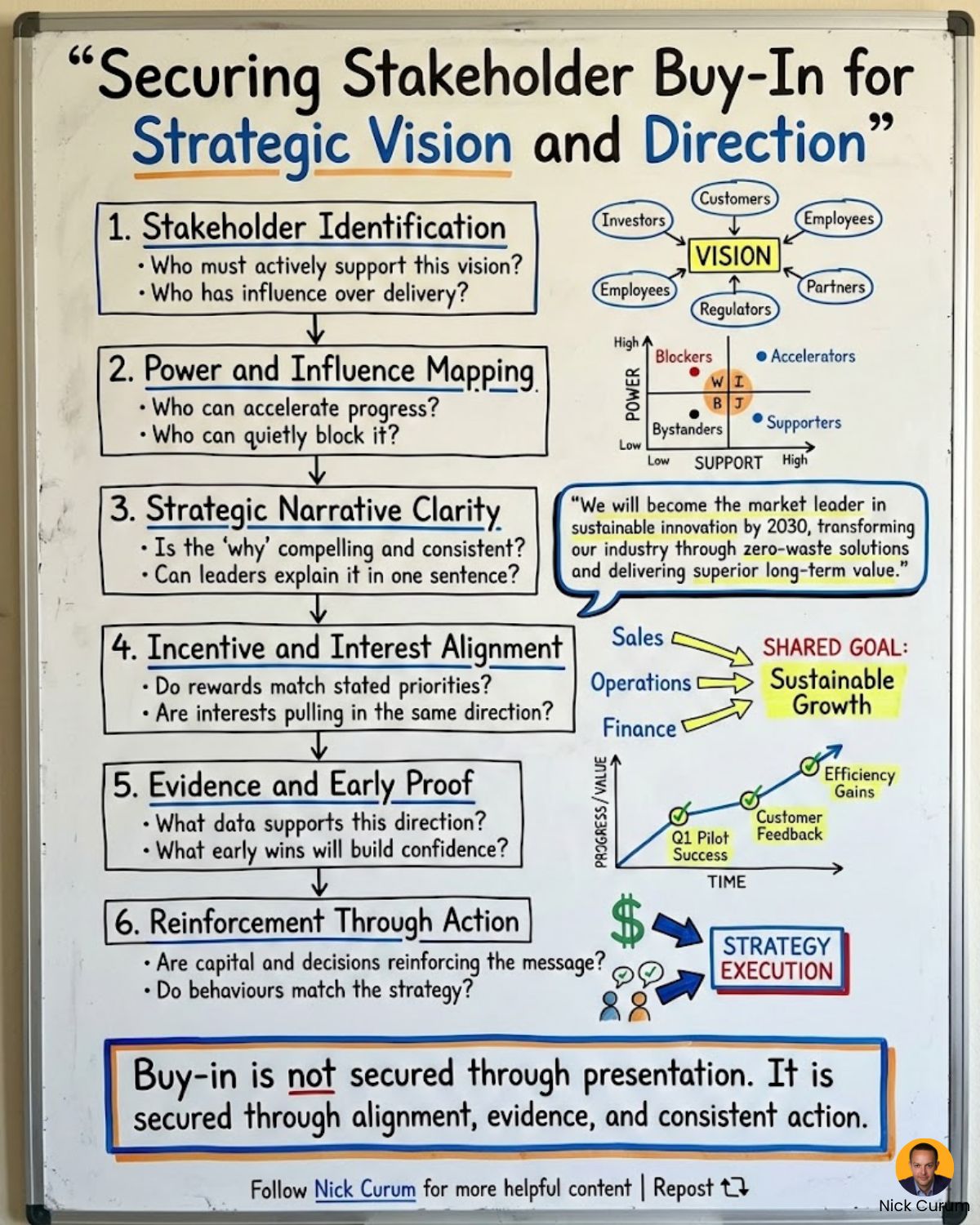
In a recent LinkedIn post, Nick Curum explores a common pitfall in strategic execution: the subtle drift away from intended goals, rather than outright failure. Curum, a strategist who often engages with corporate boards and leadership teams, argues that many strategies don’t fail because the initial vision was flawed, but because true stakeholder buy-in – a deeper form of alignment – was never fully achieved.
Curum highlights the critical difference between visible approval and invisible alignment. “Approval is visible. Alignment is invisible,” he states, underscoring a core issue that often leads to strategic derailment months down the line.
“I’ve watched boards approve ambitious strategic visions… Only to see execution stall 6–12 months later. Not from rebellion. From quiet misalignment: Incentives pulling in different directions; ‘Supporters’ who execute their own interpretation; Capital deployed inconsistently; Leaders explaining the strategy in slightly different ways.”
According to Curum, this quiet misalignment can manifest in several ways. He points to conflicting incentives, where different departments or individuals are motivated by competing goals that inadvertently pull the strategy off course. Furthermore, he notes that even well-intentioned supporters might interpret and execute the strategy based on their own understanding, leading to inconsistent application. Inconsistent capital deployment and subtle variations in how leaders communicate the strategy also contribute to this gradual drift, as Curum explains.
The Crucial Distinction: Buy-in Versus Agreement
Curum emphasizes that genuine buy-in goes beyond mere agreement. “Buy-in is not agreement. It is alignment of power, incentives, proof, and behaviour,” he writes. This comprehensive alignment ensures that all facets of the organization are rowing in the same direction, supported by the necessary resources and demonstrated by consistent actions.
Curum’s Six-Step Test for Strategic Resilience
To diagnose and prevent this strategic drift, Nick Curum proposes a six-step test that leaders and boards should conduct. This diagnostic tool aims to uncover potential weaknesses before they lead to significant deviation.
The Six Steps to Strategic Alignment
Curum outlines the following steps in his assessment:
- Stakeholder identification
- Power and influence mapping
- Strategic narrative clarity
- Incentive alignment
- Evidence and early proof
- Reinforcement through action
As Curum points out, “Most boards discover one of these is fragile. And they usually don’t notice until capital has already moved, incentives are set, and reversing course becomes political.” This often means that by the time the misalignment is recognized, the strategy has already been significantly executed in the wrong direction, making corrective action difficult and costly.
Identifying Early Warning Signs
Curum suggests that paying close attention to these six areas can help leaders identify early warning signs of silent resistance or misalignment. He plans to delve deeper into diagnostic questions for directors, signs of resistance, and a commonly misread stakeholder type in his accompanying newsletter, indicating the practical application of his framework for those responsible for strategic direction and capital allocation.
📝 About This Content
This article is based on insights shared by Nick Curum on LinkedIn.
📅 Originally posted on February 24, 2026 | View original post on LinkedIn →