
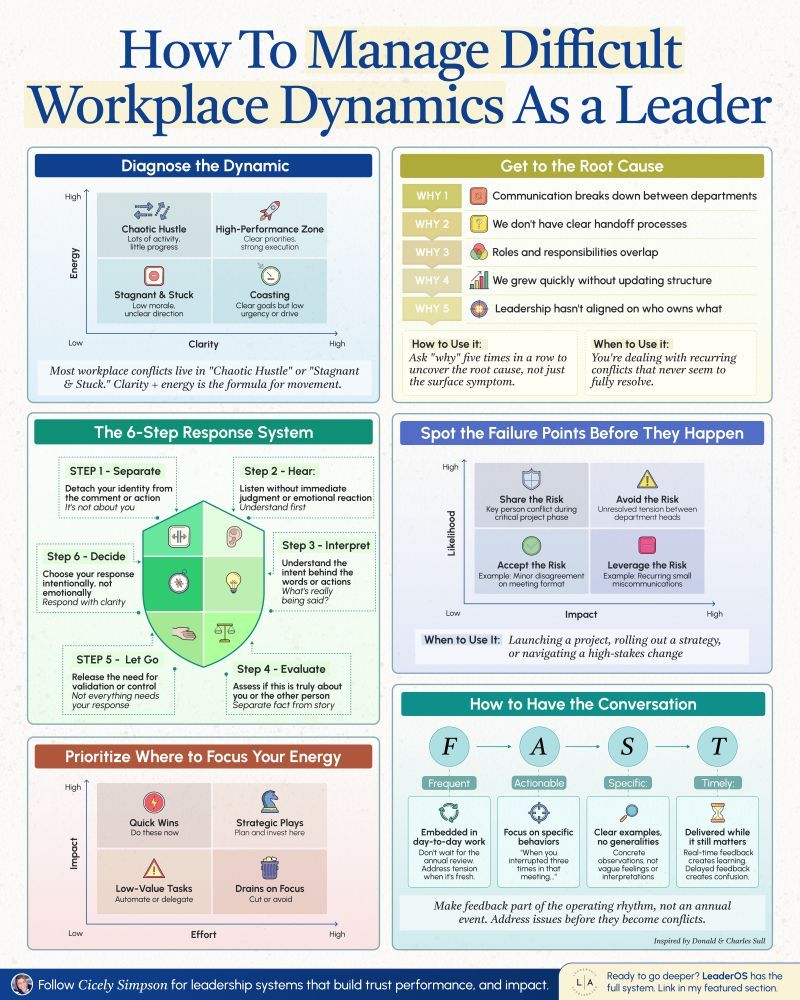
In a recent LinkedIn post, Mark O’Donnell addresses a common leadership challenge: recurring conflicts within teams that seem to resurface repeatedly. O’Donnell posits that these persistent disagreements are rarely about interpersonal issues or the complexity of the problem itself. Instead, he argues, the root cause is a lack of clarity and a failure to make decisive actions.
O’Donnell highlights the detrimental effects of unresolved conflicts, stating:
“Trust erodes, Decisions stall, Good people get tired of having the same conversation and start disengaging.”
He emphasizes that this is a “clarity problem posing as something else,” suggesting that leaders often misdiagnose the issue, leading to ineffective solutions.
Identifying the Root Cause: Clarity Over Personality
Mark O’Donnell challenges the conventional wisdom that team conflicts stem from personality clashes or difficult situations. His analysis suggests that the true culprit is often a reluctance among leaders to confront and resolve the underlying issues directly. “Recurring conflict is almost never a people problem,” O’Donnell asserts, framing it instead as a failure in clear communication and decision-making.
According to O’Donnell, the longer these issues are left unaddressed, the more damaging they become. He outlines the cascading negative impacts, including the erosion of trust, the stalling of crucial decisions, and the eventual disengagement of valuable team members who grow weary of repetitive discussions.
Three Approaches to Resolving Recurring Conflicts
O’Donnell presents three distinct strategies leaders can employ when faced with persistent team disputes, noting that most leaders tend to rely on only one:
1. The Inaction Approach: Doing Nothing
This strategy involves hoping the problem will resolve itself or attempting to manage around it. O’Donnell is quick to dismiss its effectiveness, warning:
“Spoiler: it doesn’t resolve. It just resurfaces next month with more baggage attached.”
He explains that this passive approach merely allows the issue to fester, becoming more complicated and burdensome over time.
2. The Direct Approach: Confronting the Issue Head-On
O’Donnell advocates for a more direct method, which involves identifying the individuals involved and addressing the conflict openly. He suggests initiating a conversation like, “We’re not aligned here. It’s slowing us down. Let’s fix it.” While this may feel uncomfortable, O’Donnell believes it is often met with relief.
“But nine times out of ten, the other person is relieved someone finally said it.”
This approach, according to O’Donnell, cuts through ambiguity and moves towards resolution.
3. The Collaborative Approach: Bringing Everyone Together
The third strategy involves gathering all involved parties in a single meeting to foster a unified discussion and decision. The goal, as O’Donnell outlines, is not to determine who is right but to uncover the core issue beneath the tension. He explains that when everyone hears the same information simultaneously, it prevents the spread of misinformation and facilitates genuine progress.
Key Leadership Principles for Conflict Resolution
Mark O’Donnell concludes by distilling the essence of effective leadership in managing conflict. Leaders who successfully navigate these challenges, he argues, have mastered three key principles: separating the issue from the individual, maintaining focus on the core problem, and making necessary decisions even when they are difficult.
He encourages leaders to reflect before their next challenging conversation by asking themselves:
- What is the actual issue underneath all the tension?
- Am I focused on solving it or on being right?
- What decision needs to be made, and am I willing to make it?
O’Donnell suggests that the answers to these questions provide a clear path forward, helping to overcome one of the most common obstacles hindering leadership team effectiveness.
📝 About This Content
This article is based on insights shared by Mark O'Donnell on LinkedIn.
📅 Originally posted on March 9, 2026 | View original post on LinkedIn →