
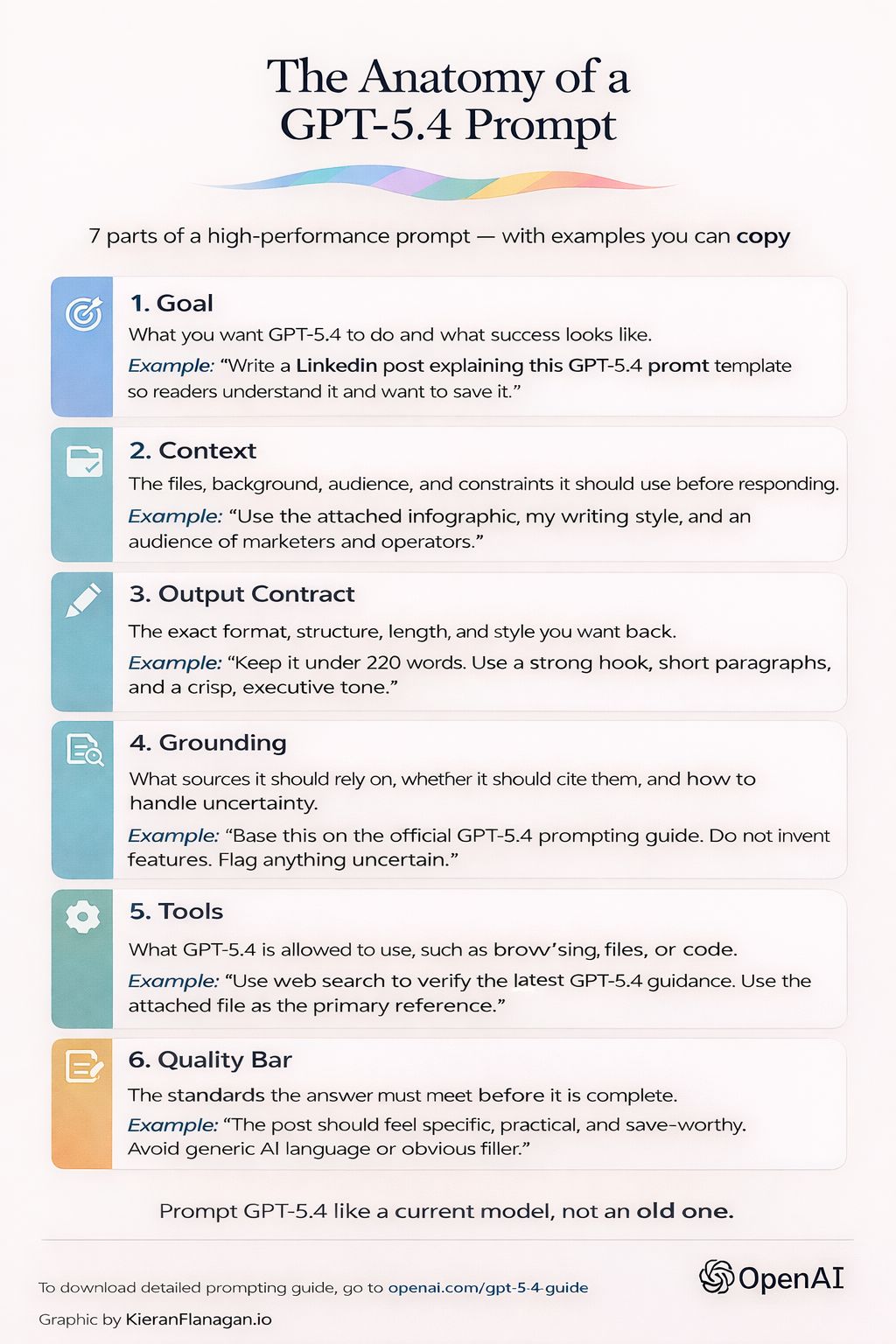
In a recent LinkedIn post, Kieran Flanagan explores a structured approach to prompting advanced AI models, specifically highlighting a template designed for GPT-5.4. Flanagan aims to demystify the process of achieving high-quality outputs from the latest AI iterations, presenting a framework that breaks down prompt engineering into six essential components.
Flanagan introduces the concept by stating,
“GPT-5.4 is here; it’s been called the best model on the planet. Here’s a prompt template you can use to get world-class results.”
This sets the stage for his detailed breakdown, emphasizing that superior AI outcomes are not accidental but rather the result of deliberate and well-crafted instructions.
The Six Pillars of Effective AI Prompting
According to Flanagan, a robust prompt template should address several key areas to guide the AI effectively. He outlines these as Goal, Context, Output Contract, Grounding, Tools, and Quality Bar.
The Goal section, as Flanagan explains, is where the user defines the specific task for the AI and what constitutes a successful completion. For instance, he suggests a goal like:
“Write a LinkedIn post explaining this GPT-5.4 prompt template so readers understand it and want to save it.”
This highlights the importance of clear objective setting.
Next, the Context component requires the user to provide essential background information, including relevant files, audience demographics, and any operational constraints. Flanagan provides an example:
“Use the attached infographic, my writing style, and an audience of marketers and operators.”
This element underscores the need for the AI to understand the environment in which its output will be used.
The Output Contract dictates the precise format, structure, length, and stylistic requirements of the AI’s response. Flanagan emphasizes the need for specificity here, noting that an example could be:
“Keep it under 220 words. Use a strong hook, short paragraphs, and a crisp, executive tone.”
Ensuring Accuracy and Reliability
Beyond the initial instructions, Flanagan’s framework addresses how to ensure the AI’s outputs are accurate and reliable. The Grounding section involves specifying the sources the AI should consult, whether it needs to cite them, and how to handle ambiguous information. Flanagan advises, “Base this on the official GPT-5.4 prompting guide. Do not invent features. Flag anything uncertain.” This directive is crucial for maintaining factual integrity.
Furthermore, the Tools section defines what capabilities the AI is permitted to use, such as web browsing, file access, or code execution. Flanagan suggests including instructions like, “Use web search to verify the latest GPT-5.4 guidance. Use the attached file as the primary reference.” This allows for leveraging the AI’s full potential while maintaining control.
Finally, the Quality Bar sets the standards the AI’s output must meet to be considered complete. Flanagan illustrates this with a quality benchmark such as: “The post should feel specific, practical, and save-worthy. Avoid generic AI language or filler.” This final step ensures that the AI’s work aligns with the user’s expectations for excellence.
Flanagan concludes his post by suggesting that users can download this prompt template and instruct ChatGPT to save it to memory for consistent use. This practical advice aims to empower users to leverage advanced AI models more effectively and efficiently, fostering a more sophisticated interaction with generative AI technology.
📝 About This Content
This article is based on insights shared by Kieran Flanagan on LinkedIn.
📅 Originally posted on March 6, 2026 | View original post on LinkedIn →