
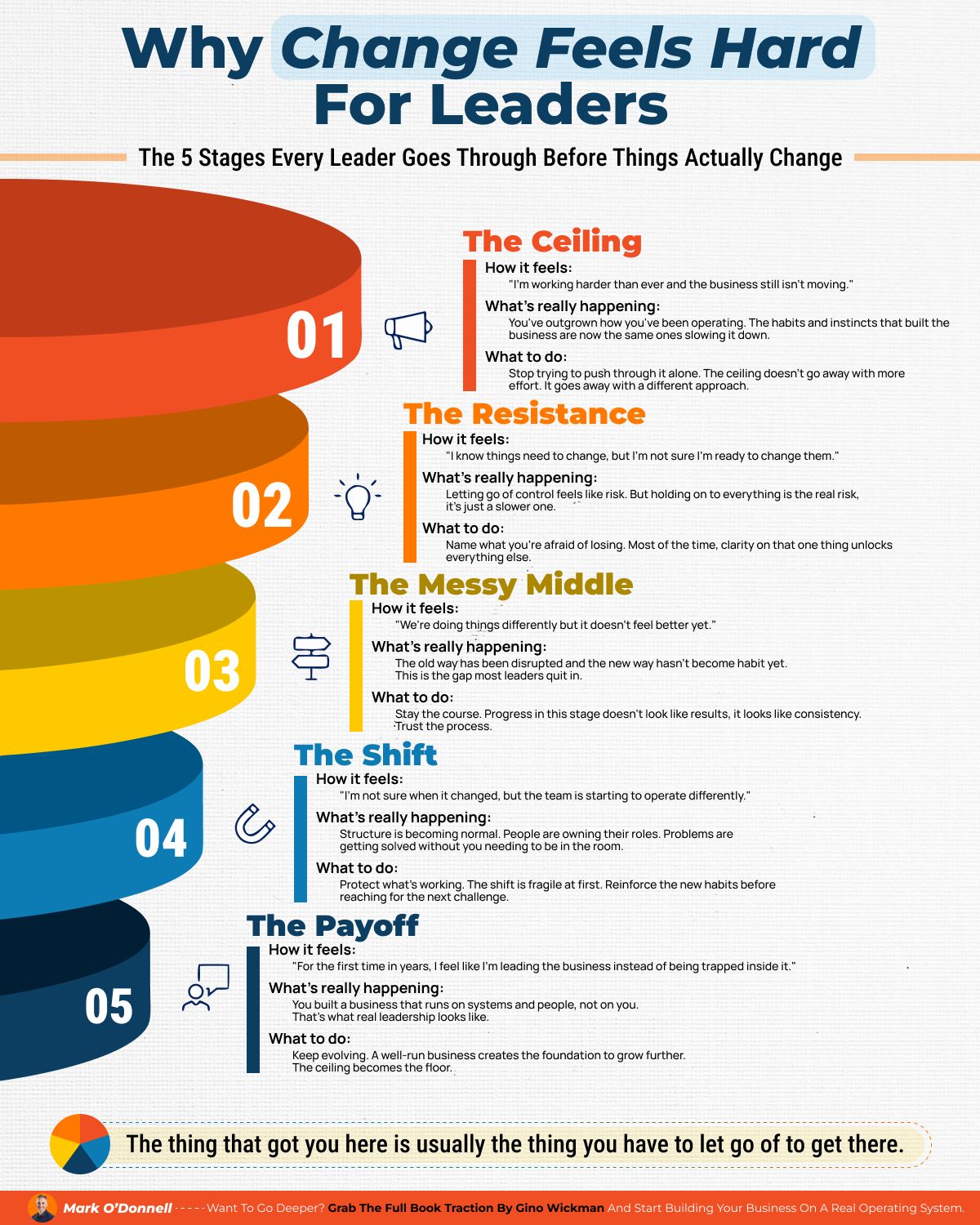
In a recent LinkedIn post, Mark O’Donnell explores the common leadership challenge of hitting a “ceiling” and offers a framework for navigating the often uncomfortable process of change. O’Donnell posits that leaders themselves are frequently the cause of these plateaus, not due to a lack of drive, but because the very strategies that led to their initial success become obstacles to future growth.
He highlights the inherent difficulty leaders face when asked to abandon what made them successful, such as control, speed, or the tendency to handle tasks themselves. These methods, while effective initially, eventually become limiting factors. O’Donnell states:
“Change doesn’t feel hard for leaders because they lack drive or commitment. It feels hard because the thing they’re being asked to let go of is the exact thing that made them successful.”
The Leader’s Unseen Obstacle: Control and Comfort
Mark O’Donnell argues that the resistance to change stems from a deep-seated attachment to the methods that have historically yielded positive results. This attachment, he explains, creates a psychological barrier that makes adaptation feel like a step backward rather than a leap forward.
Stage 1: Recognizing The Ceiling
O’Donnell identifies the first stage as “The Ceiling,” characterized by increased effort yielding diminishing returns. Leaders in this phase often find themselves working harder than ever, yet the business remains stagnant. As O’Donnell points out:
“The instincts that got you here are the same ones holding you back now.”
This realization signals the need for a fundamental shift in approach, moving beyond the familiar and comfortable strategies that have reached their limit.
Navigating the Stages of Transformation
The leadership coach outlines a five-stage process that individuals typically move through before genuine change can take root. This journey, while challenging, offers a roadmap for overcoming the internal and external hurdles associated with significant transformation.
Stage 2: Confronting Resistance
The second stage, “The Resistance,” involves acknowledging the need for change while grappling with the fear of letting go. O’Donnell notes the paradox leaders face: holding on feels unsafe, yet relinquishing control feels like a loss. He advises leaders to confront their fears directly, asking them to:
“Name what you’re actually afraid of losing.”
This introspection is crucial for moving past the initial inertia.
Stage 3: Embracing the Messy Middle
O’Donnell describes “The Messy Middle” as the critical, yet often abandoned, phase where new approaches are implemented but haven’t yet yielded discernible benefits. This period is characterized by disruption to old systems without the full establishment of new ones, leading many leaders to give up prematurely. O’Donnell emphasizes the importance of consistency during this stage, stating, “Results come later.”
Stage 4: Experiencing the Shift
The fourth stage, “The Shift,” marks a subtle but significant change where the team begins to operate more autonomously. O’Donnell observes that problems are resolved without the leader’s direct intervention, and individuals take greater ownership of their roles. He cautions that this nascent shift is fragile and requires protection to become permanent.
Stage 5: Realizing the Payoff
Finally, “The Payoff” stage is reached when leaders feel they are truly guiding the business rather than being consumed by its day-to-day operations. O’Donnell describes this as building a sustainable organization founded on clear structures and capable people. He concludes his analysis with a powerful metaphor:
“The ceiling you broke through doesn’t disappear. It becomes the floor you build from.”
Mark O’Donnell’s insights provide a valuable framework for leaders experiencing stagnation, offering a clear path through the difficult but ultimately rewarding process of transformative change.
📝 About This Content
This article is based on insights shared by Mark O'Donnell on LinkedIn.
📅 Originally posted on March 3, 2026 | View original post on LinkedIn →