
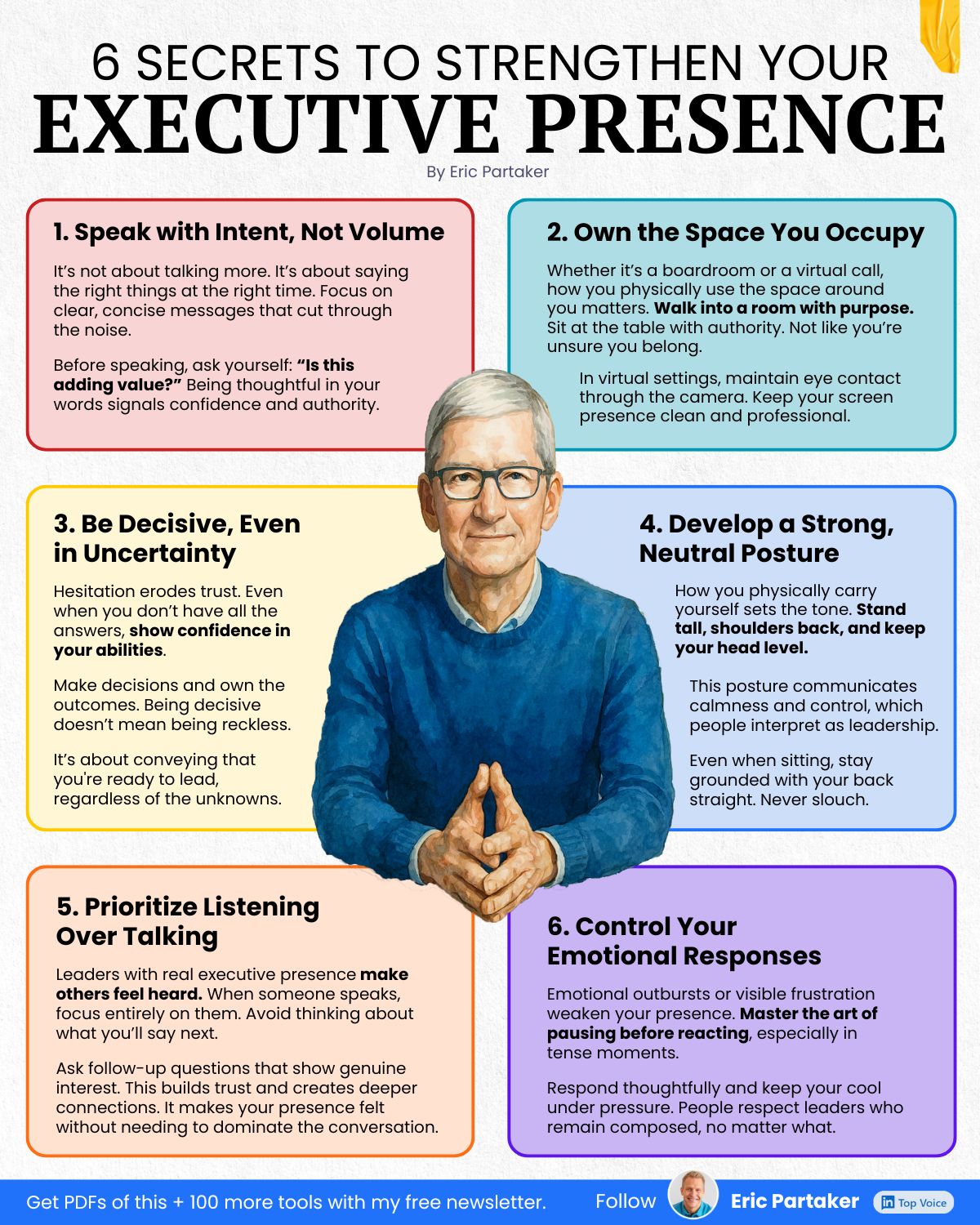
In a recent LinkedIn post, Eric Partaker explores the critical, yet often overlooked, aspect of executive presence and how it functions as a “silent superpower” for leaders. Partaker emphasizes that how a leader presents themselves, even before speaking, significantly impacts their ability to build trust, influence decisions, and inspire confidence.
Partaker begins by posing a fundamental question: “Your presence speaks before you do. But the real question is: What’s it saying?” He posits that for individuals in key roles—whether leading teams, seeking investment, or presenting to boards—executive presence is paramount.
“If you’re: — Leading a team — Hiring top talent — Raising investment — Influencing decisions — Building partnerships — Presenting to your board Then executive presence is your silent superpower.”
The Foundations of Executive Presence
The post outlines six actionable strategies for cultivating this essential leadership trait. Partaker stresses that genuine executive presence is not about dominating a room, but rather about inspiring trust and confidence through deliberate actions and demeanor.
Speaking with Impact
One of the core tenets Partaker highlights is the power of concise communication. He advises leaders to “Speak Less, Say More,” emphasizing that impactful leaders don’t waste words. Instead, they ensure their message is clear, valuable, and lands effectively. The key is to ask, “Is this adding value?” and to make every word count.
“People with presence don’t ramble. They land their message. Make your words do the heavy lifting.”
Non-Verbal Communication is Key
Partaker dedicates significant attention to non-verbal cues, arguing that presence begins long before words are exchanged. This includes how one walks, sits, and even their virtual presentation.
- Physical Demeanor: “Walk in with purpose. Sit like you earned the seat.” Partaker suggests that posture is a direct indicator of confidence and self-assurance.
- Virtual Presence: For remote interactions, Partaker notes the importance of maintaining eye contact, ensuring a clean background, and adopting a confident posture.
- Posture and Confidence: He directly links posture to perceived confidence, stating, “Slouching says: ‘I’m unsure.’ Straight back. Shoulders open. Chin up.”
Decision-Making and Active Listening
Beyond physical presentation, Partaker identifies decisive action and attentive listening as crucial components of executive presence. He argues that leadership involves making decisions, even difficult ones, and taking ownership of the outcomes.
“Uncertainty kills trust. You don’t need every answer. You need to move. Make the call. Own the outcome. That’s real leadership.”
Furthermore, Partaker emphasizes the significance of active listening. He advises leaders not to merely wait for their turn to speak but to genuinely “Actually hear them.” By asking sharper questions and making people feel truly seen and heard, trust is rapidly built. This attentive approach, he suggests, is fundamental to fostering strong relationships and effective collaboration.
Managing Pressure
Finally, Partaker touches on the ability to manage pressure. He posits that pressure doesn’t break leaders but rather reveals their true character. The advice is to pause, breathe, and then respond, noting that “Calm earns confidence.” This measured response in high-stakes situations is a hallmark of strong executive presence.
In conclusion, Eric Partaker’s insights on LinkedIn underscore that executive presence is a cultivated skill, built on mindful communication, confident non-verbal cues, decisive action, and empathetic listening. It is, as he puts it, the “silent superpower” that enables leaders to inspire trust and achieve their objectives before uttering a single word.
📝 About This Content
This article is based on insights shared by Eric Partaker on LinkedIn.
📅 Originally posted on March 3, 2026 | View original post on LinkedIn →