
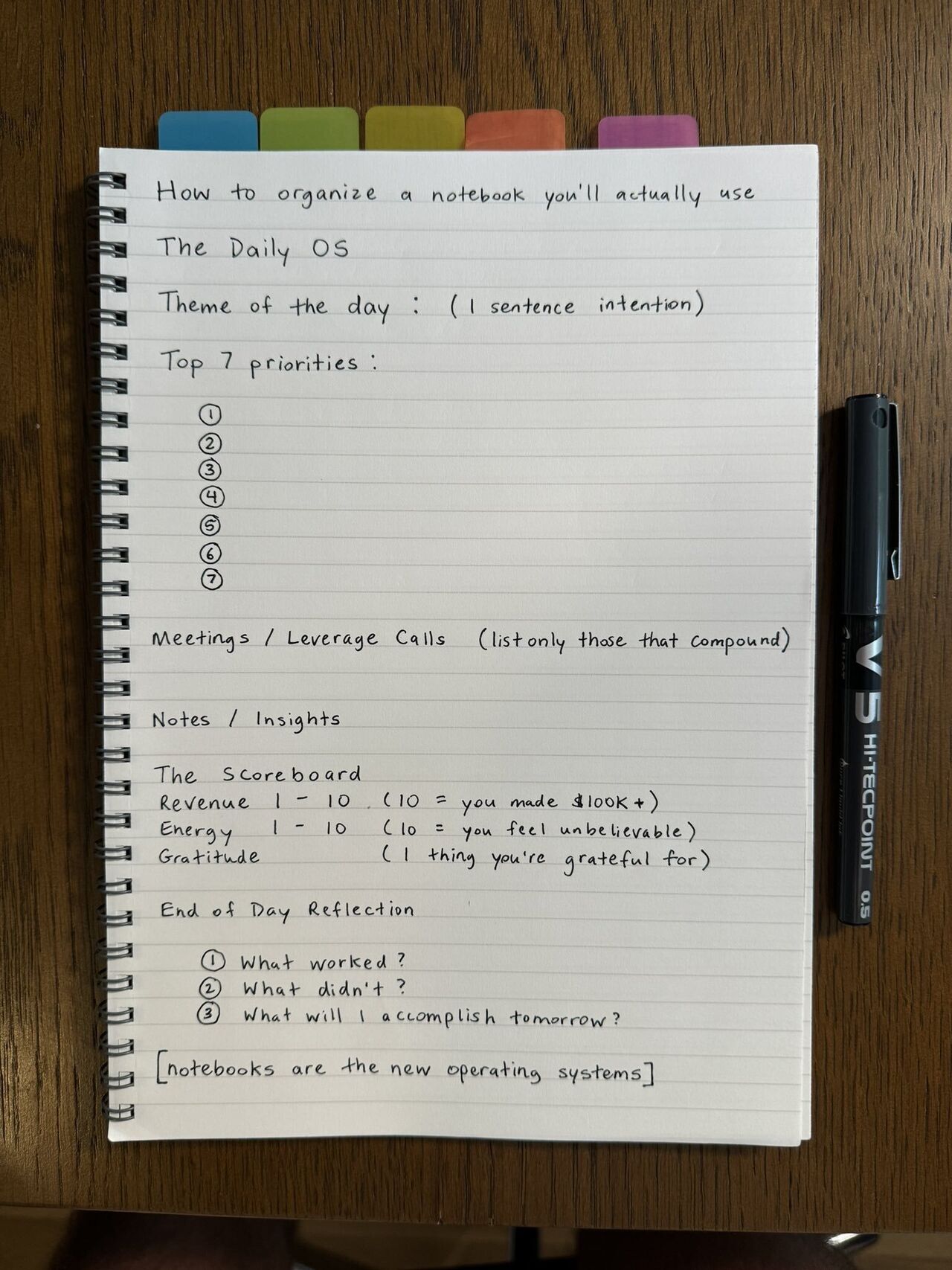
In a recent LinkedIn post, Matt Gray explores a novel approach to productivity for founders, suggesting that traditional notebooks can serve as powerful “operating systems” in an era dominated by digital tools. Gray challenges the efficacy of numerous productivity apps, advocating instead for a return to paper-based systems that he believes foster deeper focus and clarity.
Gray outlines a framework he calls “The Daily OS,” designed to be a one-page system that founders can actually stick with. He begins by highlighting a common founder struggle: the proliferation of half-filled notebooks. “Most founders have 17 half-filled notebooks scattered across their desk, car, and backpack,” Gray writes, illustrating the widespread issue of abandoned productivity attempts.
The Core Components of ‘The Daily OS’
Gray’s system is built around several key principles, each designed to bring intention and focus to the founder’s day. He emphasizes that this is not about creating an exhaustive to-do list, but rather about setting a clear direction.
1. Theme of the Day
Gray suggests starting each day by defining its core intention. This could be “Today is about deep creative work,” “Today is about strategic planning,” or “Today is about connecting with my team.” As Gray notes, “This single sentence filters every decision you make.” This intentional framing aims to guide actions and priorities throughout the day.
2. Top 7 Priorities
Moving beyond overwhelming task lists, Gray advocates for identifying only seven key priorities. He argues that the inability to narrow down priorities to this number indicates a lack of clarity. “If you can’t pick seven, you don’t have clarity yet,” he states. These priorities should be based on impact rather than mere urgency.
3. Meetings and Leverage Calls
A critical filter proposed by Gray involves evaluating meetings and calls based on their potential to create leverage versus consume time. He advises declining or delegating anything that doesn’t offer compounding benefits. “Only write down the calls that actually move needles,” Gray instructs, pushing founders to be highly selective about time commitments.
4. Notes and Insights
Immediate capture of insights is another cornerstone of the system. Gray stresses the importance of writing down thoughts and ideas as they occur, rather than relying on memory. “Write it down in the moment,” he urges. This practice, he explains, transforms the notebook into a “second brain.”
5. The Scoreboard
Gray introduces a daily tracking mechanism for three key metrics: Gratitude (one thing), Energy level (on a 1-10 scale), and Revenue progress (on a 1-10 scale). He believes that “Numbers don’t lie” and that this scoreboard can reveal crucial patterns that might otherwise go unnoticed.
6. End of Day Reflection
The system concludes with a brief, two-minute reflection process. Founders are prompted to ask: What worked? What didn’t? What will I accomplish tomorrow? Gray posits that this simple practice, when done consistently, leads to significant long-term clarity.
Why Paper Over Digital?
Gray explains the effectiveness of his notebook-centric approach by contrasting it with digital alternatives. He highlights several key advantages:
- Writing activates the brain differently than typing.
- Paper lacks the distracting notifications inherent in digital devices.
- The system forces tracking of what truly matters, addressing the principle that “you can’t optimize what you don’t track.”
By eliminating the need for apps, syncing, and constant notifications, “The Daily OS” aims to provide a focused, intentional, and sustainable productivity framework for busy founders. As Gray concludes, the entire system is designed to fit on a single page, requiring only a notebook and a pen.
📝 About This Content
This article is based on insights shared by Matt Gray on LinkedIn.
📅 Originally posted on March 2, 2026 | View original post on LinkedIn →