
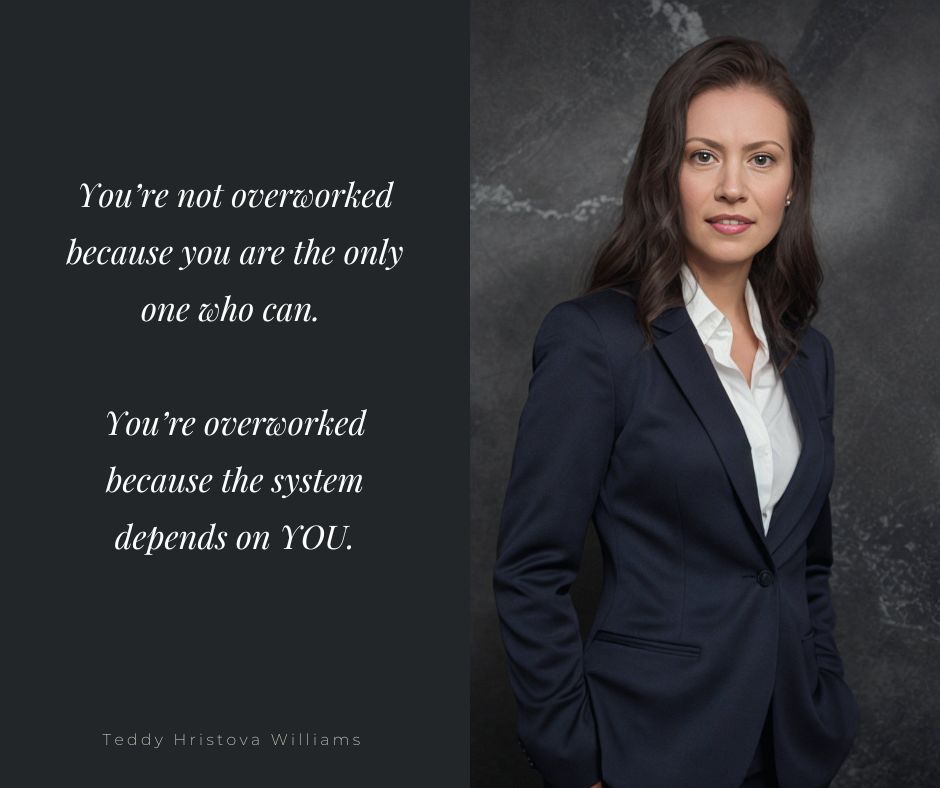
In a recent LinkedIn post, Teddy Hristova Williams delves into a common paradox faced by many high-achievers: the feeling of being overworked not due to a lack of capability, but because the very systems they operate within have become dependent on them. Williams challenges the conventional belief that overwork stems from being the sole person capable of performing certain tasks.
Instead, Teddy Hristova Williams argues that the root cause is often a system designed around an individual’s strengths, rather than fostering shared responsibility. This can lead to capable leaders becoming trapped in a cycle of doing work that, ideally, should be distributed.
“You’re overworked because the System Depends on You.”
Williams elaborates on how this dependency takes root. When expectations are unclear, when admitting mistakes feels too risky, or when a leader has a proven track record of solving a particular problem, individuals naturally gravitate back to them. Over time, this pattern solidifies into the default operating model.
The Systemic Trap for Capable Leaders
Teddy Hristova Williams highlights that this situation doesn’t arise from a leader’s shortcomings but from the architecture of the workflow. The issue isn’t about a leader needing to be less capable; rather, it’s about creating a system that leverages capability without fostering unhealthy dependency.
As Teddy Hristova Williams points out:
“This is how capable leaders get trapped in work they shouldn’t be doing. Not because they’re bad at leading but because the system keeps routing everything to them.”
The core of the problem, according to Williams, lies in the design of the system. When work consistently flows back to a single point person, it indicates a systemic flaw rather than an individual deficit. This reliance can stifle team growth and overburden the individual, even if they are highly competent.
Shifting from Dependency to Redesign
The crucial shift, as outlined by Teddy Hristova Williams, involves recognizing this systemic dependency. Once leaders understand that their overwork is a symptom of system design, their approach changes dramatically. Instead of focusing on working harder or becoming more efficient within a flawed structure, the emphasis moves towards actively redesigning how work flows.
Teddy Hristova Williams suggests:
“Once leaders see this, everything changes. They stop trying to work harder and start redesigning the way work moves.”
This perspective encourages leaders to examine their workflows, identify bottlenecks, and implement structures that distribute responsibility and empower team members. The goal is to build a resilient system where individual strengths are utilized without creating an indispensable single point of failure.
For leaders seeking to identify these patterns within their own operations, Williams offers a direct invitation to connect and explore how their systems might be unintentionally creating dependencies.
📝 About This Content
This article is based on insights shared by Teddy Hristova Williams on LinkedIn.
📅 Originally posted on March 11, 2026 | View original post on LinkedIn →