
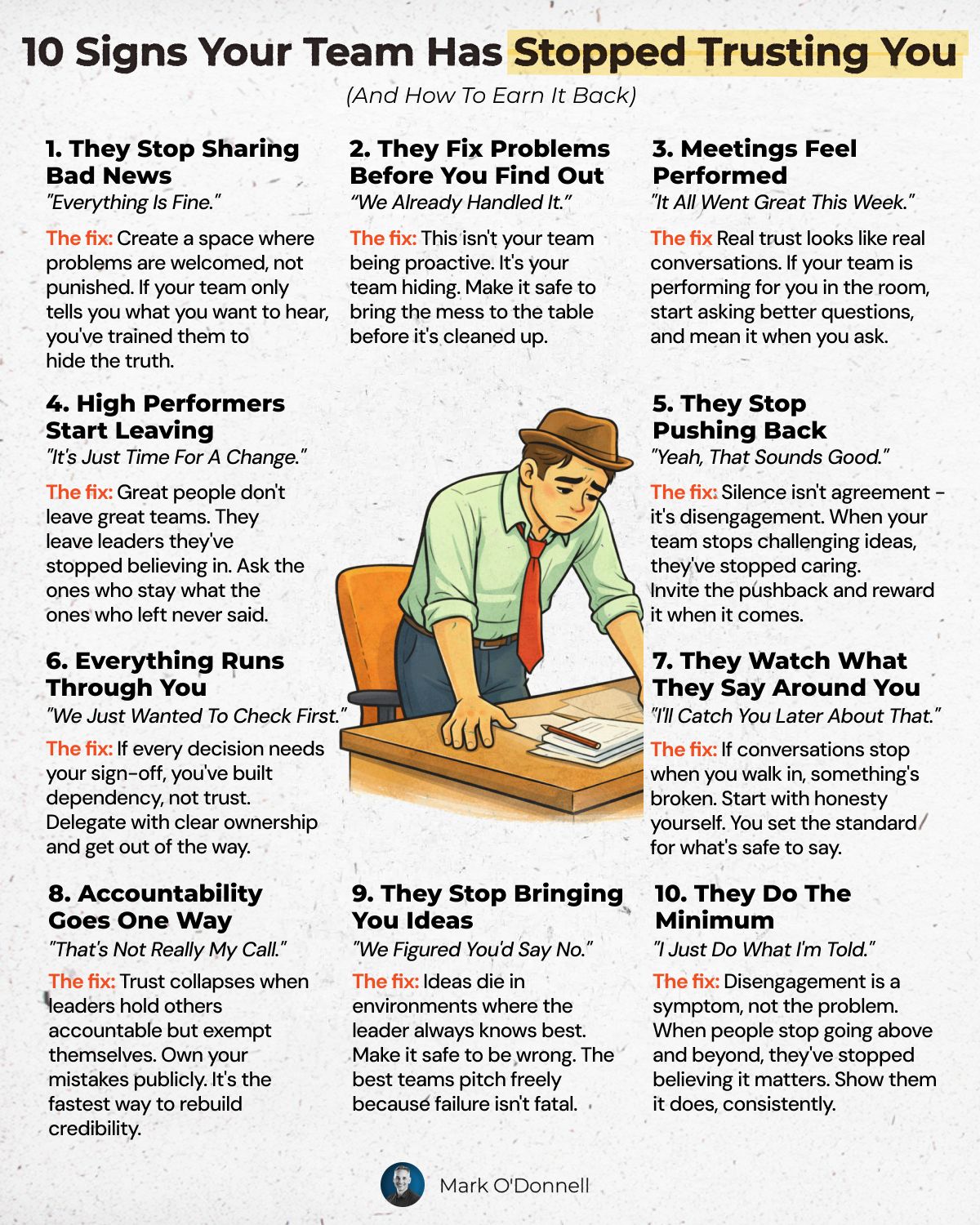
In a recent LinkedIn post, Mark O’Donnell discusses the often-overlooked signs that indicate a leader has lost their team’s trust. O’Donnell emphasizes that this erosion of trust is rarely a sudden event but a gradual process, often missed by leaders until it’s too late.
He highlights the uncomfortable truth that teams typically do not vocalize their loss of faith. Instead, trust deteriorates through subtle signals that most leaders overlook. O’Donnell states:
“It happens quietly, over time, in small signals most leaders miss.”
To help leaders avoid being blindsided, O’Donnell outlines ten key indicators that suggest trust may be waning within their team.
The Subtle Signals of Eroding Trust
Mark O’Donnell argues that the decline of trust is marked by a series of quiet, incremental changes in team dynamics. He points out that teams may start filtering information, selectively sharing only positive news, which signals that negative feedback is not welcome.
Misplaced Autonomy and Stalled Conversations
According to O’Donnell, a significant sign is when decisions begin to be made without the leader’s direct involvement. This doesn’t necessarily stem from a lack of respect, but rather from a perception that involving the leader would create unnecessary friction. He advises leaders to look for patterns rather than isolated incidents.
“Decisions get made without you It’s not that they don’t respect. Just that involving you creates friction.”
Furthermore, O’Donnell notes that meetings can become rehearsed, lacking genuine interaction. When team members merely perform for the room instead of engaging in authentic dialogue, it suggests a disconnect. He also points to the chilling effect leaders can have when conversations halt abruptly upon their arrival, indicating an environment where open communication is not fostered.
The Impact on Team Performance and Retention
Mark O’Donnell links the erosion of trust directly to team performance and retention. He observes that when trust diminishes, the best employees are often the first to leave, as strong individuals tend to stay with strong, trusting teams.
“Strong people don’t walk away from strong teams.”
He also identifies a concerning trend where team members stop challenging ideas or offering pushback. O’Donnell clarifies that silence does not equate to agreement; it often signifies a lack of investment in the team’s direction. When team members cease to challenge ideas, they have effectively stopped contributing fully.
Dependency vs. Empowerment
Another critical sign O’Donnell highlights is when all decisions still need to pass through the leader, indicating a problem of dependency rather than a cohesive team. He suggests that leaders who micromanage and retain ultimate sign-off have built reliance, not a self-sufficient unit. Empowering the team and stepping back is crucial for fostering ownership.
“If no decision gets made without your sign-off, you have a problem. You’ve built dependency, not a team.”
O’Donnell also touches upon the cessation of new ideas and the decline of discretionary effort. When employees believe their input will be rejected or that going the extra mile won’t make a difference, they stop contributing beyond the minimum requirements. As Mark O’Donnell concludes, rebuilding trust requires honest conversations, consistent behavior, and a leader’s willingness to self-reflect and address underlying issues.
📝 About This Content
This article is based on insights shared by Mark O'Donnell on LinkedIn.
📅 Originally posted on March 11, 2026 | View original post on LinkedIn →