
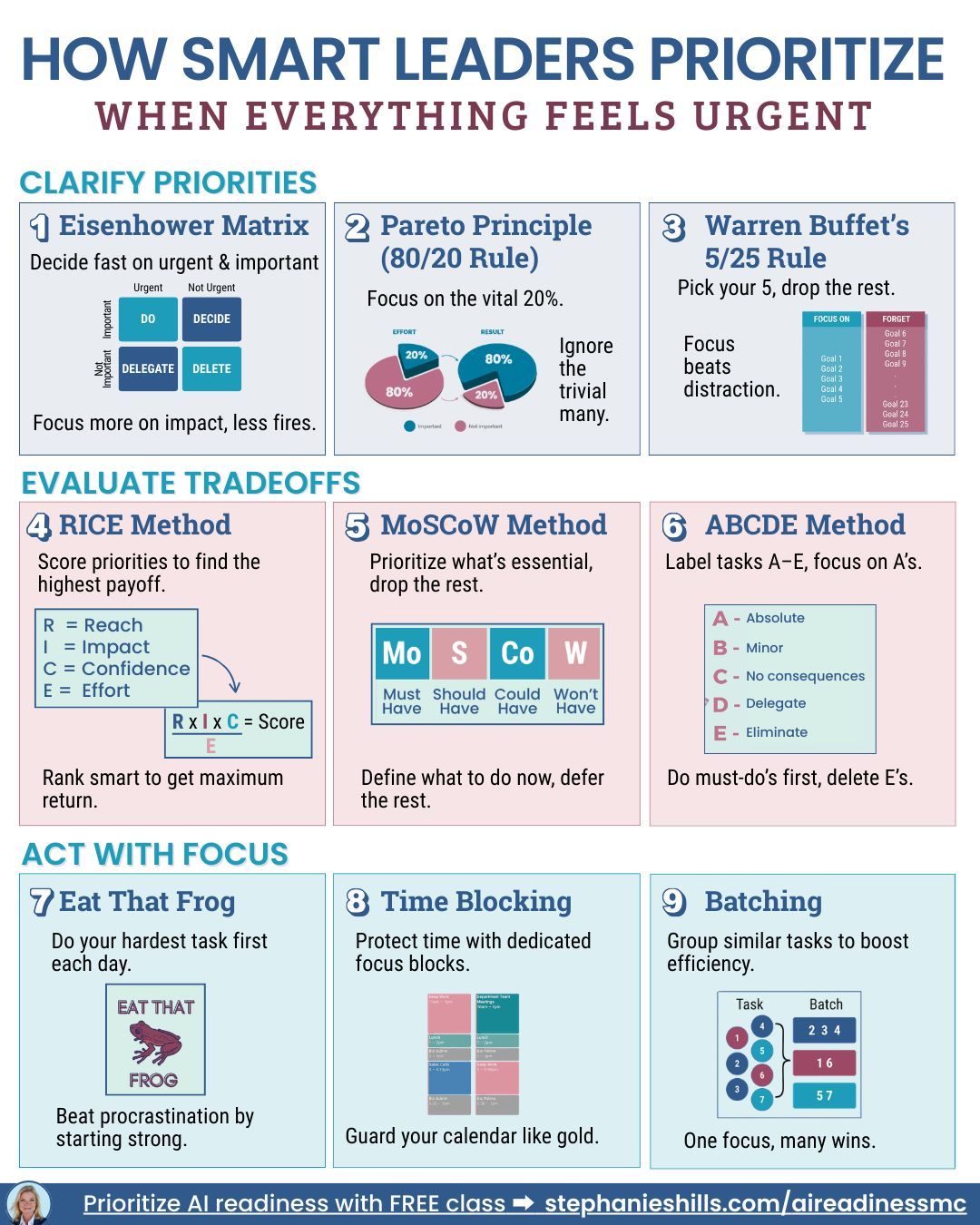
In a recent LinkedIn post, Ani Filipova discusses the persistent challenge many professionals face in implementing well-established productivity frameworks, arguing that artificial intelligence offers a powerful solution to bridge the gap between knowledge and execution.
Filipova highlights that many popular productivity strategies, such as the Eisenhower Matrix (1954) and the Pareto Principle (1896), are decades old and widely known, yet consistently fall by the wayside when faced with the daily demands of modern work. She points out the common scenario where these frameworks remain in a “bookmark folder” when faced with an overflowing inbox, urgent requests, and back-to-back meetings.
“The problem was never knowledge. It was bandwidth.”
This core issue, according to Filipova, is where AI can fundamentally change the game. She clarifies that AI is not intended to replace these historical frameworks but rather to make them practical and usable in real-time.
Leveraging AI for Prioritization with Established Frameworks
Filipova outlines several ways AI can assist in applying these frameworks, emphasizing the necessity of providing the AI with specific context, including tasks, goals, constraints, and thought processes. She details how AI can help:
Clarifying Priorities
- Eisenhower Matrix: Users can paste their task list and ask AI to sort it into the four quadrants (Urgent/Important) based on their specific role and objectives.
- Pareto Principle (80/20 Rule): AI can analyze activities to identify which ones yield the most significant results compared to where time is actually being spent.
- Buffett’s 5/25 Rule: By sharing goals, individuals can ask AI to challenge and identify the top five priorities that truly deserve focused attention.
“The thinking stays human. The execution gets faster.”
AI for Evaluating Trade-offs and Taking Action
Beyond prioritization, Filipova explains how AI can aid in evaluating trade-offs and fostering focused action. She suggests AI can assist with methods like:
Evaluating Trade-offs
- RICE Method: AI can score projects based on Reach, Impact, Confidence, and Effort after being provided with project details.
- MoSCoW Method: AI can categorize deliverables into Must, Should, Could, and Won’t categories, considering deadlines.
- ABCD Method: For a daily to-do list, AI can label tasks from A to E, providing justification for each rating.
Acting with Focus
- Eat That Frog: AI can identify the task most likely to be procrastinated on and break it down into three manageable starting steps.
- Time Blocking: AI can help draft an ideal weekly schedule tailored to individual priorities and energy levels.
- Batching: AI can group similar tasks and suggest optimal time blocks for their completion.
Filipova stresses that while AI enhances execution speed, the critical thinking and strategic direction remain human-driven. She connects these AI-powered applications to the curriculum taught in her AI Accelerator program, noting that the difficulty has never been in knowing the frameworks, but in their consistent application.
“Because knowing the framework was never the hard part. Using it consistently was. Now you can.”
This approach is a core component of her Portfolio Career Accelerator, with the second cohort set to begin on April 27th. Filipova encourages those interested to learn more via a provided link or her Featured section.
📝 About This Content
This article is based on insights shared by Ani Filipova on LinkedIn.
📅 Originally posted on March 16, 2026 | View original post on LinkedIn →