
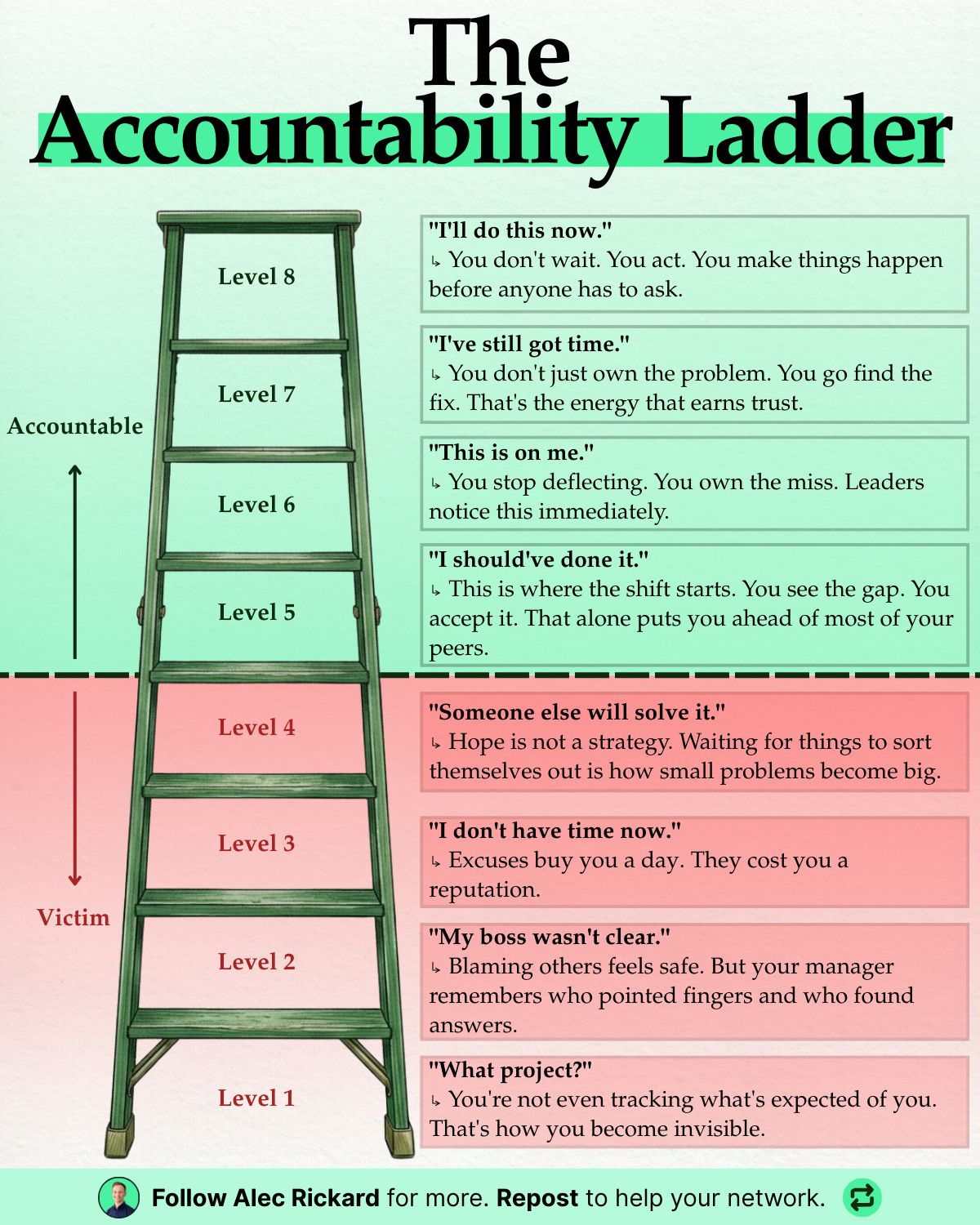
In a recent LinkedIn post, Alec Rickard delves into a critical factor he believes is often overlooked in career progression: ownership. Rickard, who has managed teams across various levels, argues that the distinction between those who advance and those who are overlooked frequently hinges on their position on what he terms the “Accountability Ladder.” He posits that a lack of ownership, rather than a deficiency in skills, is the primary impediment to career growth.
Rickard outlines an eight-level framework to illustrate this concept, starting with a low level of engagement and responsibility and progressing towards proactive problem-solving and initiative. He begins by describing the lowest rungs of the ladder, which he suggests lead to invisibility and stagnation.
“Level 1: ‘What project?’ ↳ You’re not even tracking what’s expected of you. That’s how you become invisible.”
According to Rickard, operating at these initial levels, characterized by a lack of awareness or a tendency to blame others, keeps individuals feeling comfortable but ultimately powerless. He identifies Level 4, where individuals might think, “Someone else will solve it,” as a particularly detrimental stage, as it allows small issues to escalate.
The Shift Towards Proactive Ownership
The turning point, Rickard suggests, occurs when individuals move beyond the initial levels of avoidance and excuse-making. He highlights Level 5, “I should’ve done it,” as the beginning of a crucial mental shift. This is the stage where an individual recognizes a gap or a mistake and begins to accept responsibility, a step that Rickard believes immediately sets them apart.
“Level 5: ‘I should’ve done it.’ ↳ This is where the shift starts. You see the gap. You accept it. That alone puts you ahead of most of your peers.”
Rickard further elaborates on the higher levels of the Accountability Ladder, emphasizing the proactive and solution-oriented mindset required for true career advancement. At Level 6, “This is on me,” individuals stop deflecting and own their mistakes, a behavior that leaders readily notice. As Rickard notes, this is a direct signal of developing leadership potential.
Taking Initiative and Making Things Happen
The subsequent levels, 7 and 8, represent a commitment to not just owning problems but actively seeking and implementing solutions. Level 7, “I’ve still got time,” signifies an individual who not only accepts responsibility but also proactively seeks out the fix. This energy, Rickard argues, is what builds trust and demonstrates reliability.
“Level 8: ‘I’ll do this now.’ ↳ You don’t wait. You act. You make things happen before anyone has to ask.”
This final level, according to Rickard, embodies the proactive spirit that drives success. Individuals operating at this level don’t wait for directives; they take action and ensure tasks are completed efficiently, often before they become critical issues. Rickard contrasts the perceived comfort of the lower levels with the powerful trajectory offered by embracing the discomfort of higher accountability.
The Hardest Jump: Ego vs. Career
Rickard concludes by pinpointing the transition from Level 4 to Level 5 as the most challenging. This is the critical juncture where individuals must choose between protecting their ego and investing in their long-term career development. By embracing ownership, even when uncomfortable, individuals can transform their career trajectory.
Rickard prompts readers to honestly assess their current operating level on the Accountability Ladder, suggesting that self-awareness is the first step toward personal and professional growth.
📝 About This Content
This article is based on insights shared by Alec Rickard on LinkedIn.
📅 Originally posted on March 15, 2026 | View original post on LinkedIn →