
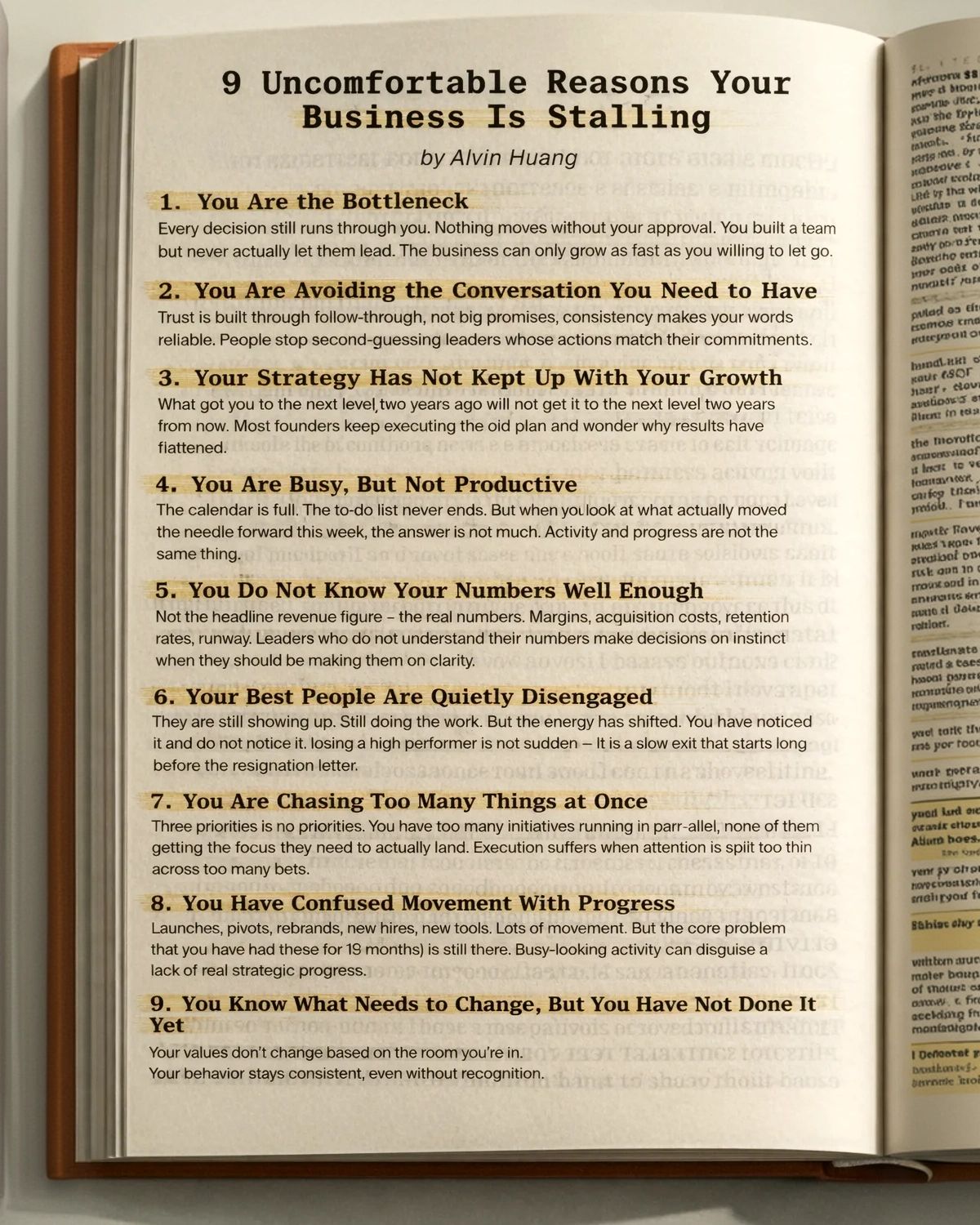
In a recent LinkedIn post, Alvin Huang delves into the often unspoken reasons why businesses stall, asserting that many problems are not inherently complex but rather difficult to confront directly. Huang emphasizes that while no one intentionally hinders their business, founders frequently perpetuate issues they are aware of.
Identifying the Core of Business Plateaus
Alvin Huang draws from personal experience, recounting a period at Truegenics where growth stagnated. He admits that his initial focus was on external factors like market conditions and competition. However, Huang realized the root causes were much closer to home. He outlines nine “uncomfortable reasons” that can impede business progress:
“90% of business problems aren’t that complicated. They’re just uncomfortable to say out loud.”
The Founder as a Bottleneck and the Avoided Conversation
One of the primary issues Huang identifies is the founder acting as a bottleneck. This occurs when leaders hire a team but fail to delegate effectively, thereby limiting the business’s capacity to scale. As Huang puts it:
“You hired a team but never actually handed them the wheel. The business can only scale as fast as you’re willing to let go.”
Another critical point raised by Huang is the tendency to avoid necessary, albeit uncomfortable, conversations. These might involve addressing a problematic team member, an inefficient process, or a persistent issue. Huang argues that the delay in confronting these matters often incurs a greater cost than the conversation itself.
Strategy, Productivity, and Financial Clarity
Huang also highlights that a business’s strategy may not have evolved to match its current stage of development. He explains that strategies effective in the past can become a limiting factor for future growth. Furthermore, he distinguishes between being busy and being productive, urging leaders to assess whether their activities are genuinely moving the business forward.
A lack of deep understanding of key financial metrics is another concern. Huang stresses the importance of knowing not just revenue, but also margins, customer acquisition costs, retention rates, and runway. He advocates for data-driven decision-making over relying solely on intuition.
“You should be making decisions on data + clarity rather than just gut feel.”
Addressing Team Morale and Strategic Focus
The well-being of top talent is also a critical factor. Huang points out that high-performing employees may begin to disengage long before they decide to leave, a shift that leaders may notice but fail to act upon. He warns that the departure of a key employee often has roots that extend back much further.
Moreover, Huang addresses the issue of diluted focus caused by too many competing priorities. Spreading attention too thin across multiple initiatives, he contends, prevents effective execution and hinders progress on core objectives.
The Power of Honest Self-Assessment
Huang concludes by emphasizing that many of these challenges stem from a failure to acknowledge and act upon what is already known. He states that the gap is rarely in understanding what needs to change, but in the decision to implement those changes.
“The gap isn’t the insight, but the decision to finally act on it.”
Ultimately, Alvin Huang’s message is one of accountability and action. While acknowledging the difficulty of these self-assessments, he asserts that every identified problem is fixable, provided leaders are willing to confront the uncomfortable truths and commit to the necessary work.
📝 About This Content
This article is based on insights shared by Alvin Huang on LinkedIn.
📅 Originally posted on March 15, 2026 | View original post on LinkedIn →