
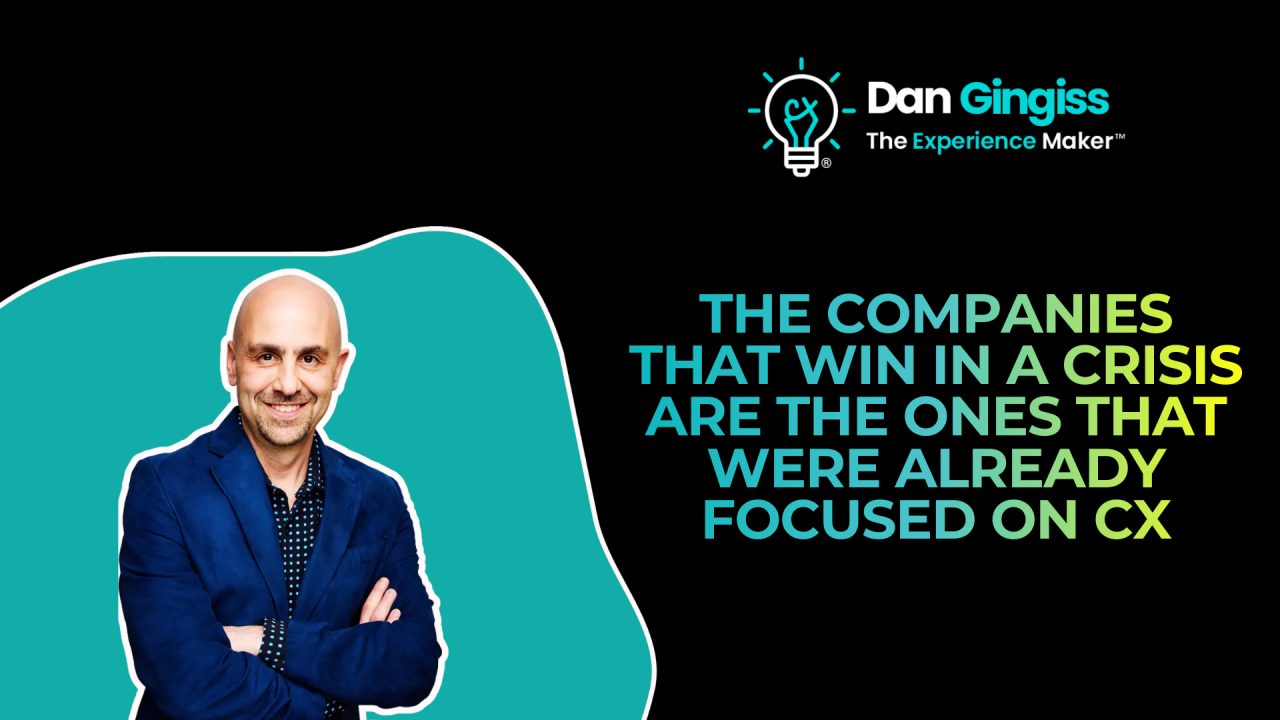
In a recent LinkedIn post, Dan Gingiss, CSP discusses the critical role of customer experience (CX) during times of crisis, arguing that companies often miss the mark by scrambling to focus on CX only when disruption occurs. Instead, Gingiss, CSP emphasizes that the companies that navigate crises successfully are those that have consistently prioritized foundational customer service principles all along.
According to Dan Gingiss, CSP, the common corporate reaction to a crisis is to suddenly pivot to customer experience. He contends that this reactive approach is fundamentally flawed. “And that’s the problem,” Gingiss, CSP writes in his post. “In uncertainty, customers don’t suddenly become unreasonable… they become crystal clear about what they need.”
The Core Needs During Disruption
Dan Gingiss, CSP highlights that during a crisis, customer expectations don’t change in nature, but rather become more focused on the essentials. He identifies key elements that customers crave when facing uncertainty:
- Reliability
- Clear communication
- Simple processes
- Real human support
As Dan Gingiss, CSP points out, these are not novel demands that emerge only during a crisis. They represent the bedrock of good customer service that should be in place at all times. He argues that the companies that excel in a crisis are those that have already mastered these “boring” but essential aspects of their operations.
Communication as the Experience Itself
A central theme in Dan Gingiss, CSP’s analysis is the redefinition of communication during a crisis. He asserts that in these high-stakes moments, communication transcends being a mere function and becomes the entirety of the customer’s experience.
“Because in a disruption, communication isn’t a separate function. It IS the experience.”
This perspective underscores the importance of proactive, transparent, and empathetic communication. Gingiss, CSP’s insight suggests that how a company communicates during a crisis directly shapes the customer’s perception of the company’s competence, care, and trustworthiness. He implies that failing to communicate effectively is, in essence, failing the customer experience.
Building Trust Through Consistent Action
Dan Gingiss, CSP further explores how companies can build and maintain trust when the stakes are high. His newsletter, which he references in the post, delves into the strategies employed by winning companies. The core message is that trust is not built in a crisis; it is earned through consistent, positive interactions and reliable service delivery leading up to and during challenging times.
Gingiss, CSP argues that the “boring stuff” – consistent reliability, straightforward processes, and accessible human support – are the true differentiators. These are the elements that foster loyalty and provide a stable foundation for customers when external circumstances become unstable. In his view, companies that are perceived as winning in a crisis are simply those that have consistently performed well on these fundamental CX metrics.
Ultimately, Dan Gingiss, CSP’s LinkedIn post serves as a crucial reminder for businesses: customer experience is not a department or a program to be activated during emergencies. It is the sum total of every interaction, and its strength during a crisis is a direct reflection of the ongoing commitment to fundamental service excellence.
📝 About This Content
This article is based on insights shared by Dan Gingiss, CSP on LinkedIn.
📅 Originally posted on March 19, 2026 | View original post on LinkedIn →