
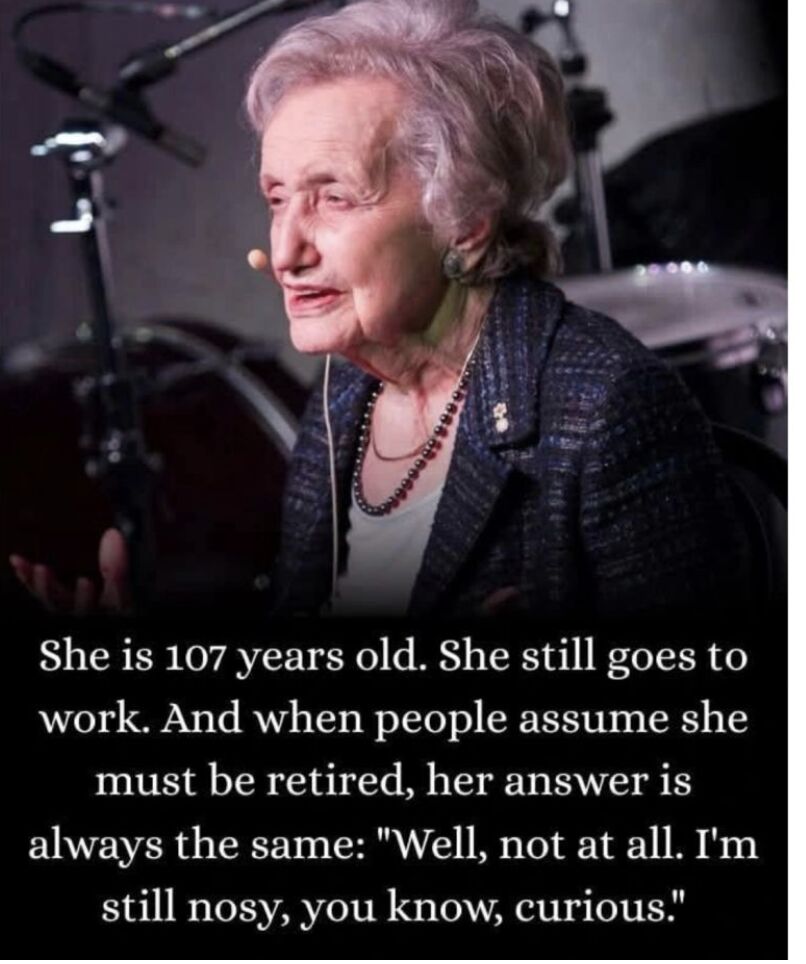
In a recent LinkedIn post, Dr. Martha Boeckenfeld highlights the enduring power of human curiosity, using the remarkable career of neuroscientist Brenda Milner as a case study for staying relevant in an era increasingly dominated by artificial intelligence.
Dr. Martha Boeckenfeld opens by introducing Brenda Milner, a pioneering figure in cognitive neuroscience, who at 107 years old remains actively engaged in her lab. Milner’s groundbreaking work, particularly her studies with patient H.M. that demonstrated the hippocampus’s critical role in forming new long-term memories, fundamentally altered the understanding of how memory functions. Dr. Martha Boeckenfeld emphasizes the longevity and impact of Milner’s career, spanning over seven decades and built on a foundation of persistent inquiry.
“One question. Decades of follow-up questions. A career built entirely on curiosity.”
The Enduring Value of Human Curiosity in the Age of AI
Dr. Martha Boeckenfeld contrasts Milner’s lifelong dedication to asking questions with the capabilities of modern AI. While AI excels at retrieving information, summarizing, predicting, and generating content, Dr. Martha Boeckenfeld argues that it lacks the crucial human ability to discern which questions are truly worth asking. This capacity for asking meaningful questions is, in her view, the core of the “human operating system.”
As Dr. Martha Boeckenfeld puts it:
“AI retrieves information in seconds. It summarizes. It predicts. It generates. But it doesn’t know which questions are worth asking.”
This distinction is central to Dr. Martha Boeckenfeld’s argument about human irreplaceability. While many professionals worry about obsolescence beyond the age of 50, Dr. Martha Boeckenfeld points to Brenda Milner, who has remained at the forefront of her field for 57 years past that age, as proof of what sustained curiosity can achieve.
The “Multiplication Effect” of Curiosity
Dr. Martha Boeckenfeld proposes a “Multiplication Effect” of curiosity within organizations and industries:
- One curious mind asking the right question can lead to a breakthrough that reshapes understanding.
- Ten curious minds within an organization can foster a culture that adapts more effectively to disruption.
- One hundred curious minds across industries can create a workforce capable of maintaining relevance regardless of age or technological advancement.
According to Dr. Martha Boeckenfeld, the focus on what AI might take away could be misplaced. Instead, she suggests a more pertinent question: “What keeps you irreplaceable no matter how fast the tools change?” She posits that Brenda Milner’s life and career provide a powerful answer to this question.
Curiosity as a Fundamental Skill
Dr. Martha Boeckenfeld concludes by reframing curiosity not as a mere “soft skill,” but as the essential operating system for navigating the future. In her view, the ability to continually ask “why” is what will ensure human relevance and adaptability in the face of rapid technological evolution.
“Curiosity isn’t a soft skill. It’s the operating system for the next 60 years.”
Dr. Martha Boeckenfeld encourages readers to share the post if they believe that the courage to question is the skill that ultimately outlasts any technological tool.
📝 About This Content
This article is based on insights shared by Dr. Martha Boeckenfeld on LinkedIn.
📅 Originally posted on March 21, 2026 | View original post on LinkedIn →