
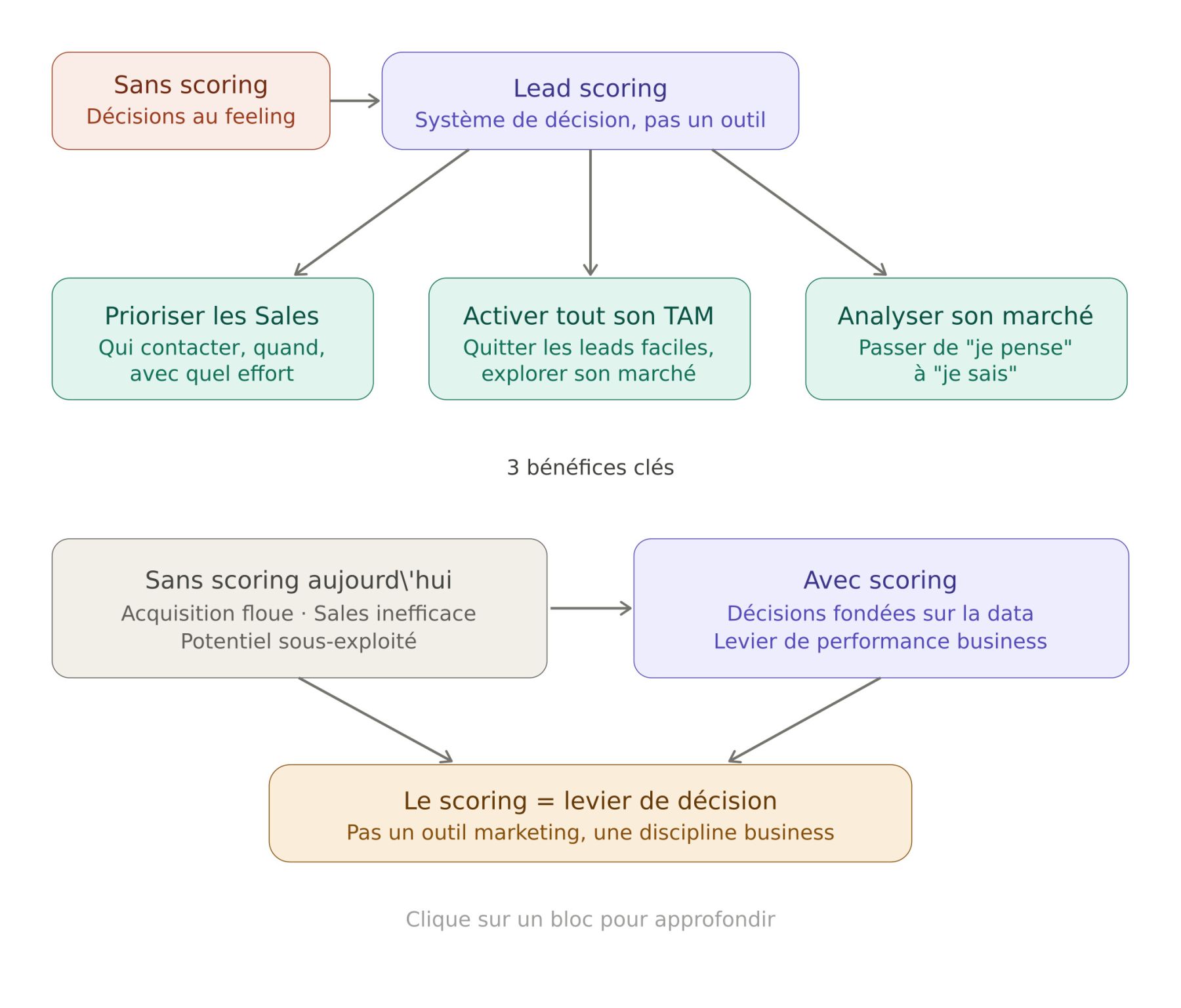
In a recent LinkedIn post, Christian Francois discusses the critical importance of structured lead scoring, arguing that relying on sales team intuition alone is a costly mistake. Francois highlights how a well-defined lead scoring system is not merely a marketing tool but a fundamental decision-making framework that drives business performance.
Francois begins by recounting his own past experiences, admitting to a less structured approach early in his career. “A few years ago, I did like many: a list of leads, a bit of intuition, and we go after ‘the most interesting ones’,” he writes. He clarifies that “most interesting” often translated to “most visible, not most profitable.” This personal anecdote sets the stage for his core argument: the significant financial drain caused by inefficient lead allocation.
The Cost of Intuition Over System
Christian Francois emphasizes that the transition to a structured lead scoring system revealed a simple truth: it’s a decision system, not just a tool. He outlines several key reasons why businesses must implement lead scoring:
1. Prioritizing Sales Efforts
Without a scoring system, Francois points out that sales teams can waste valuable time on leads that are unlikely to convert, while high-potential leads may be contacted too late. This misallocation directly impacts the sales pipeline and overall efficiency. “All leads are not equal,” Francois states. “And without scoring: your closers spend time on average leads, the best leads arrive too late, your pipeline is biased.” A scoring system, conversely, provides clarity on “WHO to contact, WHEN, and with WHAT level of effort.”
2. Maximizing Total Addressable Market (TAM) Exploitation
Francois argues that a lack of lead scoring often leads to a narrow focus on easily accessible leads, resulting in the under-exploitation of the market. “Without scoring, you always do the same thing: you focus on the ‘easy’ leads,” he explains. This approach means businesses often only “exploit 10-20% of your market” and miss out on significant opportunities. Implementing a scoring system, however, forces a more rigorous approach to market segmentation and activation of previously overlooked segments.
3. Forcing Market Analysis and Clarity
Creating a lead scoring system, according to Francois, is an uncomfortable but necessary process. It compels businesses to confront fundamental questions about their ideal customer profile and buying signals. “Creating a scoring is uncomfortable. Because it forces you to answer real questions: What is a good lead for me? What signals show that a prospect will buy? What differentiates my customers from others?” he writes. This self-examination shifts the operational basis from assumptions to data-driven certainty, moving from “I think…” to “I know…”
Lead Scoring as a Business Performance Lever
The critical shift, as highlighted by Christian Francois, is understanding lead scoring not as a marketing tactic but as a powerful business performance lever. He concludes that companies without a scoring system are likely facing:
- Unclear acquisition strategies
- Ineffective sales operations
- Under-exploited business potential
Francois plans to share his method for calculating a first lead scoring system in an upcoming post, encouraging followers to stay tuned.
📝 About This Content
This article is based on insights shared by Christian Francois on LinkedIn.
📅 Originally posted on March 23, 2026 | View original post on LinkedIn →