
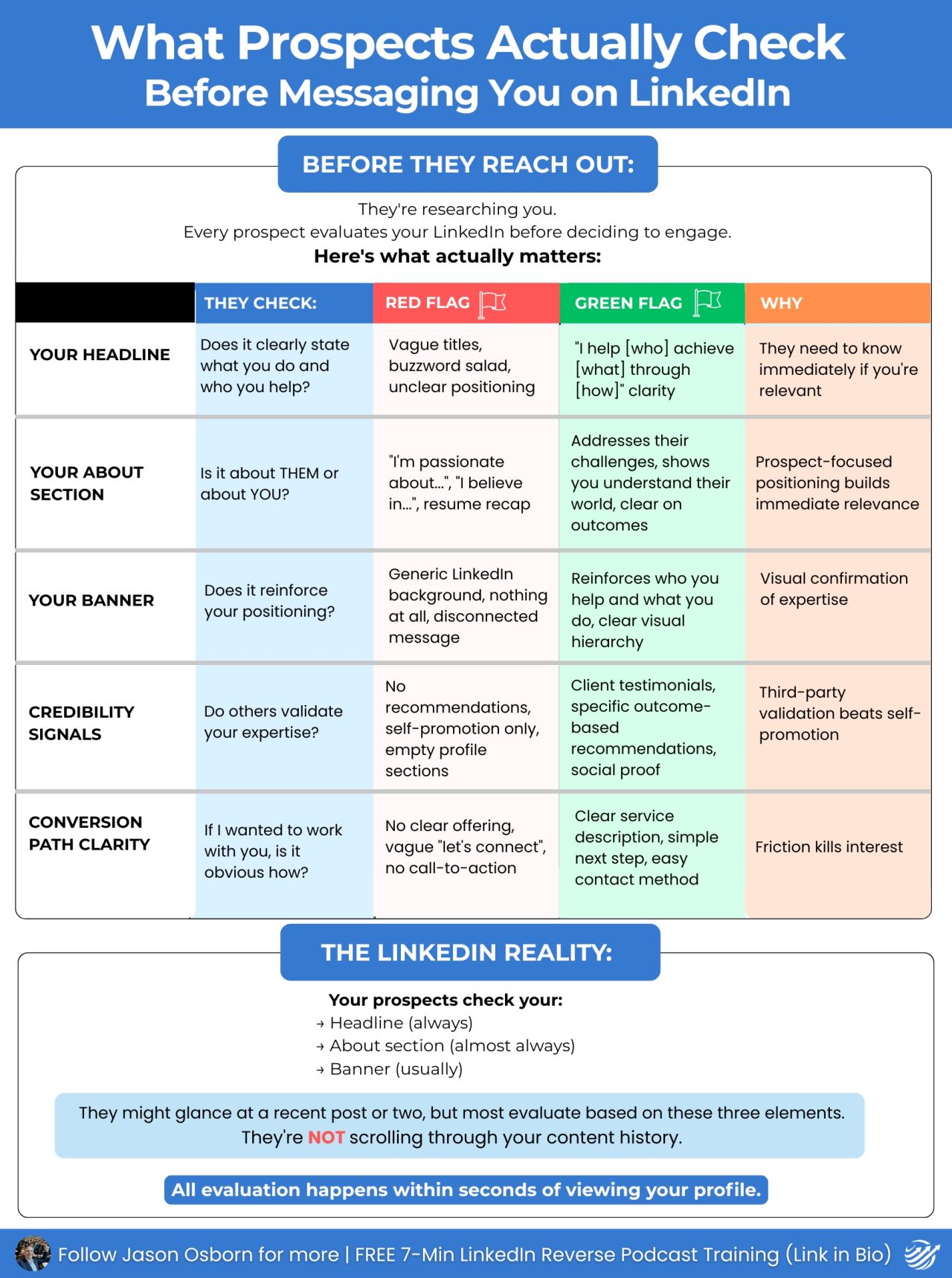
In a recent LinkedIn post, Jason Osborn discusses what prospects *actually* look for when evaluating a professional profile, emphasizing that strategic clarity on key profile elements often outweighs the sheer volume of content posted.
Jason Osborn highlights that while many users focus on content creation, the initial impression and decision-making process for potential clients or collaborators hinges on specific, readily accessible information on a LinkedIn profile. He points out that prospects are not sifting through endless posts but are making rapid judgments based on core profile components.
“Every prospect evaluates your LinkedIn before deciding to engage. Most people optimize for the wrong things. Here’s what they actually check.”
The Criticality of Profile Fundamentals
According to Osborn, the most scrutinized elements are the headline, the About section, and the banner image. He elaborates on each, identifying common pitfalls and best practices.
Headline Clarity
Osborn stresses the importance of a clear, concise headline. He identifies vague titles and buzzword-filled descriptions as major red flags.
“They check: Does it clearly state what you do and who you help?” Osborn asks, contrasting this with ineffective approaches. He advocates for a structure like “I help [who] achieve [what] through [how]” to ensure immediate relevance for the prospect.
Prospect-Centric About Section
The About section, Osborn argues, should be written with the prospect in mind, not as a self-centered narrative.
“Is it about THEM or about YOU?”
he questions. He advises against generic statements about passion or belief, instead recommending content that addresses prospect challenges and clearly articulates outcomes. This focus, he notes, builds immediate relevance by demonstrating an understanding of the prospect’s world.
Reinforcing Banner and Credibility Signals
Osborn also touches on the LinkedIn banner, suggesting it should visually reinforce the profile’s positioning rather than being a generic or blank space. Furthermore, he emphasizes the significance of credibility signals.
“They check: Do others validate your expertise?” Osborn prompts. He points to a lack of recommendations and solely self-promotional content as red flags, while client testimonials and outcome-based recommendations serve as crucial green flags, providing essential third-party validation.
The Role of Content in the LinkedIn Ecosystem
A key insight from Osborn’s post is the assertion that prolific content creation is not a prerequisite for success on LinkedIn. He argues that a strong profile, coupled with a proactive outreach strategy, can yield significant results even without a consistent posting schedule.
Content as a Supporter, Not the Strategy
Osborn clarifies that content serves as a supplement to a well-defined outreach strategy.
“Content is supplemental. It supports your outreach strategy when you have one. It’s not the strategy itself.”
he states. This perspective challenges the common misconception that one must constantly publish content to gain traction or secure business on the platform.
He concludes by reiterating that the LinkedIn profile’s primary function is to serve as a credibility foundation.
“Your LinkedIn profile isn’t a resume. It’s your credibility foundation.”
Osborn asserts. He advocates for a combination of a strong profile (Headline + About + Banner) and proactive, relationship-led outreach as the formula for achieving results, rather than relying solely on content volume.
📝 About This Content
This article is based on insights shared by Jason Osborn on LinkedIn.
📅 Originally posted on March 25, 2026 | View original post on LinkedIn →