
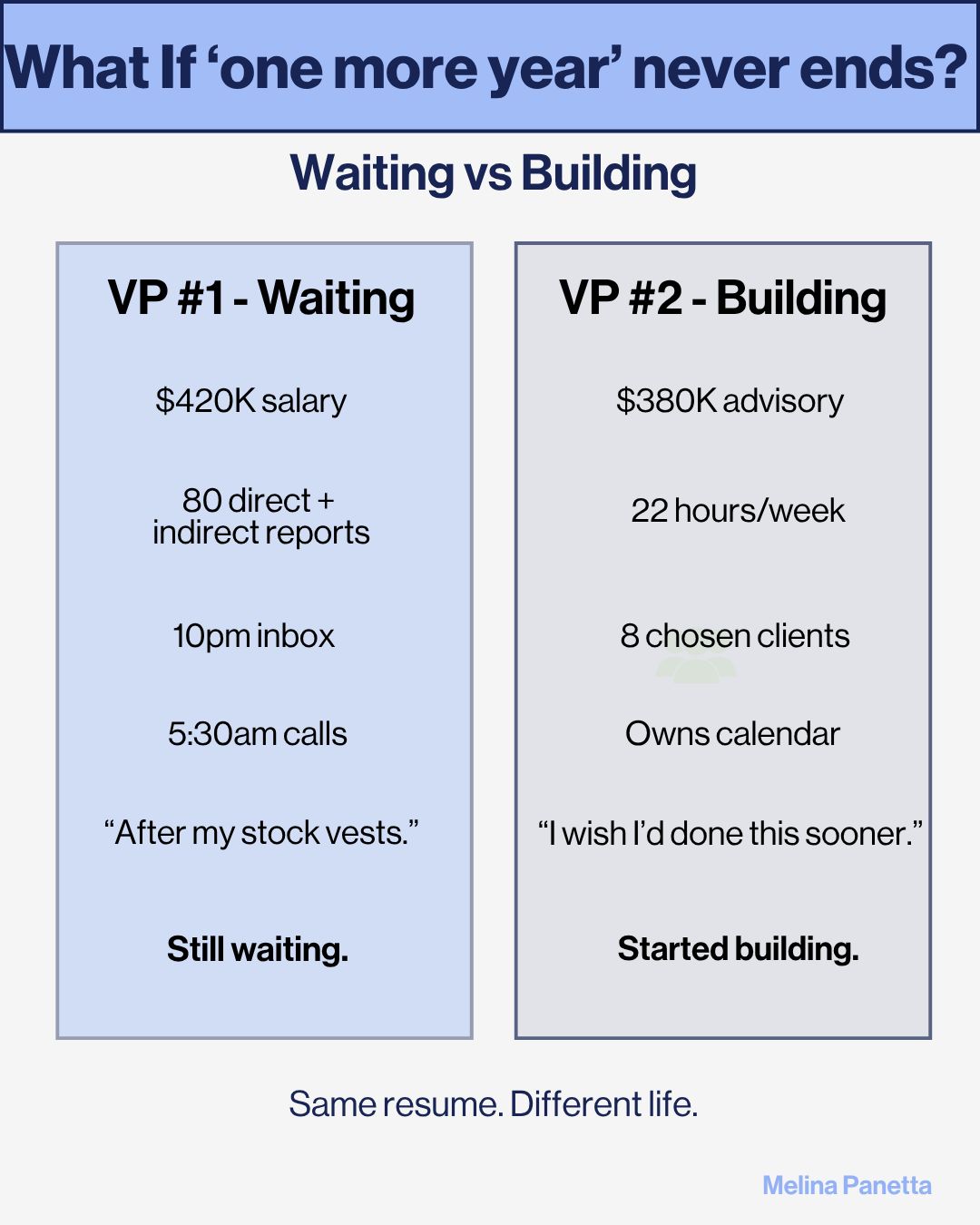
In a recent LinkedIn post, Melina Panetta explores the critical decision-making process many senior professionals face around age 50, contrasting two hypothetical Vice Presidents (VPs) with identical resumes and salaries but vastly different life trajectories. Panetta uses this comparison to highlight the subtle, often ‘rationalized’ delays that can prevent individuals from building a fulfilling ‘Second Act’ outside of their corporate roles.
The core of Panetta’s analysis rests on the divergent paths of two VPs, both having turned 50 the previous year. One VP remains in the corporate world, achieving a promotion to SVP with a substantial salary and an expanded team. From an external perspective, this individual appears to be ‘winning’. However, Panetta presents a starkly different internal reality:
“10pm email clean-up so he doesn’t fall behind. 5:30am global calls from different hotel rooms. Bonus tied to goals he didn’t set. A calendar that runs him. Slack open on vacation.”
This VP, according to Panetta, is caught in a cycle of deferral, his aspirations perpetually pushed back with phrases like, “After this bonus,” “After the next vest,” or “After my son graduates.” Panetta labels these justifications as seemingly responsible, yet ultimately trapping.
The ‘Rational’ Trap of Delay
Panetta argues that the primary obstacle is not a lack of courage, but rather the insidious nature of delayed action, which is often framed as rational decision-making. This is illustrated by the second VP in Panetta’s narrative.
This VP, also having reached 50, chose a different path. He spent a year testing advisory opportunities while still employed, securing three clients before officially resigning. Panetta notes his strategic approach:
“Left when $180K was already committed.”
Eighteen months later, this VP is reportedly working 22 hours a week, managing eight clients, and earning $380K in advisory fees. His reflection, as shared by Panetta, underscores the missed opportunity: “I wish I’d done this five years ago.”
Building Before You Have To
Melina Panetta emphasizes that the divergence between these two VPs stems not from inherent differences in bravery, but from a proactive approach to building an alternative future. “The difference isn’t courage,” Panetta states, “It’s whether you start building before you have to.”
Panetta’s advice is not to resign immediately but to cease relying on future corporate milestones as a concrete plan. She advocates for a parallel construction strategy:
“Build while the job funds it. That’s how you leave on your terms.”
This approach, according to Panetta, empowers individuals to transition out of corporate roles on their own timeline, rather than being forced by circumstance or burnout. She encourages professionals to initiate the development of their ‘Second Act’ proactively, leveraging their current employment as a financial buffer rather than an indefinite commitment.
Panetta concludes by urging professionals to re-evaluate the perceived rationality of delay, suggesting that the most responsible action is often to begin building the desired future while still securely employed, ensuring a more empowered and self-directed transition.
📝 About This Content
This article is based on insights shared by Melina Panetta on LinkedIn.
📅 Originally posted on March 27, 2026 | View original post on LinkedIn →