
In a recent LinkedIn post, Noemi Kis✨ discusses the ephemeral nature of job titles and the lasting power of transferable skills. The business leader and growth advocate highlights a personal realization that many perceived professional competencies are company-specific and thus transient, while a core set of enduring skills provide true career resilience.
Noemi Kis✨ begins by framing the common career trajectory: “I spent years climbing the corporate ladder. Building expertise for one company.” This was followed by a pivotal moment of clarity: “Then I walked away at 30 and realized: most of what I ‘knew’ was useless outside.” This experience led to the identification of eight critical skills that, in her view, form a leader’s true, portable capital.
The Skillset That Endures
The core of Noemi Kis✨’s message revolves around the idea that while job titles and company affiliations can vanish overnight due to restructuring or strategic shifts, a well-cultivated skillset remains a constant asset. She emphasizes that these are not merely soft skills, but fundamental capabilities that drive effectiveness across any role or industry.
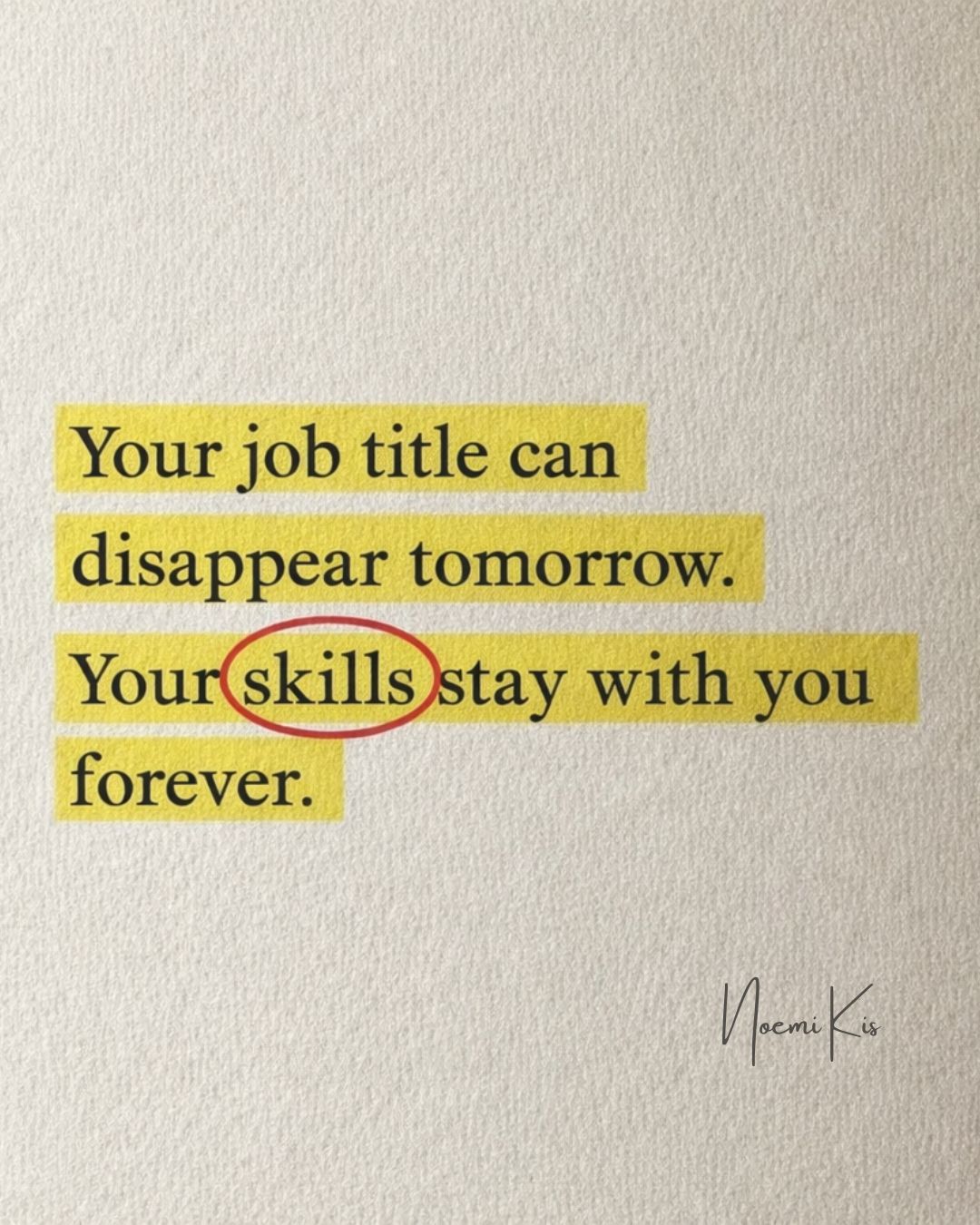
“Your job title can disappear tomorrow. Your skills stay with you forever.”
Noemi Kis✨ elaborates on this by listing eight specific skills she deems indispensable. These include clear communication, emotional regulation, learning how to learn, selling ideas, building relationships, self-discipline, adaptability, and critical thinking. For each skill, she provides actionable advice, such as practicing daily writing for clear communication or treating setbacks as data for adaptability.
Deconstructing Essential Skills
According to Noemi Kis✨, the ability to communicate effectively is paramount. This goes beyond simply speaking or writing, but involves conveying meaning concisely and precisely. She advises, “Say what you mean in fewer words” and advocates for consistent practice in writing to hone this skill.
Emotional regulation is another key area highlighted by Noemi Kis✨. In a professional environment, the capacity to manage one’s reactions, particularly under pressure, is crucial. Her practical tip is to “Pause before reacting when triggered” and to consciously identify the emotion being felt before acting upon it.
Furthermore, Noemi Kis✨ underscores the importance of “Learning how to learn.” In a rapidly changing business landscape, the ability to acquire new knowledge and skills efficiently is a significant advantage. She suggests breaking down complex subjects into manageable experiments and focusing on underlying principles rather than rote memorization.
“Jobs disappear. Companies restructure. But these skills compound over time. They follow you everywhere.”
The post also touches upon the often-underestimated skill of selling ideas. Noemi Kis✨ suggests that success in this area involves focusing on the benefits for the recipient and developing resilience against rejection. Similarly, building strong relationships is framed not as transactional, but as a long-term investment. She advises leaders to “Be useful before asking for help” and to maintain connections even when there is no immediate need.
Skills as True Capital
Noemi Kis✨ concludes her post by reiterating the central theme: that an individual’s true wealth lies in their skills, not their temporary roles. This perspective challenges conventional notions of career success, which often focus on hierarchical advancement within a single organization.
“Your true capital is your skill. Everything else is temporary.”
By sharing these insights, Noemi Kis✨ encourages professionals to invest in developing these foundational, transferable skills, positioning them as the most reliable assets for navigating the uncertainties of the modern corporate world.
📝 About This Content
This article is based on insights shared by Noemi Kis✨ on LinkedIn.
📅 Originally posted on April 3, 2026 | View original post on LinkedIn →