
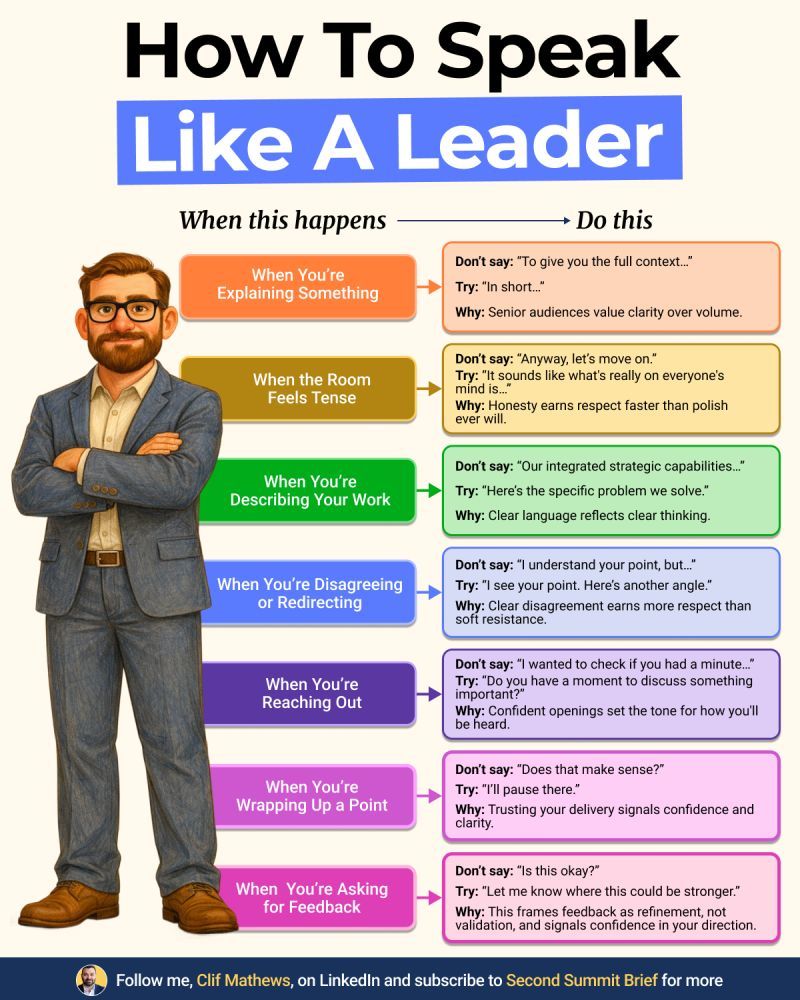
In a recent LinkedIn post, Mark O’Donnell explores how seemingly small changes in communication can significantly impact a leader’s effectiveness. He highlights that many leaders, while possessing deep business knowledge, often undermine their messages through habitual phrasing and communication missteps.
O’Donnell emphasizes the critical link between how a message is delivered and its reception, stating that the way leaders communicate matters just as much as the content itself. He points out a common pitfall: leaders tend to forget the nuances of communication, leading to messages landing incorrectly.
“Most of the ones I’ve worked with know their business inside out… But the way they communicate undercuts them constantly.”
The Impact of Habitual Phrasing
Mark O’Donnell argues that everyday communication habits and the use of particular phrases can create persistent misunderstandings. He believes that addressing these linguistic habits is a straightforward process that can yield substantial improvements in how leaders are perceived and how their messages are received.
Replacing Counterproductive Phrases
O’Donnell provides a practical guide, suggesting specific alternatives to common phrases that can inadvertently hinder effective communication. He frames these suggestions as simple swaps that leaders can implement quickly.
- When explaining a complex topic, O’Donnell suggests moving away from phrases like “To give you the full context…” and instead opting for a more concise approach like, “In short…”
- In situations where tension is palpable, he advises against the dismissive “Anyway, let’s move on.” Instead, O’Donnell proposes acknowledging the atmosphere with, “It sounds like there’s something bigger on everyone’s mind here.”
- When describing their company or services, leaders often fall into jargon. O’Donnell contrasts the vague “Our integrated strategic capabilities…” with the more effective and direct, “Here’s the specific problem we solve.”
Conscious Communication as a Leadership Decision
According to O’Donnell, the way a leader communicates with their team is a fundamental leadership choice. He urges leaders to be more deliberate and conscious about their language and its implications.
“How you talk to your team is ultimately a leadership decision. Make it a conscious one.”
He further elaborates on this by offering alternative phrasing for common communication scenarios. For instance, when pushing back on an idea, O’Donnell advocates for a more collaborative approach than the typical “I understand your point, but…”. He suggests, “I see it differently. Here’s why.” This reframing encourages dialogue rather than defensiveness.
Improving Outreach and Feedback
O’Donnell also touches upon the importance of precise language in initiating contact and seeking input. He points out that asking, “I wanted to check if you had a minute…” can be less effective than a more direct and purposeful question like, “Do you have time to talk about something important?”
Similarly, when seeking feedback, the phrase “Is this okay?” can elicit superficial responses. O’Donnell proposes a more constructive prompt: “Where could this be stronger?” This question invites deeper reflection and actionable insights.
“The hardest conversations to have are usually the most important ones.”
Mark O’Donnell concludes by encouraging leaders to save his advice for challenging conversations and to consider the significance of confronting difficult topics rather than avoiding them. He also promotes his new book, “Issues,” which delves into handling such critical discussions, and his newsletter designed for leadership clarity.
📝 About This Content
This article is based on insights shared by Mark O'Donnell on LinkedIn.
📅 Originally posted on April 2, 2026 | View original post on LinkedIn →