
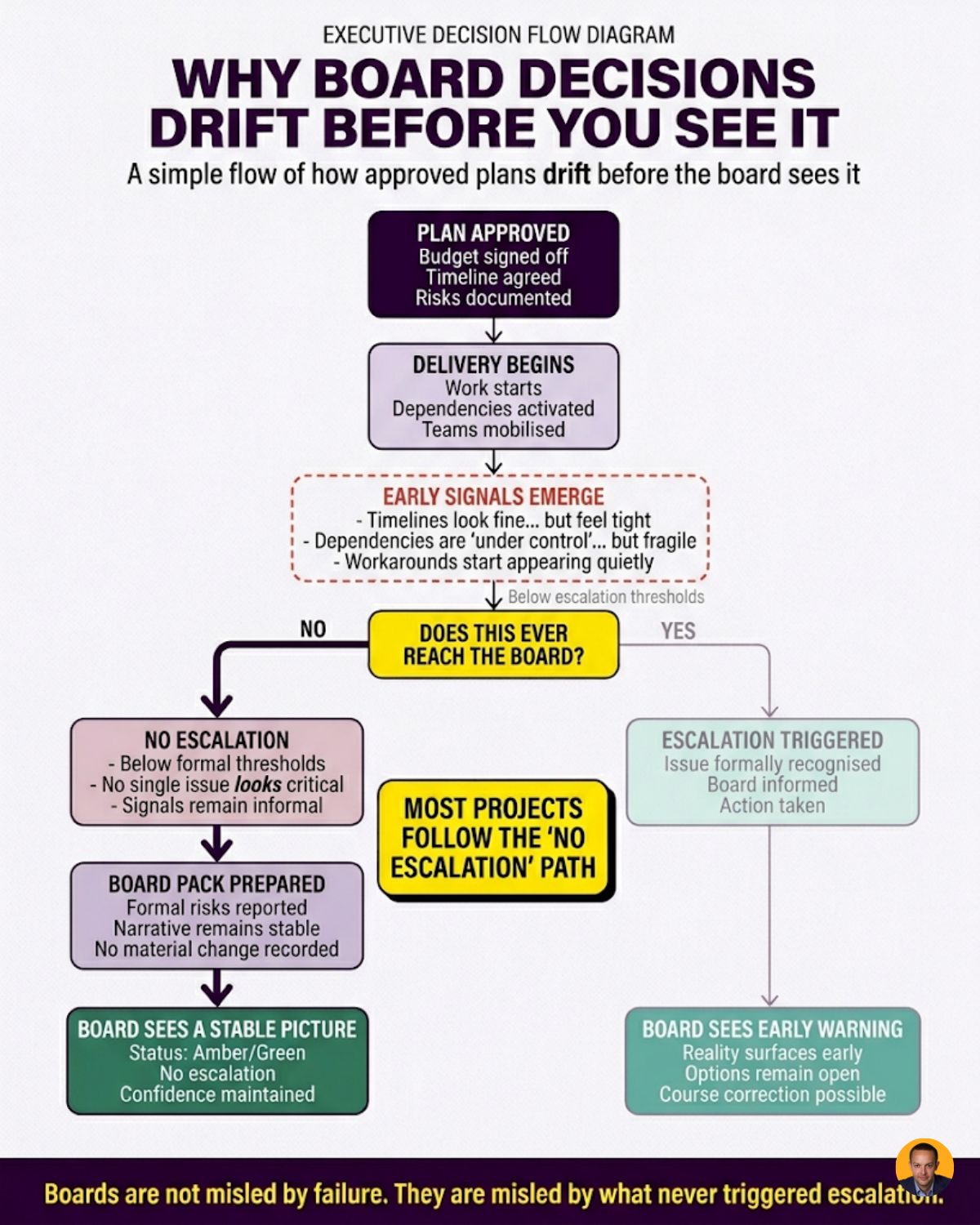
In a recent LinkedIn post, Nick Curum highlights a critical blind spot in corporate governance: the tendency for boards to focus on individual problems rather than the compounding patterns that precede them. Curum, drawing on his experience with large infrastructure and transformation programs, argues that traditional governance structures are ill-equipped to catch these subtle, interconnected signals until it’s too late.
The Illusion of Manageable Delays
Curum points out that many seemingly minor issues, when viewed in isolation, do not trigger alarm bells. A small delay, a dependency slip, a workaround, or an ‘uncomfortable update’ can all be explained away individually. However, these are not isolated incidents but rather connected fragments that quietly reshape a project’s trajectory long before they become apparent in formal reporting.
“None of these feel material in isolation. None of them cross a threshold. So none of them get escalated.”
As Nick Curum explains, the problem lies not in a lack of information, but in how that information is presented and perceived. Boards are designed to engage with clearly defined issues, risks, and assumptions. When problems manifest as a series of disconnected, explainable fragments, they fail to meet this threshold for attention.
From ‘How is it Progressing?’ to ‘How Did This Happen?’
The shift in board conversation, from proactive progress checks to reactive ‘how did this happen?’ inquiries, is a key indicator of governance failure, according to Curum. This transition signifies that the underlying patterns have coalesced into an undeniable problem—a delay that cannot be recovered, a cost overrun that cannot be absorbed, or a timeline that must be reset.
The Gap Between Signals and Meaning
Curum emphasizes that the real governance gap is not necessarily between the board and management, but ‘between signals and meaning.’ He argues that strong boards recognize this and actively look beyond the reported data.
“Strong boards recognise this. They do not just ask: ‘What is being reported?’ They look for what is repeating. What feels slightly off across multiple areas.”
Effective boards, in Nick Curum’s view, probe for consistency, identify anomalies across different reports or conversations, and seek to understand the narrative that emerges from informal discussions, not just the formal reports. This proactive approach is crucial because, as he notes, ‘the real risk is not what is hidden. It is what is fragmented.’
Identifying the Compounding Risk
As the year draws to a close, Curum suggests a more insightful question for boards and leadership teams to consider than simply ‘What are we missing?’ He proposes a reframing:
“So a better question at this stage of the year is not: ‘What are we missing?’ It is: ‘What small signals are we treating as unrelated… that actually belong together?'”
This question, according to Nick Curum, gets to the heart of proactive governance. It encourages a focus on the subtle, interconnected signals that, if left unexamined, will inevitably lead to larger, unmanageable problems. By shifting the focus from isolated issues to the patterns they form, organizations can enhance their ability to anticipate and mitigate risks effectively, ensuring that decisions do not drift long before a ‘problem’ is officially recognized.
📝 About This Content
This article is based on insights shared by Nick Curum on LinkedIn.
📅 Originally posted on April 6, 2026 | View original post on LinkedIn →