
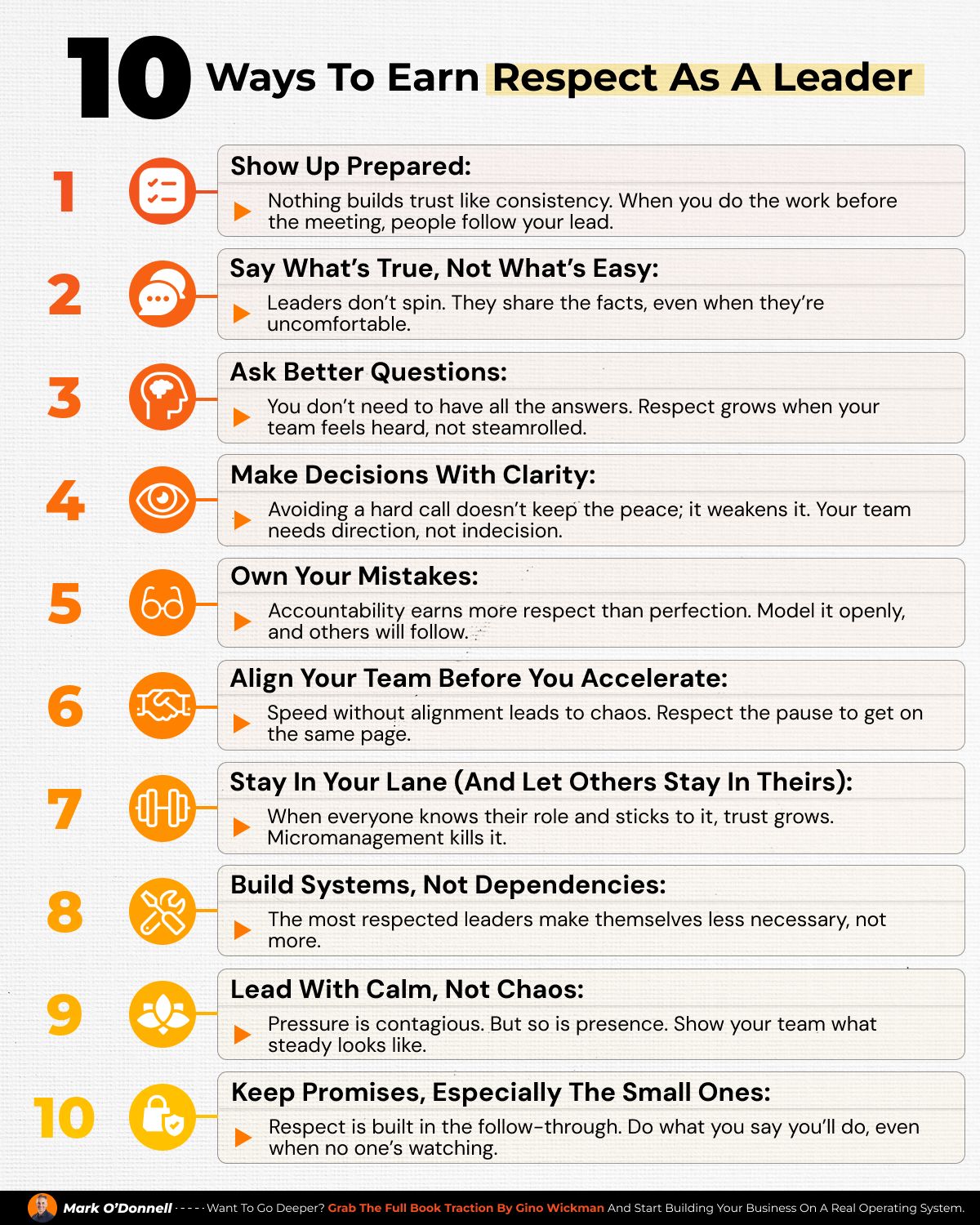
In a recent LinkedIn post, Mark O’Donnell delves into a fundamental aspect of leadership: the earning of respect. Drawing on two decades of experience, O’Donnell asserts that respect is not an entitlement bestowed by position, but rather a currency that must be meticulously earned through consistent action and authentic behavior.
O’Donnell begins by challenging a common misconception among leaders, stating:
“A lot of leaders think they’re entitled to respect purely because of their position. But your team doesn’t care about that.”
He emphasizes that a team’s perception of a leader is shaped by their actions, particularly under pressure and during challenging times. This foundational insight sets the stage for his exploration of practical strategies leaders can employ to cultivate genuine respect.
The Pillars of Earned Respect
Mark O’Donnell outlines ten distinct ways leaders can actively build and maintain respect within their teams. These actionable points focus on integrity, transparency, and consistent performance. As O’Donnell notes, the core of this process is simple: “Respect HAS to be earned, one decision at a time.”
Transparency and Honesty
A key theme in O’Donnell’s post is the importance of truthfulness, even when delivering difficult news. He advocates for direct communication, arguing that teams are more resilient to facts than to feeling misled.
“Say what’s true, not what’s easy. Don’t spin bad news into something it’s not. Your team can handle the facts. What they can’t handle is feeling misled.”
This approach, according to O’Donnell, builds a bedrock of trust that is essential for long-term team cohesion and performance. Similarly, owning mistakes is presented not as a weakness, but as a demonstration of accountability that mirrors the desired behavior in team members.
Decision-Making and Direction
O’Donnell also highlights the critical role of decisive leadership. He posits that avoiding decisions does not preserve harmony but rather creates uncertainty. Instead, leaders must provide clear direction.
“Avoiding decisions doesn’t keep the peace. Your team needs direction, not someone who waits for the ‘perfect moment’.”
This clarity in decision-making, coupled with aligning the team before embarking on new initiatives, prevents chaos and ensures that collective efforts are focused and productive. As O’Donnell suggests, moving too fast without proper alignment leads to confusion rather than progress.
Building Systems and Personal Accountability
Further elaborating on sustainable leadership, O’Donnell advises building systems rather than fostering dependencies. The ultimate goal, in his view, is to create structures that allow the team to function effectively, even in the leader’s absence. This aligns with his point about staying in one’s lane and allowing team members to operate within their defined roles, thereby fostering natural trust and avoiding the pitfalls of micromanagement.
Perhaps one of the most crucial, yet often overlooked, aspects O’Donnell emphasizes is managing pressure. He argues that a leader’s reaction under duress is a powerful signal to their team.
“Your team watches how you react. If you’re frantic, they’ll be frantic. Show them what steady looks like, even when things are hard.”
Ultimately, O’Donnell concludes that leadership respect is built on a simple, consistent foundation: showing up reliably, doing the necessary work, and honoring commitments. This commitment to follow-through, especially on smaller promises, is where respect truly resides.
📝 About This Content
This article is based on insights shared by Mark O'Donnell on LinkedIn.
📅 Originally posted on April 5, 2026 | View original post on LinkedIn →