
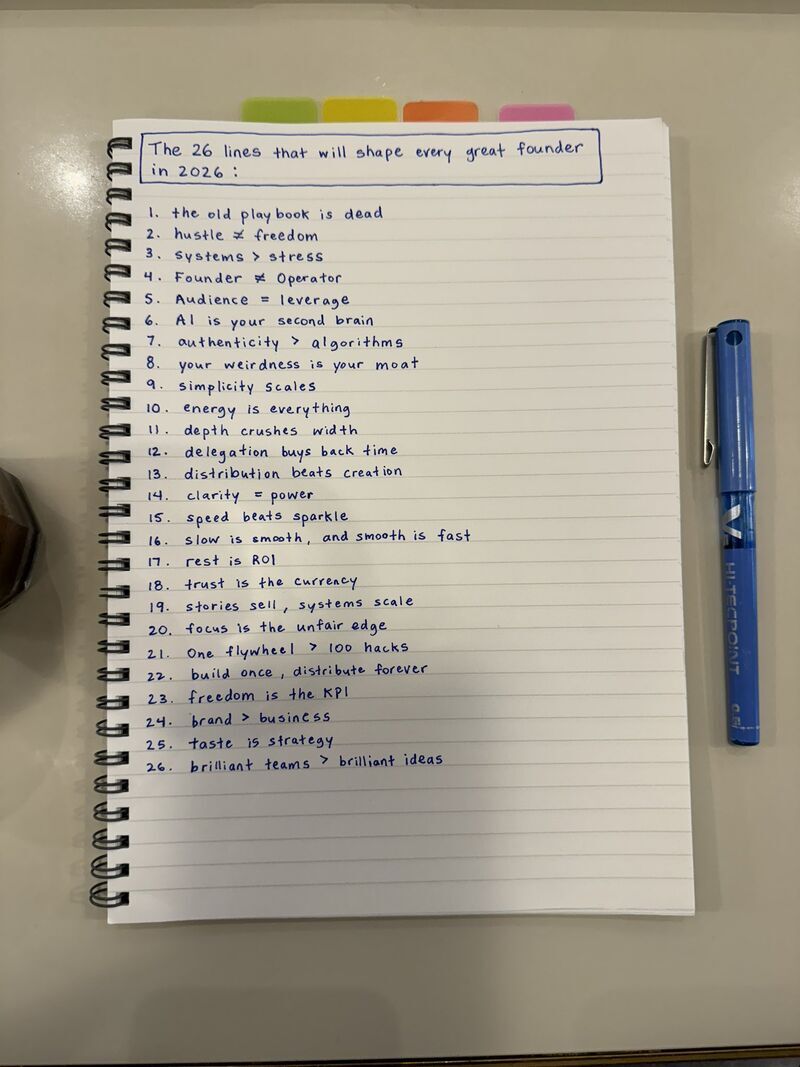
In a recent LinkedIn post, Matt Gray challenges traditional entrepreneurial wisdom, arguing that the strategies effective for founders in 2020 are now obsolete. Gray outlines a new “playbook” for aspiring and established founders alike, emphasizing systems, leverage, and personal freedom as the new key performance indicators for success in 2026.
Gray begins by dismantling the outdated notion that relentless hustle equates to entrepreneurial success. He states:
“Hustle ≠ Freedom. Working 80-hour weeks doesn’t make you a founder. It makes you an employee of your own company.”
This assertion sets the stage for Gray’s core argument: the modern founder’s role is shifting from constant operational involvement to strategic leadership and system building.
The Obsolescence of the Old Playbook
According to Matt Gray, the advice that guided entrepreneurs even a few years ago is no longer relevant. He urges founders to discard outdated strategies and adopt a new mindset focused on efficiency and long-term vision.
Systems as the Foundation for Freedom
A central theme in Gray’s analysis is the critical importance of building robust systems. He contends that true freedom as a founder comes not from working more, but from creating structures that allow the business to operate autonomously.
“Build systems that run without you, or you’ll never escape the day-to-day.”
Gray distinguishes the founder’s role from that of an operator, advocating for founders to become “architects” who set the vision and build the team, rather than getting bogged down in daily tasks. This shift, he argues, is essential for scaling effectively.
Leverage and Audience as Key Assets
Matt Gray highlights “Audience = Leverage” as a cornerstone of the new founder playbook. He emphasizes that building and nurturing an audience is paramount, positioning it as a founder’s most valuable asset that should be cultivated proactively.
“Your audience is your most valuable asset. Build it before you need it.”
Furthermore, Gray touches upon the integration of Artificial Intelligence, not as a threat, but as a powerful tool. He suggests that founders should “Stop resisting it. Start leveraging it.” as AI can serve as a “Second Brain” to enhance productivity and strategic thinking.
Authenticity and Uniqueness in a Digital Age
Countering the idea that algorithmic optimization is the sole path to success, Matt Gray posits that authenticity holds greater power. As he notes, “The algorithm rewards what’s real, not what’s polished.” He further elaborates that personal quirks and unique characteristics are not liabilities but strategic advantages, stating, “Your weirdness is your moat.” This suggests that genuine connection and distinctiveness are crucial for standing out.
Redefining Success Metrics
Gray challenges conventional business metrics, arguing that “Revenue is vanity. Freedom is the real metric that matters.” He advocates for focusing on “Freedom Is The KPI,” suggesting that the ultimate goal of entrepreneurship should be to gain control over one’s time and life, rather than simply accumulating wealth or scaling operations endlessly.
Other key tenets of Gray’s updated playbook include the power of simplicity over complexity, the importance of energy management, and the strategic advantage of deep focus. He also stresses that “Distribution Beats Creation,” indicating that reaching the market effectively is often more critical than having the theoretically best product.
In conclusion, Matt Gray’s insights on LinkedIn present a compelling vision for the future of entrepreneurship, urging founders to move beyond the “hustle culture” and embrace a more strategic, system-driven, and freedom-oriented approach to building successful ventures.
📝 About This Content
This article is based on insights shared by Matt Gray on LinkedIn.
📅 Originally posted on April 5, 2026 | View original post on LinkedIn →